
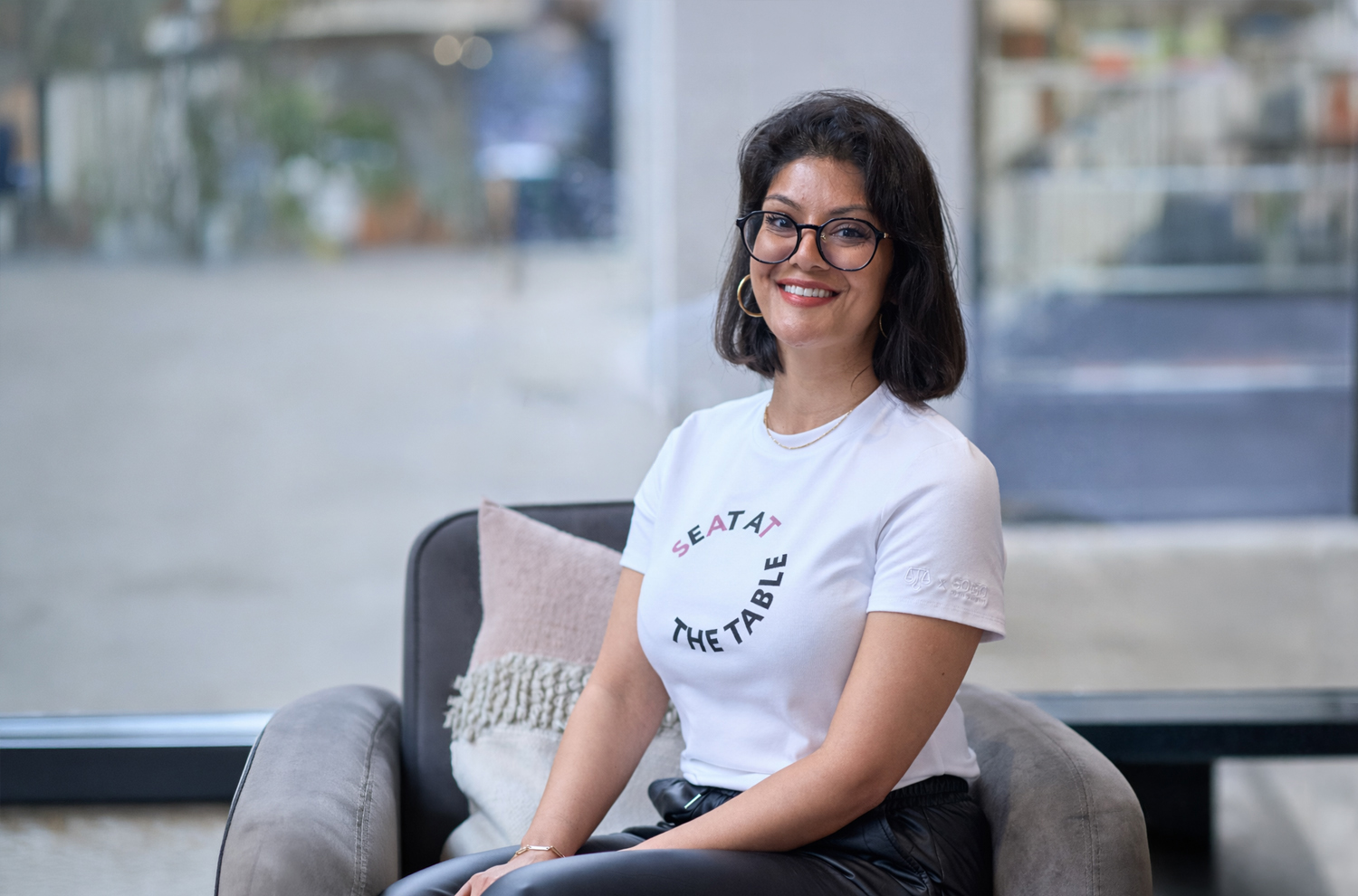
Sonica Beckmann is a British Asian qualified solicitor, entrepreneur, UK 40 Under 40 winner and mum of two. Raised in a low income migrant household, she was the first in her family to attend university and went on to build a distinguished legal career across major multinational organisations. By the age of 31 she had been appointed Head of Legal at a multi-billion dollar company.
Her time in senior corporate environments gave her a nuanced understanding of workplace culture, power structures and the persistent challenges women face professionally. In 2023, Sonica made the decision to diversify from law and pursue a long held vision, founding the London based womenswear brand House of Kind. Blending affordable luxury tailoring with a values driven ethos, House of Kind is rooted in the belief that kindness is a powerful form of leadership.
In a short time the brand has rapidly gained recognition for its purposeful approach to fashion and impact led growth, championing inclusivity, representation and female solidarity. Most recently, House of Kind was shortlisted for a Draper’s Conscious Fashion Award for its statement collaboration T-shirt with 50:50 Parliament, designed to encourage women to take a seat at the table and engage in public life.
In this episode, Sonica shares the harrowing story that shaped her entire mission, being kept in the office until 2am the week her father died, and how that experience, alongside years spent navigating rigid, hierarchical corporate cultures across three countries, led her to build a brand grounded in something radically simple: kindness. It is a conversation about grief, resilience, corporate culture, motherhood and why putting humanity back into leadership should never have been considered unconventional in the first place.
Conversation Highlights:
- The devastating story of Sonica’s first six weeks as a trainee solicitor, kept in the office until 2am the same week her father passed away, and the archived files that never needed to be touched
- How that experience, alongside her mother’s stroke a month later, forged a determination to complete her training contract no matter the personal cost, because qualifying meant no one could ever take that from her
- Why clothing became such a powerful symbol for Sonica, from arriving at Chancery Lane in a hand-me-down suit that quietly signalled she did not fit in, to founding a brand built around a different kind of uniform altogether
- The founding vision behind House of Kind, clothing with subtle details that allow women to recognise an ally the moment they walk into a room
- Why the mismatch between the school day and the working day is so fundamentally broken, and why flexibility built on trust rather than suspicion consistently produces happier, more productive teams
- The honest reality of returning to the UK after a decade in Kuwait, Dubai and Singapore, and the shock of rediscovering how difficult everyday systems, from healthcare to childcare costs, had become
- How House of Kind launched through Sonica’s own network in the fashion industry, and why she believes showing genuine kindness throughout her career, without ever expecting anything back, is what made people so willing to help when she finally asked
- The partnership with 50:50 Parliament and the Seat at the Table T-shirt, and Sonica’s belief that getting more women into rooms where decisions are made is one of the most powerful levers for lasting change
- Why Sonica believes fear and competition, whether between women in a boardroom or across wider society, all stem from the same root, and why community and solidarity offer a genuinely different way forward
- Turning 40 and the full circle realisation that after decades spent desperately trying to fit in, she has finally reached a place of not caring whether her message of kindness is considered conventional at all
Listen If You’re:
- Someone who has experienced grief or personal crisis while navigating an unforgiving corporate environment
- A mother who has ever felt torn between the demands of a career and wanting to be present for your children
- Curious about what it actually takes to launch a values driven fashion brand from scratch
- Interested in how female solidarity and representation in politics and leadership can genuinely shift outcomes for women
- Someone who has spent years trying to fit into a workplace culture that never quite made sense
- Ready to be reminded that kindness is not naive, it is hopeful, and it can be the foundation of a serious, successful business
Favourite Quote for Mums in Business:
“We need a global marker of a good human being. A reminder to be kind and that we’re of the same kind.” – Sonica Beckmann
About the Guest:
Sonica Beckmann is a qualified solicitor, entrepreneur and founder of House of Kind, a London based womenswear brand blending affordable luxury tailoring with a values driven ethos rooted in kindness. A UK 40 Under 40 winner with a distinguished legal career spanning multiple countries and major multinational organisations, she now channels that experience into building a brand and a movement that champions female solidarity, inclusivity and representation. House of Kind partners with Dress for Success Greater London, UN Women, Women for Women International, Stonewall UK and 50:50 Parliament. Sonica is also a mum of two.
You can find House of Kind at houseofkind.london, on Instagram, Facebook and Linkedin where you can also connect with Sonica directly. House of Kind is also stocked in a number of Surrey based boutiques and on Wolf and Badger.
About the Host:
I’m Victoria Phipps – a Mum of two, analogue family photographer, charity co-founder, photography business educator, marketer and now podcaster! My career has wandered all over the place and is becoming a bit of a complex tapestry as I head into this middle phase of life, but I can honestly say I’ve loved every minute of it so far.
I was raised by a nurturing Mother and an entrepreneurial Father and have inherited traits from both, so the tension between ambition and motherhood is one I grapple with on a daily basis! I’m fascinated to hear the stories of other women on a similar path, who are striving to build thriving businesses whilst being present for their children. It’s a tough juggle, but I hope the conversations shared on this podcast help Mums in business feel less alone and inspired to keep going in pursuit of their dreams!
If You Enjoyed This Episode:
Please subscribe, rate and review the podcast – it helps other mums find us!
Share in your Instagram stories, tag @mummeansbusinesspodcast and let us know your biggest takeaway.
Share this episode with a fellow Mum in business who you feel would resonate with Sonica’s story.
Episode Transcript:
Hello and welcome to the Mum Means Business podcast, where we shine a light on inspiring women who have one thing in common. When they’re not managing tantrums, homework, P.E. kits and play dates, they are busting their gut to build a thriving business that supports their family life. I’m your host Victoria Phipps and I’m figuring out how to play this game right alongside you. I’m a motherhood, family and personal brand photographer, I teach portrait photographers how to lead with print in the digital age, I’m marketing lead in the family business my Dad founded over 20 years ago and I’m “Mum” to two little girls.
If you’re a multi-passionate mum too, in need of some solidarity whilst navigating the messy middle of making your big dream a reality, then stick around. This is for you.
NOTE: This is the transcript from the original recording, rather than the edited episode so timings may vary.
Victoria (00:01)
My guest today is a British agent, qualified solicitor, entrepreneur, UK 40 under 40 winner and mum of two. Raised in a low income migrant household, she was the first in her family to attend university and went on to build a distinguished legal career across major multinational organizations. By the age of 31, she’d been appointed head of legal at a multi-billion dollar company.
Her time in senior corporate environments gave her a nuanced understanding of workplace culture, power structures, and the persistent challenges women face professionally. And so in 2023, Sonika Beckman made the decision to diversify from law and pursue a long-held vision, founding the London-based women’s wear brand House of Kind.
Blending affordable luxury tailoring with values driven ethos, House of Kind is rooted in the belief that kindness is a powerful form of leadership. In a short time, the brand has rapidly gained recognition for its purposeful approach to fashion and impact led growth, championing inclusivity and representation and celebrating female solidarity. Most recently, House of Kind was shortlisted for a Draper’s Conscious Fashion Award for its statement collaboration t-shirt with 50-50 Parliament.
one of which is currently hanging in my wardrobe upstairs. Designed to encourage women to take a seat at the table and engage in public life. Sonika’s journey from law to fashion places her at the intersection of business, creativity and cultural impact. Through House of Kind, she’s building a movement grounded in the belief that when women support one another, meaningful progress follows. Sonika, I am so looking forward to hearing your story in your own words.
Sonica Beckmann (01:45)
you
Victoria (01:47)
Welcome to the Mum Meets Business podcast.
Sonica Beckmann (01:49)
Thank you so much, my gosh, it always feels quite a lot hearing your profile and hearing about you, so kind of you.
Victoria (01:59)
it’s such a pleasure. And it’s an impressive profile or bio. And I think it’s a great way to start these conversations because I just want to begin by reminding all my guests how just bloody brilliant they are. I
think it’s ace.
Sonica Beckmann (02:13)
So kind. Thank you.
Victoria (02:17)
But I do want to let you tell your story in your own words. So let’s start with the decision to found House of Kind. What made you do it?
Sonica Beckmann (02:27)
Okay.
I kept going into boardrooms and meetings, just myself, maybe like one or two other women, but like between 12 and 20 old white men. And I wouldn’t even know if the women would have my back. And I just thought there has to be a way for women to walk into a room and recognize an ally. Like I genuinely believe that we’re stronger together.
You know, and I also just think the corporate world can be really harsh, but actually there’s, there is a lot of power in leading with kindness. So I wanted to amalgamate the two with my love for fashion, because I’d also seen that there was a gap in the market for affordable luxury. And I just came up with House of Kind. Each of our pieces have got key details on them that allow a woman to be recognized as an ally the minute she walks into a room. So it’s just, it’s just signaling you’re safe with me.
your
Victoria (03:29)
I love that. And it’s so subtle. All your clothes are
Sonica Beckmann (03:32)
Mm-hmm.
Victoria (03:33)
really beautiful, but it’s that subtlety of detail that it’s kind of like just like a secret pact or like a clan that you understand if you recognise it, that you’re on the same level. And I imagine that you had a series of experiences.
at that high level in the corporate world, and perhaps you still do,
Sonica Beckmann (04:01)
Mm-hmm.
Victoria (04:02)
that really motivated you to take this action because I have limited experience of the corporate world. I’ve always either done my own thing or worked in the business that my father founded. So in terms of, know, working in the city, suits, ties, all of that stuff, I’ve never done it.
But as an outsider looking in, I certainly appreciate, based on anecdotal stories that my friends who are working in corporate have told me, that experience of feeling intimidated a lot of the time, actually, and going into meetings feeling like you really have to assert yourself more than any man who is around the table, perhaps, and that you’re automatically at a disadvantage somehow.
So tell me about some of those experiences that you had that made you want to do something to sort of just address the balance.
Sonica Beckmann (05:06)
My first proper experience of it was probably on my training contract. I was the only ethnic minority. I was also the youngest person to have been accepted on it. And my dad passed away my first six weeks. And it was
Victoria (05:22)
And how old were you?
Sonica Beckmann (05:23)
23.
Victoria (05:25)
Wow.
Sonica Beckmann (05:26)
And that week I was there, the week he passed away, I was kept in the office until 2 a.m. every day.
and I,
Victoria (05:37)
my gosh.
Sonica Beckmann (05:38)
yeah, and I later found out that they had just dumped archived files on my desk. I didn’t even need to be there. The matter had closed over four years ago, but they’d kept me there. And I just.
Victoria (05:52)
and they knew
that your father had passed away.
Sonica Beckmann (05:55)
Yeah, yeah, yeah, the person that I was training with knew. But we had this weird, he wouldn’t even talk to me. I remember I walked in on the first day of my training contract and I come from, as you know, I come from a humble background. I was wearing a brown Primark hand-me-down suit from my sister, but I thought I looked really smart. I’d also just spent
Victoria (06:16)
You
Sonica Beckmann (06:17)
my degree in Brighton. Happy go lucky, anything goes, no one cares. And suddenly
Victoria (06:22)
Yeah.
Sonica Beckmann (06:22)
I’d gone from Brighton.
into Chancery Lane in London and I thought I looked great but it was known from the minute that I walked in that I didn’t fit. Everyone else had really sharp tailored suits, blue, just gorgeous and I just, I knew I stood out but I don’t think I’d ever realised the impact of your clothing before and how much of an impression and what it actually means to fit in through how you look.
And then six weeks later when my father passed away and I was treated really poorly, I just didn’t understand why you would do that to someone. Eventually, I was able to go home. I burst into tears. And one of the senior secretaries took me to the to one of the senior partners and was just like she is being tortured. She’s been here. She’s been you know, her father’s passed away. She’s been here and he didn’t know.
Victoria (07:22)
and she’s gone.
Sonica Beckmann (07:29)
can you hear me?
Victoria (07:31)
Oh, you’re back. I don’t know what happened. Now continue on your track. It you changed devices. Okay, don’t worry.
Sonica Beckmann (07:39)
I haven’t done anything. I’ve got this little thing that’s come
up. It says visual effects unavailable. It’s causing too much strain on your hardware.
Victoria (07:48)
Okay, well, I think we’re good. I think we’ll carry on. I think we’re okay. It still says it’s uploading. So you were saying that one of your colleagues took you in to see your senior person and said, if
Sonica Beckmann (08:01)
Yeah.
Victoria (08:02)
you start again by, you know, she is being tortured.
Sonica Beckmann (08:05)
Yeah, she just said she’s being tortured. Her father’s passed away and you’ve kept her here till 2 a.m. And actually he was so kind and he said, we wondered what you were doing here, but people have different coping mechanisms. He had no idea that I was being kept there until, and they did, they sent me home in a taxi and I went home. But it was just the way I was treated by this, the training partner, he wasn’t the training partner, he was the person I was training with.
I just couldn’t believe that you would do that to someone and you could be so cruel. And then I also in hindsight, recognise that I didn’t fit in because of how I looked. Hence clothing being so important and it’s also why I’ve partnered with Dress for Success because number one, it’s incredibly important for women to have financial freedom, but also number two, in order to get a job and succeed, unfortunately, as well as your skill set, it does matter.
what you look like and that was a hard lesson I learnt.
Victoria (09:07)
that’s such a traumatic experience and to hang something so important on, you’re going through
Grief, extreme grief. You’re so young to lose your dad and all you presumably want to do is just like be with your family and do that together. And this thing of our being so young and I don’t know how old
Sonica Beckmann (09:31)
you
Victoria (09:32)
you are, I’m 40 and I feel like I look back now at me in my early 20s and I was so compliant and I was so people pleasing was just like the name of
Sonica Beckmann (09:42)
Yeah, you are wrong.
Victoria (09:43)
the game. And I didn’t want to rock any boats. I had.
I had a job in an architecture practice and it was similar in that there was a uniform. It was a hipster uniform. We’re going back. It’s like
Sonica Beckmann (09:52)
Mm-hmm.
Victoria (09:55)
2008. It was a hipster uniform and you were expected to work beyond your paid day. And it was a sort of game of the longer you stay, the better you are, the more likely you are to be given the good work, promotions and the fullness of time and all of that. And I hated that game.
And it was an unspoken rule because no one talked about it. It wasn’t something that was addressed in your interview process.
Sonica Beckmann (10:23)
Yeah.
Victoria (10:24)
And I feel like that culture of overworking was just layered from one generation to another. We did it, so now you have to do it. And that’s how you earn your stripes. And then you
Sonica Beckmann (10:36)
completely agree.
Victoria (10:37)
add in, yeah, well, and it is unspoken, but then you add in the clothing and you’re just…
You know, you’ve done your best, you’ve been at Uni and Brighton, you don’t have a lot of money at that point in your life, and you’ve borrowed this suit, which you think looks quite smart,
Sonica Beckmann (10:54)
Mm-hmm.
Victoria (10:55)
and you just feel that it’s not hitting the mark.
Sonica Beckmann (11:00)
Well, I had no idea
that it wasn’t hitting them. That’s the thing, because I was born
Victoria (11:05)
Okay, go on.
Sonica Beckmann (11:06)
in a first generation migrant family. So I couldn’t actually speak English until I was five, which is a little fun fact about
Victoria (11:13)
Okay, right, yeah.
Sonica Beckmann (11:14)
me. My parents, my dad just worked lots of like manual labor jobs, including having a market store in Shepherd’s Bush that I used to help on just from literally from like six years old.
So because they’d never been in that environment and we didn’t really have the role models, et cetera, I just didn’t know how you were supposed, there was no one to be like, hey, Sonika, actually come this way, you need to be wearing this. This is what you should be doing. There was no one to ask. And I didn’t think.
Victoria (11:49)
Yeah, but so when did you get a sense of it? Because I’ve certainly, we’ve all experienced it as women. It could be like you go to a party or you go to a night out, whatever, and you can feel immediately that you’ve got it wrong, that you’re overdressed or underdressed, and it’s kind of mortifying, particularly when you’re sort of in your teens and early twenties, because you’re
Sonica Beckmann (12:08)
Mm-hmm.
Victoria (12:09)
desperate to fit in and get it right. So when did you get a sense of it in the workplace that you weren’t nailing it?
Sonica Beckmann (12:17)
Well, it was just the first day. It was the first day I walked in.
Victoria (12:20)
Okay, yeah.
Sonica Beckmann (12:21)
But what I was wearing was smart. It was still a suit. just didn’t,
Victoria (12:25)
Yeah, yeah.
Sonica Beckmann (12:26)
you know, like now that I’m in fashion and I’ve earned more money and I can afford different things, I can immediately see the difference in fabrics. You know, I can now see a polished, tailored suit in comparison to something that might have been taken. And there’s nothing wrong with pride, but you can see it. I can now see the difference.
But back then I couldn’t because that’s all I had. And that’s when I learnt.
Victoria (12:52)
Did you?
Or did you get a sense that actually what you wore was going to impact how you progressed in your career? That they were linked directly, like one was directly proportional to the other.
Sonica Beckmann (13:10)
So
when I first got paid, I did use that paycheck to go out and buy more appropriate clothing, so to speak. So that’s what I did. But then after my dad died, he died two weeks after that, because it was in the first six weeks of my training contract, everything, just my entire world turned upside down. And then I didn’t really think about anything other than the fact that I knew that once I qualified, no one could take it from me.
because then at that point, because obviously once I’d been sent home, the senior partner got involved, it upset the person that had been treating me poorly because they shouldn’t have been doing that. But then that caused a lot of problems further down the line for me when I came back to work once I’d taken a month off. But also a month after that, unfortunately, my mother had a stroke and was in hospital and I was just like, my God, I’m going to lose both my parents.
And actually I was presented with a settlement to like to basically take so I leave the firm but I didn’t even open it I refused but I was cornered by this man and by HR to just quit my training contract and I refused. So at that point if I’m honest clothing didn’t even matter to me I just knew I had to survive the next 18 months because once I qualify no one can take it and I thought there were days I’d walk into that office and no one would talk to me no one acknowledged my presence.
And I did the FaceTime thing that we would talk about. So like when you say, you know, the unwritten rule that you don’t leave before the partners you don’t, even though no one would speak to me, I would go in and I would sit there and I would do it.
Victoria (14:49)
This sounds horrendous.
Sonica Beckmann (14:51)
It would be better if I’m laughing.
It was so awful. my god, it was so awful.
Victoria (14:56)
It’s heartbreaking.
mean, how was your mum? You know, she had a stroke, how was she?
Sonica Beckmann (15:03)
She passed away four years later, so not great.
Victoria (15:08)
and you were so determined to finish your training contract,
Sonica Beckmann (15:13)
Yeah.
Victoria (15:15)
I’m guessing your parents had worked really hard to give you those opportunities to
Sonica Beckmann (15:20)
that
Victoria (15:22)
encourage you to do what you wanted to do and go for that.
Sonica Beckmann (15:25)
Well, they had moved over from India to give us a better life. So my dad is also, was Windrush generation. He brought my mum over and they’d always impressed the importance of education on us. So we studied, you know, and I, and my dad was so proud of me that he used to tell everyone I was a lawyer even before I, I’d finished my LPC. So I wasn’t going to let that go. And also I just, I wanted a better life for myself.
and I knew that if I qualified as a lawyer, I would never earn under X. So I wasn’t gonna let them take that from me. And so I did, I showed up. But in saying that, I would never want anyone to feel how I did, which is why even though I’ve progressed through the ranks and quite quickly, I have always shown kindness and patience. And it’s so important to remember that people are people. You never know
Victoria (16:22)
Yeah.
Sonica Beckmann (16:22)
what someone is going through.
Victoria (16:25)
Yeah, 100%.
This is just, it’s like you say, being human.
Sonica Beckmann (16:33)
down.
Victoria (16:34)
And there’s something about that corporate environment that expects you to behave as though you’re robotic in some sense, that you show up regardless of what is going on in your personal life and the two are completely separate things. And what you’re trying to bring into that now through your fashion brand, it’s just, it feels like a bit of humanity. You why can the two not coexist?
Sonica Beckmann (16:59)
But they should coexist and that’s the other thing we spoke. Well, you mentioned the trauma is passed on generational trauma, right? Well, I was kept here till like 1 a.m. I don’t know doing bundles so you can do the same. But why? Why are we passing this down? Why are we doing this? It doesn’t need to be done. So my favorite thing I used to do with my team, you have two days a year where you could literally call me and say, hey, I’m hungover. I’m not going to say a thing to you.
your people go and live your best life but it also means we’ve got an open dialogue do you know what I mean? where
Victoria (17:35)
Yeah, exactly.
Sonica Beckmann (17:36)
like I trust you you’re gonna get it done also you can if there’s anything you want to talk about or you’re having issues or with childcare and stuff I would always be really lenient I mean in my in last role there was someone their child had broken their leg and she was worried to tell me
But actually we rearranged her hours and we made sure she could go to all the appointments and do everything. That’s her child, you know? But also
Victoria (18:03)
Yeah. Yeah.
Sonica Beckmann (18:05)
if you look at the school day, like school starts at 8.45, work technically starts at 9. School finishes at 3.30, work technically finishes at 5. How is it going to work? Like, no it doesn’t.
Victoria (18:20)
No, it doesn’t. It doesn’t.
Sonica Beckmann (18:22)
And so when you recognise this as well, like I’m a mum as well, and I…
I juggle, I try and make everything work. It doesn’t work. And then on top of it, you add the pressures of how much childcare costs in this country. It honestly, it’s,
Victoria (18:38)
and in London.
Sonica Beckmann (18:39)
it is mental. Like how are you supposed to survive? And then as a mother, if you take time out, it’s, no, she’s got too much of a big gap on her CV. Do you
Victoria (18:51)
Mm.
Sonica Beckmann (18:51)
like how we so act, we just need to look after one another.
and make it work for one another. You know? And you can
Victoria (18:59)
Yeah.
Sonica Beckmann (18:59)
lead with kindness, with compassion. And actually, when we’ve done the, you know, you have like happiness reports or whatever they’re called for the teams.
Victoria (19:08)
Yeah.
Sonica Beckmann (19:08)
How happy is your, always use the score the highest because they’re trusted. They know they can get their other things and the work is moving and getting done.
Victoria (19:17)
Hmm, yeah.
Yeah, and I think, you there are so many conversations about flexibility and it’s a hot topic at the moment just with
Sonica Beckmann (19:25)
Yeah.
Victoria (19:26)
the way the political scene is. But I think actually it is all about trust. I think the resistance to it is this sort of pre-COVID idea that if people are working flexibly, they’re not getting their work done. And actually I would argue that it is toxic and dispiriting to hold somebody to hours.
that they don’t need to be filling. The bum’s on seat situation, it’s so demoralizing for people. Absolutely,
Sonica Beckmann (19:53)
Yeah.
Victoria (19:53)
if somebody has a deadline and if they need to get work done and there’s a team and there’s something you’ve all got to go for and you have to stay late and whatever, then everyone generally will rally together if they are working in a positive collaborative environment. But then it’s ebbs and flows, know, then it’s like, right, we nailed it, we did it, well done everybody, high fives.
you know, be flexible for the next few weeks. Like take, if you need to leave early and pick your kids up, whatever. Like, I just think that it’s about humanity again. If you create the right environment where people feel supported and trusted as grownups, because we are grownups
Sonica Beckmann (20:29)
Yep. Yes.
Victoria (20:31)
and we do, especially, I feel like mothers, the whole question about motherhood and flexibility is an interesting one because leaving stay at home moms aside, who I think work.
so hard I could not do what a stay at home mum does day in day out. I am so in awe of that because
Sonica Beckmann (20:51)
same.
Victoria (20:51)
for me, work is like creative rest. It’s peace of like, it’s just having a different part of your brain triggered the adult conversation, the challenge. And I love the dance between the two. I love being mum and I love going to work. And I think the idea that mums
are lazy or don’t want to work is completely ridiculous and very naive because most moms crave that adult interaction, that challenge,
Sonica Beckmann (21:18)
But, he-
Victoria (21:19)
and they will get it done.
Sonica Beckmann (21:21)
I, on, it is work. Do you want to know how it’s work? Because if you can’t do it yourself, you have to pay someone else to do it. That is how you know it’s work. So, and also the different
Victoria (21:29)
Yeah, completely, yeah. Yeah, yeah, yeah.
Sonica Beckmann (21:34)
hats that you wear, the organisation skills and just the creativity and the structure and the teaching and everything else. It is
a job. It’s just not paid. Yeah.
Victoria (21:44)
the emotional labor, yeah, completely. You’re basically, you’re everything. Yeah,
I think there was some exercise done recently and I’m terrible at remembering stats. It is my least, my weakest link. But there was an exercise done where they actually tried to quantify the annual salary of a stay at home mum. If you were to outsource everything that person does and it was well over 100K.
know, husbands cannot afford their wives in this situation for the most part. And it’s such a valuable thing to do to actually just section all of this thing out. You know, what would you pay a cleaner? What would you pay a therapist sometimes? You’ve got a mum raising teenagers. What would you pay a PA to go and do all the dry cleaning pickups? What would you play a chauffeur to do all the school runs and all the ferrying around at the weekend to all the clubs and all the birthday parties? What would, you know, actually if you quantify it.
It is so valuable. And the point is that working mothers are doing this stuff and they’re doing their jobs and they want to be in both of those places. And the idea that they cannot be trusted somehow or that they’re gonna take the piss and ask for flexibility when they don’t need it is so ridiculous. And I think what you’re doing.
both in practice when you’re actually leading your teams in your legal life and with House of Kind is so needed, it’s so needed. And it comes back to like this female solidarity question because sometimes you’ve got, know, mothers themselves of a previous generation who are saying to the trainee, you know, well, this is what I had to do. You have to stay late.
Like this is the work that needs doing, these are the hoops that we jump through. And that’s where it gets really destructive because we’re not making any progress and two wrongs don’t make a right. And I think just to counter it, yeah.
Sonica Beckmann (23:43)
No, you don’t need to pass. Yeah, you don’t need
to pass on the generational trauma. But also, if we do look at the mothers before where they were doing this, we had au pairs. And, you know, so they had cheaper labor. Brexit, you voted Brexit, now not only do we not have the cheaper labor, there’s no one. And also the extended family, there just isn’t that anymore.
Grandparents
do have that, they’ve got the right, you you’ve lived your life, do what you want to do, I hear you. But as a mother, if you don’t have your parents, you don’t have the extended support, the au pairs have gone, so you’re now having to pay, we were paying, this is extortionate, for two children when we moved from Singapore to the UK, we’re paying just shy of 5,000 pounds a month for nursery.
for two children, right? So, and that was in a head of legal role, but that is a lot of money. Once you’ve done
Victoria (24:45)
Yeah.
Sonica Beckmann (24:45)
that, you’ve paid your mortgage, you’ve paid your bills, you you don’t have anything to really, you know, can I have a takeaway? You should be able to have your takeaway if you want to. You should be able to go and do nice things. But the way it’s structured over here, actually you’re a bit like, things are feeling a bit tight. And they shouldn’t.
Victoria (25:04)
Yeah, yeah, but when you look at your salary, you’re like, how are things feeling tight? And you’ve
Sonica Beckmann (25:09)
Yeah.
Victoria (25:09)
worked bloody hard to get there. You have done all the things that were laid out in the path to success that you were told about at school, you know, you’re head of legal in a multi-billion dollar company, and you’re worried about whether or not you’re thinking, do we need a takeaway? Like, I’ve got some pasta there, I could just, and you’re just like, this isn’t the life. Yeah.
Sonica Beckmann (25:29)
Even though I’ve done like 14 hours, you know, I’ll come home and
cook, my
Victoria (25:34)
Yeah.
Sonica Beckmann (25:34)
husband will. But it’s a crazy way to live. I’ve lived in three different countries. I’ve lived in Kuwait, Dubai, and then Singapore. And I came back to the UK. And I just cannot believe how hard life is over here and how difficult we make things for ourselves. And then I also believe that the difficulty leads to quite
aggrieved and angry feelings. So there is a bit of a division. Whereas actually if we
Victoria (26:03)
Yeah.
Sonica Beckmann (26:03)
were clubbed together and we did have more of community feel where we help one another out, life would be easier. But it’s not like that. Everyone is so protectionist. It’s tough.
Victoria (26:17)
It is, and the systemic change that feels obvious. And I think it feels obvious to mothers. I think we can all look
Sonica Beckmann (26:26)
Yeah.
Victoria (26:27)
at it. And so many conversations I’ve had on this podcast and we’re like, my God, just give me a bit of power. And
Sonica Beckmann (26:32)
Hahaha!
Victoria (26:32)
we’ll just, we’ll change this and we’ll make this like that.
Sonica Beckmann (26:34)
Yeah.
Victoria (26:35)
And then we’ll do this like this. Bob’s your uncle, And you could get a table of mothers and it would all be kind
Sonica Beckmann (26:42)
We will fix it.
Victoria (26:45)
of…
Better, I wouldn’t say it would necessarily be fixed, you know, after that first conversation, but it would be a hell of a lot better within an hour, if you could actually action some of those changes, because it does feel like we are fighting all the time. And, you know,
Sonica Beckmann (26:59)
It does. We’re angry but we’re
angry because we’re tired. We’re angry because
we’re
Victoria (27:04)
Yeah.
Sonica Beckmann (27:04)
tired and we don’t have the support. We’re all trying our best to get by. It’s burnout, you know? It’s on the brink of burnout and that’s what happens. You get… fighty.
Victoria (27:18)
Yeah,
it’s, yeah, well, you know, we were not taught how to necessarily sort of healthily tap into our rage. I don’t know about you, I’m making assumptions on your behalf. I was not
Sonica Beckmann (27:29)
I
Victoria (27:29)
taught how to tap into my rage. And you can mask a lot of that anger for a really, really long time. And I think generations of women have done this. And I think in the end, it does manifest in physical ill health for a lot of women when they get to midlife.
later years. But actually to open up these conversations and be honest with each other about the struggle and the challenge and how we’re all feeling trying to work within the system as mothers who want to have impact, who want to make money
Sonica Beckmann (28:04)
Mm-hmm.
Victoria (28:05)
and who want to contribute to society, community and do all of those good things. But also want to spend time with our kids. Because you
Sonica Beckmann (28:12)
Yeah, really.
Victoria (28:13)
know, our kids are similar ages and like
you become aware once they start school of how quickly that time goes. And you don’t want to feel like you just worked it all away. But that
Sonica Beckmann (28:26)
No.
Victoria (28:26)
was the prescribed path is you do all of those things and in the end, you’ll be happy and successful. And then you kind of get to this point and you’re kind of seeing your kids at the drag ends of the day, know, throwing some food at them, getting them to bed, repeat again the following day.
Do you ever find yourself kind of questioning like, this, have I done it right? Or is it, yeah. And so.
Sonica Beckmann (28:52)
Of course. Of course, it’s a grind.
Especially having lived, as I said, in other countries. I am sometimes like, my god, I brought us back here. Life would have been so much easier in other countries where you’ve got more affordable childcare options, where you’ve got…
a sense of community in that the expat community and the local communities where everyone comes together, it’s just easier. Where, you know, if your child is sick, you don’t have to call the doctor’s surgeon, be a number cue, like, I don’t know, 96 for like an hour and a half. Actually, you can just get through to someone and sort it. Yeah, of course there are times where I’m just like, what have I done? If I’m honest, but then.
Victoria (29:39)
Why did you come back then?
Sonica Beckmann (29:41)
So I was offered the head of legal role for Super Drug Savers in the Perfume Shop and that’s why I came back.
Victoria (29:47)
Okay.
Sonica Beckmann (29:47)
I just thought we’d been away for 10 years and my husband’s mother is still here and around. I thought it’d be nice for the children to have some like a grandmother, be nice to be around some of his family, our friends etc again.
And also, maybe I just didn’t think it through. I just thought it would be like roses and sunshine. And I came back and I couldn’t believe how much the UK had changed in the last 10 years. Just couldn’t believe it. Like how difficult it was. And that’s because I’d been away. And so you can really see a marked change. Like the levels of, yeah.
Victoria (30:26)
Yeah, that’s probably… Go on.
Sonica Beckmann (30:28)
Because if you’re in it every day, you don’t notice, right? Because you’re just like, but.
Victoria (30:31)
Yeah, yeah.
Sonica Beckmann (30:33)
The marked level increase in homelessness, I just couldn’t believe it. If you go around Victoria Station or in East Croydon, like I couldn’t believe it, how bad it was.
The trying to get into a doctor’s surgery, like I am, I wasn’t feeling well, it’s probably TMI, but I had a UTI. And in Singapore, they would take your sample, do your cultures, they would give you some antibiotics. They’d check what works. Over here, I had to wait two weeks to get an appointment, by which time things were quite bad. No
Victoria (31:07)
Yeah.
Sonica Beckmann (31:07)
one checked anything, they then just gave me some antibiotics, the wrong antibiotics.
They
didn’t work. So I got worse then I had to go back a week later They just gave me some more antibiotics again, so now I’m four weeks in two courses of antibiotics You can only imagine what’s happened to my stomach and then I
Victoria (31:24)
goodness.
Sonica Beckmann (31:24)
didn’t work either the delirium kicked in And you think about the amount of tax, etc You’re paying and you just like this should
Victoria (31:32)
Yeah.
Sonica Beckmann (31:33)
have been this should have been easy So I’ve also now
Victoria (31:35)
Easy, easy, yeah exactly.
Sonica Beckmann (31:37)
have three doctors appointments three courses of drugs
You know, like, what happened? I don’t understand. We’ve made this so difficult.
Victoria (31:44)
Yeah, yeah, yeah, and that’s actually, yeah,
it’s more complicated than it needs to be. And because it’s been done badly, it’s been done three times. And all that time
Sonica Beckmann (31:54)
is not.
Victoria (31:55)
you’re suffering and you’re a mum and you can’t be ill, it’s not allowed. You’ve got your children to look after. So you keep going.
Sonica Beckmann (31:58)
No. I my children to look after
and I had this new job that I was in that I was also doing some pretty crazy hours in. Yeah.
Victoria (32:08)
Yeah, yeah,
yeah. I suppose that’s it. It’s when you go away as well and you see how something works differently or better. And I think as well, you know, I do think often like when I speak to friends who are in London, it’s a very different experience. I think we’re really lucky, but I live out in the sticks in the Northwest in that we kind of can get through to a doctor within 15 minutes. We can get a same day appointment. Childcare is…
you know, one child 50 quid a day, 60 quid a day. It’s not ideal, but then salaries are different. So it’s all relative.
Sonica Beckmann (32:47)
Yeah.
Victoria (32:48)
But yeah, I think it’s having that break and seeing it done differently and perhaps having that perspective and then bringing your family back here. But this is again, galvanizing because you think, well, what can I do to make some change to have some positive impact?
And so when did you first have the idea for House of Kind?
Sonica Beckmann (33:10)
the end of well actually I was thinking about it the minute I moved from Singapore to the UK we moved in 22 because I remember going shopping for some new clothing it’s a very different look these the Superdrug head offices are in East Croydon and I’d been in Singapore which is quite fancy and I just thought I don’t want to alienate people I want to fit in you know so you you can tell I’ve learned to dress for the occasion
Victoria (33:38)
Yeah.
Sonica Beckmann (33:40)
And I went shopping and everyone was wearing. The high street was just dominated by big boxy boyfriend blazers. I am five foot three. I’m not very big. They don’t suit me. I look like I’m dressed in daddy’s clothing. Yeah,
Victoria (33:54)
Yeah
Sonica Beckmann (33:56)
it was bad. And then what my normal go-to’s would have been, say, Caramellen or Ted Baker.
And both of them, whatever reason, tax reasons, had kind of gone under and weren’t there. And I just thought there
Victoria (34:08)
Okay.
Sonica Beckmann (34:09)
was a big gap in the market for actually form-fitting clothing. But that was just in the back of my mind, and I didn’t think of doing anything then. But I did think, actually, someone should address this. Because why are we all wearing these oversized clothes that make us, like, why are we in a weird masculine uniform? You know?
And then actually at the end of 2023, when I left my role, I was like, right, I’m gonna do it. There was still a big gap in the market for this sort of clothing. And I wanted a way for a woman to recognise an ally. And then alongside that, because I was finding a position to give back, I wanted to partner with a number of charities to make sure that was embedded from inception. And so it all came together in January 24.
Victoria (34:55)
Okay, and how did you launch it? Talk me through that process.
Sonica Beckmann (35:00)
I reached out to you.
Victoria (35:03)
Hehehehehe
Sonica Beckmann (35:05)
I basically just reached out into my network. So prior to the super drug role, I was head of legal for Alpha Tames Asia operations, which
Victoria (35:13)
Mm-hmm.
Sonica Beckmann (35:14)
were lots of brands that we know. So all of SAR, all of the intertext brands, SAR, Massimo Pullen Bear, the big sports brands, Nike, Reebok, Under Armour, etc. Robinson’s department stores and Marks and Spencer’s, franchises.
So I have been within the world of fashion. I just reached
Victoria (35:32)
Mm-hmm, yeah.
Sonica Beckmann (35:33)
out into my network and they helped me secure some designers, some branding, and I just rolled with it. I thought, I’m just gonna do it and see what happens. And so I did. Yeah, thank you.
Victoria (35:45)
Amazing. But that’s a
testament to the relationship building that happens all along your career, that you are always having interactions with people.
Sonica Beckmann (35:58)
Mm-hmm.
Victoria (35:58)
And if you can show kindness and humanity and personality at every stage of what you’re doing, regardless of what everybody else is doing as well, I imagine there’ve been environments that you’ve been in in your corporate career.
that have felt quite stiff. And if you can interject or inject a little bit of kindness, a little bit of personality and start building relationships with people, you just never know when you might be calling upon each other in future and you actually stand out and you’re able to then have this idea and go back to those people and tap in and say, hey, I’m thinking of doing this, can you help?
Sonica Beckmann (36:45)
Yeah, but also the truth is I genuinely love people. So if I’m ever speaking with someone, I don’t want anything. I just like people. I like knowing that people are happy. I like getting to know people. And also in my personal life, I’m always surrounded by people. It’s how I thrive. So you get those that are lone rangers in their own time. And of course I do. I need to recharge my social battery. But I love being around people. And I don’t…
I don’t really get to know people because I want anything and I think you can probably see that a mile off. I also don’t like asking for help which is probably quite silly because I’m a new entrepreneur but I did reach out into my network and I was like, hi could you please help me I’d love to get into the store and my friends were just like, Sonika we have been waiting for you to ask us. Why is it taking you this long? Of course we will help you.
But I don’t like asking because I never want people to think I’m talking to them just because I want something. I don’t.
Victoria (37:48)
Of course, that’s,
and don’t, yeah, don’t misunderstand me. That’s, that’s kind that’s not what I mean. I just think it’s surprising how actually, if you bring that energy into
Sonica Beckmann (37:56)
you never know. Yeah.
Victoria (37:59)
every room that you’re in, you don’t, didn’t know that you were going to start a house of brand, a house of, yeah, you did a house of kinds. You didn’t know that you were, this would be part of your career path. You had no idea, but you’re just being yourself.
Sonica Beckmann (38:12)
No, not at all.
Victoria (38:15)
Yeah, you’re just being yourself. You’re being friendly, you’re being kind, you’re showing interest in other people and their wellbeing. How happy are they in this experience? Are their needs being met as well as yours and whatever else? It’s just having that consistency of positive energy and kindness and bringing that to everything that you do because that’s who you are. And then down the line, you just never know. It’s not that one thing leads to another. It’s
Sonica Beckmann (38:40)
No, it’s… You should always. Yeah.
Victoria (38:43)
just that
That’s the power of kindness. And people then are so pleased to help you.
Sonica Beckmann (38:47)
It is honestly it is.
The overwhelming support I’ve had from people has been crazy. And also from people that I don’t know, like women have
Victoria (38:59)
Mm.
Sonica Beckmann (39:00)
just been incredible. They’ve heard about what I’m doing and they’re just like, hey, we love this. How can we help? And it’s just once again shows the power of what happens when women come together and support one another and champion one another.
And I just also think that right now there’s so much division and hate everywhere you look. God, I turn on the news and I’m just like, I can’t deal with this. Like what is happening? You know? And then, yeah.
Victoria (39:29)
Yeah, yeah, I have to restrict my news consumption
because it just depresses me so much. And I find that it does really impact my energy. I feel
Sonica Beckmann (39:38)
It does.
Victoria (39:39)
kind of hopeless if I watch too much of it. And it stops me from doing those small things that I think do impact my local environment, like the people around me or like bringing this podcast out. just kind of, it’s so dispiriting to constantly
have that barrage of negativity and division. It can just take the wind out of your sails and it makes you feel like what’s the point in doing anything because look at all of this. can I have an impact that
Sonica Beckmann (40:10)
make a difference. Yeah.
Victoria (40:12)
is exactly, yeah. And I just think that is the most, it’s just the saddest thing of all because actually I believe to my core that we can all make a difference but I think it breeds such anxiety in people.
and such hopelessness that it stops people and drains their energy, stops them from making those small actions that do have a positive impact, even if it is only in their local vicinity, their community, their family. And I think actually I found it really helpful just limiting it because it’s too much sometimes and it does make you just feel like what is the point? Do you ever feel like
Sonica Beckmann (40:51)
It is too much.
Victoria (40:52)
that?
Sonica Beckmann (40:52)
Yeah, I do. But there are days when I’m just like, oh my god, like I watch the news and I turn on what’s happening in in Gaza, in Iran, God in Afghanistan, you know, like what, what is 2026? What on earth? And then I’m just, wouldn’t, it’s just actually, so you do get paralysed by it, if I’m honest, because I’m just like, I can’t deal with this. But then I’m also like, no, the world needs House of Kind right now.
It does. It needs a marker of humanity, a reminder to be kind, and that we’re of the same kind. You know, we need it. So I feel
Victoria (41:28)
Yeah, exactly.
Sonica Beckmann (41:29)
like I’ve accidentally come at the right time, if I’m honest.
Victoria (41:33)
No, completely,
I see it, yeah. And it’s incredible to think back to that young woman who was in that trainee position, just heartbroken, consumed by grief and being so tormented, feeling like she’s not wearing the right clothes, as if that’s important in that moment, but feeling it and also feeling like they have to stay until, she has to stay until 2 a.m. in the morning.
to fulfill this brief of this job in order to get this training contract done and qualify
Sonica Beckmann (42:06)
Yeah.
Victoria (42:07)
and secure herself. And now, you you project forward however many years and here she is like at the top of her legal game, creating a fashion brand that is centered around kindness and kindness, particularly I suppose, between women.
and that solidarity and what a full circle moment.
Sonica Beckmann (42:35)
It is full circle,
but it’s because I don’t want to pass on the trauma. I don’t want to be anyone. think certain things happen to you in life and you learn. You’re like, hey, actually that was beautiful. I would love to pass that on. my God. I never want anyone to feel how I did. You know, and I was in that. So I would love to make the world a more happier, unified place. Lots of sunshine, rainbow and butterflies.
type thing and I just I genuinely think
Victoria (43:04)
Sounds good.
Sonica Beckmann (43:07)
that well like it the world could be magical we’ve got everything out there we need if only we stopped pointing fingers and stopped seeing one another as competition and all of that and just work together there’s so much magic to be made if we just came together and it’s also with all the division and hate if we all just came together we don’t even have to be rude no thank you
Can you imagine if all of us came and we were
Victoria (43:31)
Yeah. Yeah.
Sonica Beckmann (43:32)
just like, no, sorry, we’re not interested, but thanks. It would do things.
Victoria (43:36)
Yeah, and I think,
completely. it essentially is the same stuff that’s at the core of this. It’s the same sort of fear that is driving competition between women in a corporate environment as it is that is driving people who are, you know.
assuming that all the problems in the world are down to immigration and assuming, or do you know what I mean? But it’s all fear driven and it’s all competition and it’s all coming from a place of deep anxiety and it’s all negative. And actually I think as mothers, we are so well placed to understand how different it could be because our children just do not have any of that. Our
Sonica Beckmann (44:25)
on.
Victoria (44:26)
children do think
that everything is magical. My daughter
Sonica Beckmann (44:30)
We do.
Victoria (44:31)
the other day spent a whole hour just looking at a snail and just watching it and trying to feed it different leaves to see what it liked. And I’m just like, this is beautiful.
Sonica Beckmann (44:40)
Yep.
Victoria (44:41)
It’s just that appreciation of all that is good in this world and friendships as well. They just make friends with each other so easily and they find their common ground.
You know, they might not both like dinosaurs, but they might both like pizza. And so they just don’t talk about dinosaurs and they eat some pizza. Like, it’s just so simple, so positive. Yeah, yeah, yeah.
Sonica Beckmann (45:00)
But it can be that simple, can’t it? That’s the thing. I think as adults
we complicate things and we try and hoard more than we need as opposed to sharing it out. know, like talking about children, my daughter, so I’m Indian, my husband is German-Jamaican, so my children look, well, they’re like a happy mix. My daughter’s best friend is Somalian-Jamaican.
my daughter and her best friend think that they’re twins and I love it. Mummy aren’t we twins? She’s my sister, look we look the
Victoria (45:34)
Yeah, yeah, exactly.
Sonica Beckmann (45:39)
same. I’m like yes, yes you do, you beautiful little girls, yes. Just don’t ever lose that magic. And I don’t know what happens. Somewhere along the way we lose it.
Victoria (45:44)
Yeah. Yeah. Yeah, exactly. Well, I mean,
yeah, the conditioning starts to set in and I think that whole thing of fitting in becomes so important. And it’s all about being accepted, feeling like you belong, being liked and respected by your peers. But we start to sort of stray from our own natural instincts and our own innate behaviors and perform in a way.
and we find out what goes down well and what doesn’t. And we
Sonica Beckmann (46:17)
Yeah.
Victoria (46:17)
start to just distance ourselves from ourselves. And so it begins. it is so sad. And as mothers, obviously, we take that upon ourselves to just try and help our kids just be themselves as much as possible for as long as possible and avoid
Sonica Beckmann (46:32)
Yeah.
Victoria (46:33)
this thing that we’re all going through where we have kind of, you know, we have been there in the corporate environment in our early 20s or in the architecture office, like…
it’s five o’clock I’m supposed to leave, but I’m pretty sure I’m not supposed to leave and trying to figure it out and not feeling confident enough to be like, it’s five o’clock, I’m no longer being paid, goodbye everybody. Like that’s something we might do now, but it’s a whole process that we had to go through. And it’s like, how can we empower our children to hold onto that sense of right and wrong, that simplicity of like, you know, you are a legal person, it’s the justice of it. So this is fair, I’m being paid till now.
So it’s fair that I go now because I also have a life and that’s, I’ve finished my work. So why would I stay? And it’s actually so, yeah, yeah.
Sonica Beckmann (47:17)
But you do, you do the FaceTime, don’t you? You do end up
doing the FaceTime. then it was almost like burnout was a badge of honor. I remember on my training
Victoria (47:27)
Yes, exactly. Yeah.
Sonica Beckmann (47:28)
contract, they used to show us the different hours that people had worked in a week, you know, almost in a competitive way. And one of the trainees had done 120 hours in a week. Well, of she won, or whatever. But like, what do you do? Why have you done that?
Victoria (47:40)
and did they win and get a gold star? Like what happened? But isn’t it toxic?
Yeah. Yeah, yeah, yeah.
Sonica Beckmann (47:46)
is so toxic so friggin toxic and the other thing
is like in the nicest way possible when you’re doing like commercial commercial or whatever you’re doing corporate like the worst thing that’s going to happen is right the worst someone’s gonna lose some money no one is going to die like no one literally no one’s gonna die guys it’s just not that deep and i say that as a lawyer but it’s the truth
Victoria (48:11)
Yeah. Yeah. Yeah. Yeah.
Sonica Beckmann (48:17)
And I think we just need
Victoria (48:17)
Yeah, yeah.
Sonica Beckmann (48:18)
to put things into perspective, because I also spent my 20s, and to some extent my 30s, desperately trying to fit in, desperately trying to be liked. And now, I’m 40 this month, and I’m so excited about you. Thank you.
Victoria (48:33)
Happy birthday.
I love it. You’re going to have a great time. It’s the best decade so far, I think.
Sonica Beckmann (48:37)
I just feel so
established. Like, you know,
Victoria (48:40)
Yeah.
Sonica Beckmann (48:41)
no, I don’t want to do something. Why not? Because I’m an adult. I said no, you know, like I don’t. Yeah. Yeah, yeah, yeah. And I
Victoria (48:45)
Yeah, I don’t think I’ll enjoy it, so there you go. Yeah.
Sonica Beckmann (48:49)
feel like I’ve gone full circle. So I did really, really want to fit in. And now I’m at the stage where actually I don’t care if I don’t fit in. I’m OK. You know, I don’t care if my message of kindness, unity, et cetera, isn’t conventional.
I’m okay with that. That’s who I am as a human being and it makes me happy.
Victoria (49:07)
But honestly, yeah, but Sonika, why the hell
is it not conventional? Yeah, it makes you happy. Why is it not conventional? It’s the foundation of everything.
Sonica Beckmann (49:15)
Cause that’s just… yeah. It is.
Victoria (49:17)
It’s such an important mission that you’re on. It should absolutely be conventional. I think we’ve just gone so far in this sort of crazy direction where people are losing their heads because as you say, somebody is going to lose some money. And it’s like, just go and touch grass. Like, come on.
Just go and touch some grass.
Sonica Beckmann (49:36)
Go and stand on some grass, drink some
water, let the sunshine touch your skin and reckon it’s okay. And the other thing that happens
Victoria (49:44)
Yeah. Yeah. Yeah.
Sonica Beckmann (49:47)
is people work and work and work and work. And then at the end of it as well, like when you get to a certain age, you also get chewed up and spat out. That’s why you get men and women in their like mid 50s struggling to get another job now.
having been institutionalized, having worked their lives for a company that now doesn’t care because the younger, fresher blood is coming in. Why have you done that? You know? And that’s also, yeah.
Victoria (50:15)
Well, because that’s what they were told to do.
That’s what they were told to do and it was a deal. You do all this and you’ll retire a millionaire and you’ll be fine. You’ll get some time then. It’s not that we’ll make you redundant at 50 and then good luck with all that, like with
Sonica Beckmann (50:32)
No, no.
Victoria (50:32)
the next 15 years. That wasn’t the deal. And so it’s a massive betrayal, I think, when that happens. And I’ve got a few family members who that’s happened to. Yeah.
Sonica Beckmann (50:38)
It’s awful. It’s awful when that happens.
But when you also reflect on how you may have treated people and some of the decisions you’ve made and the things you’ve done, when you look back, you must also be like, God, why was I like that? You know? And that’s the thing.
Victoria (50:55)
because the culture
is so powerful, isn’t it? And this is why it’s so important to counter it and to offer a different message. And that’s what you’re trying to do through House of Kind. And
Sonica Beckmann (51:05)
Yep.
Victoria (51:06)
it sounds like it’s been so well received. Obviously, you’ve had all these women in your network that have been so keen to help you,
but talk
Sonica Beckmann (51:15)
I have, yeah.
Victoria (51:16)
me through like, how has it gone? How does it feel to be doing it now? Because you’re still balancing it. I say the word balance loosely.
with your legal work. So how does it
Sonica Beckmann (51:25)
I am. I’m bootstrapping.
Victoria (51:26)
feel now? Yeah, how does it feel now?
Sonica Beckmann (51:30)
It’s incredible. It feels really lovely to know that I’ve got the support of all these amazing women. And when you see someone that you don’t know wearing your clothes, I can’t really describe the feeling. But I remember I was out in London and we went to a club.
and was someone in a blazer. That’s why I’m laughing. But I was like, oh my God, you’re in House of Pint. And it was a guy and he was
Victoria (51:48)
Ooh. Sounds awful to me. just like, ooh, I hope you’re home by 10 p.m.
Sonica Beckmann (52:00)
like, yes, yes I am. And I was like, that’s my friend. And I hugged him.
Victoria (52:02)
wow. that’s so cool.
Sonica Beckmann (52:06)
Yeah, it is. It is really cool. It does. It feels great. I would love the momentum to keep going and growing. I would love.
House of Kind to be a global brand. And not for the monetary aspects of me. Honestly, it’s so much bigger than me. I want it because I want there to be a global marker of a good human being just by visualizing them. So you’re in a sticky situation, you walk in, you can see someone in it, you know they will help you. Or just also as a counter to all of the division and the hatred, et cetera, that’s out there that we keep seeing everywhere. But you see people in pockets in House of Kind.
you know they’re not thinking that way, that actually there is still beautiful, decent humans in the world that want one another to thrive, that believe in kindness, in supporting one another. And so that’s the vision which I’m really, really plugging towards. So it
Victoria (53:03)
Yeah.
Sonica Beckmann (53:03)
doesn’t feel like work when I’m doing it, but having a startup is tough.
Victoria (53:09)
No, it is, of course it is. But I think, you know, we talked a bit, well, I did, I think about the
Sonica Beckmann (53:14)
You
Victoria (53:15)
uniform, you know, the corporate uniform, that it
Sonica Beckmann (53:18)
Mm-hmm.
Victoria (53:18)
really matters what sort of tie you’re wearing, that it really matters where you bought your shoes from, that it really matters, you know, the cut of your suit, the quality of the fabric. And that actually is gonna help or hinder you in your career because that’s the uniform. And that’s how
Sonica Beckmann (53:33)
Mm-hmm.
Victoria (53:34)
you read each other before you’ve even opened your mouth in a boardroom, whatever it might be.
And it’s the same, you I said about the architects and circa 2008, the hipster uniform. And I think this is a universal thing that lots of people will recognize bar say the NHS, where they’ve all got their scrubs. But, you know, there are different working sectors where actually people conform with what they wear to suit that particular genre. And actually what you’re doing is you’re building a uniform that is just signaling, I’m a good one.
And that can be so powerful in itself. You know, it can find, it can work in a corporate environment. It can work if you’re going out for drinks afterwards, it can work and it’s functional, it’s beautiful, it’s well-made, it’s affordable to people in comparison to some of the more designer brands. But it’s just this signal, like I’m part of the nice club. And the kind club.
Sonica Beckmann (54:32)
You are. Thank you.
Victoria (54:35)
And I love it. And I think, of course it’s hard.
to get a startup off the ground. It is. And one of the things that I’m kind of coming to terms with in my business, like post-maternity era is patience. And I think that can feel really hard, but it kind of comes back to that Tony Robbins quote, you you underestimate what you can do in 10 years and you kind of overestimate what you can do in a year. You know, you think you’re going to get loads done this year and actually it’s just going to take some time. And
Sonica Beckmann (55:08)
It is.
Victoria (55:09)
You believe in it so much and you’ve got all these people to help you, but you also have two children. You also have your
Sonica Beckmann (55:15)
Potatoes.
Victoria (55:16)
legal role. So it’s trusting the process. But tell me about, you know…
the most audacious things that you would like it to achieve. You want it to be a global brand. I know you’ve got this partnership with 50-50 Parliament and the t-shirt that I have upstairs. So in terms of
Sonica Beckmann (55:37)
you.
Victoria (55:38)
political impact, what do you feel like it could do?
Sonica Beckmann (55:41)
just
get more women in public spaces and public office, right? For us, all decisions, and I don’t think people realise how important the decisions that are made in Westminster are for us and how they dictate almost every aspect of our lives. From the time the bus comes to the school hours, flexible working, maternity leave, all of these things that affect us on a daily basis, the decisions are made in Westminster.
So if we can get more awareness, but not only for public office, but also just in leadership roles and in other prominent roles, in all roles actually, in all places where decisions are being made, we need women present, we need representation. And that is what the T-shirt, the seat at the table T-shirt is for, to highlight that. It’s got a bit of a cult following growing, which has been very, very cool to see, actually.
Victoria (56:37)
I’m very
happy to be a member of the cult. It’s
Sonica Beckmann (56:39)
Thank you.
Victoria (56:40)
also a great t-shirt. Like it washes really well. It’s really like, it’s good quality. It’s a brilliant t-shirt.
Sonica Beckmann (56:44)
It’s a high GSM deliberate
t-shirt. All of the clothing, because of my retail background and understanding markups, et cetera, everything has been priced deliberately to be affordable, but still fit within the luxury. So I have had people that have looked at the clothing and they’re like, not like you should be selling this a lot more expensive, but I don’t want to. This is not about me making a fortune from this brand. It’s not at all.
And I mean it when I say that. It’s about my partnerships with the charities. So we’re with Dress for Success Greater London.
where with UN Women, Women for Women International, Stonewall UK, and 50-50 Parliament. And these all complement one another really well in the whole full circle feminism, inclusivity, making sure no woman gets left behind. So it’s about raising some money and more awareness for those charities as well, but also genuinely grouping women and creating a community, a global community of women through the brand.
hence the price points but also for me personally I hate layering I get hot and bothered so the t-shirt is a thicker, I’m wearing it now, it’s yes a thicker GSM
Victoria (57:55)
It really is. It is.
Sonica Beckmann (57:57)
t-shirt it’s got some stretch in it you don’t have to worry about your bra or anything showing just pop it on and off you go with the messaging
Victoria (58:06)
I can vouch for the t-shirt. I’m gonna put a link to the t-shirt in the show notes. If you wanna buy this t-shirt
Sonica Beckmann (58:09)
I can’t.
Victoria (58:12)
and support all of these amazing courses, go buy the t-shirt, follow the link, because it’s a banging t-shirt. I get so frustrated. This is a side note, but you put on a colorful bra or a black bra and then white t-shirt, just so you’ve gotta change everything. It doesn’t work, but this is a
Sonica Beckmann (58:25)
Mm-mm. No. No.
Victoria (58:28)
different t-shirt. It’s a different t-shirt. I have one last question for you, Sonika, before I let you go.
Sonica Beckmann (58:35)
Mm-hmm.
Victoria (58:36)
What would you say now if you could go back and have a conversation with your eight-year-old self?
Sonica Beckmann (58:42)
It’s going to be okay. say. It’s all gonna work out. It’s gonna be okay. It’s gonna be a bumpy ride, but you’re made for it. You’ve got this. It’s gonna be okay. Yeah, so much
Victoria (58:56)
Lovely.
Sonica Beckmann (58:56)
has just happened. A lot. A lot has happened. Here we are, still going strong.
Victoria (59:02)
You’ve
been through so much, Sonika, and you know, there are people in this world who would feel so challenged to overcome the things that you’ve gone through and come out at the other end with so much positivity and so much energy to give to make this world a better place, to create an environment.
where perhaps we can just have all of these women round the big table, sorting everything out. And I think it’s incredible and it’s so inspiring. And I really appreciate you taking the time to talk to me and share your story because I think everyone can take something away from it. It’s such an important mission. And I just think it’s brilliant. Tell me where, tell me where.
Sonica Beckmann (59:57)
Thank you. I love talking to you.
Victoria (1:00:02)
I have. Tell me where everyone can find you and go and find out more about House of Kind and follow you and yeah, support the cause.
Sonica Beckmann (1:00:12)
So we have our own website, which is houseofkind.london. Our socials are also houseofkind.london on both Instagram, Facebook, et cetera. So please follow and help us grow the brand. We are also in a number of Surrey-based boutiques and on Wolf and Badger as well. So we’re growing.
Victoria (1:00:34)
Send me all the links, Sonika. I will put them all in the show notes because the clothes are beautiful, super versatile, very
Sonica Beckmann (1:00:42)
Mm-hmm
Victoria (1:00:43)
high quality and all just advocating for kindness. And I think as you say, it’s so needed. And I have loved this conversation too, Sonika. Thank you so much.
Sonica Beckmann (1:00:54)
Thank you.