
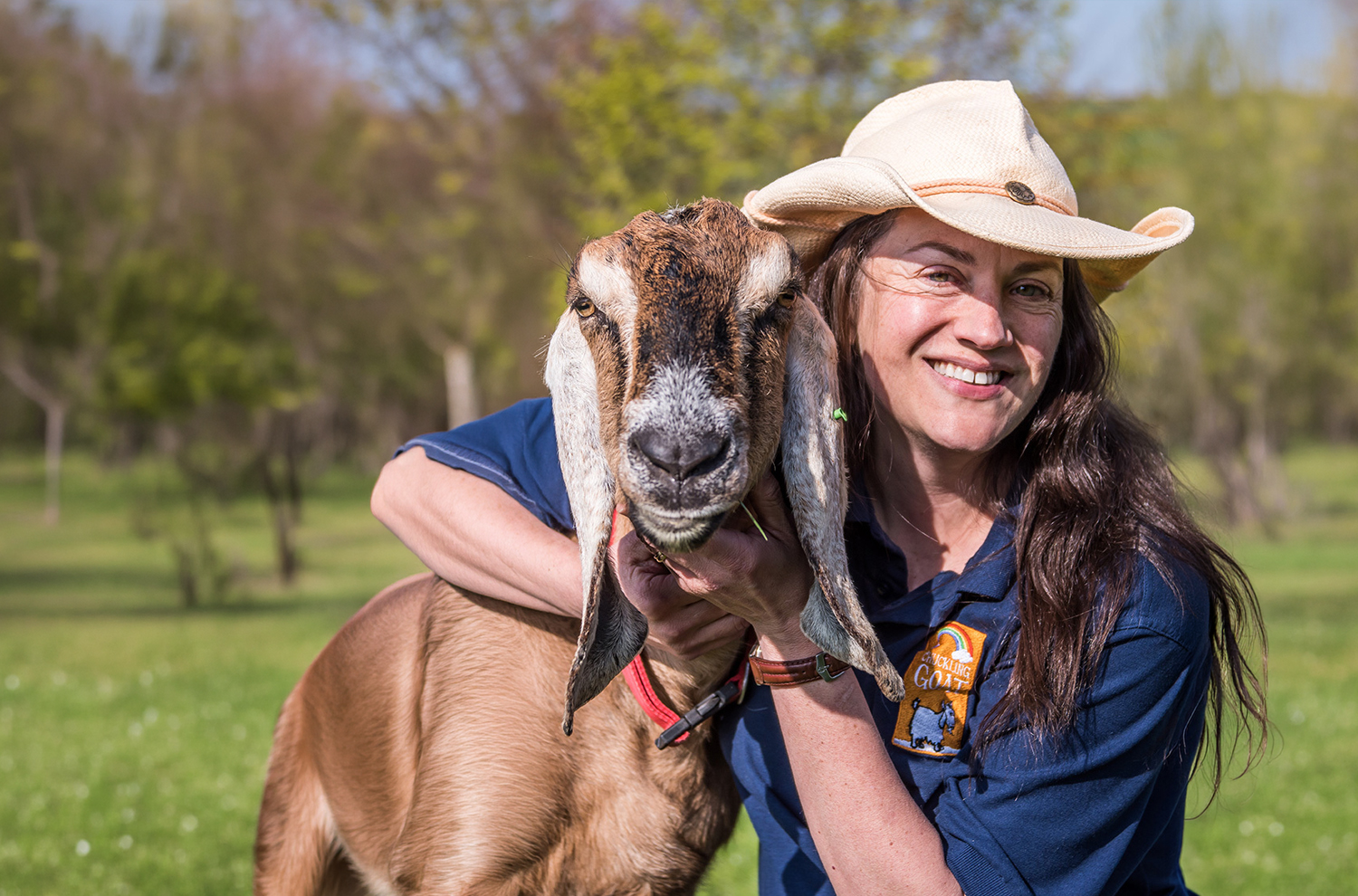
Shann Jones is a wife, a mother and a grandmother who brings together entrepreneurship, family life and her deep love of nature to challenge conventional thinking about leadership, resilience and what it really means to build something that lasts. Originally from the States, this former journalist and radio talk show host fell for a Welsh farmer and settled their beautiful blended family on his hillside farm overlooking the Irish Sea.
A series of health issues close to home led her to discover the healing power of kefir, made from their excess goat’s milk. And the rest is history. Shann became the founder and CEO of Chuckling Goat. With the support of her family, she has built the business from her kitchen table into an international award-winning natural health brand serving more than 300,000 customers, myself included.
Awarded an MBE for services to innovation and charity, Shann is known for combining cutting-edge microbiome science with practical, compassionate leadership. She is also the author of several books on health and wellbeing and is currently writing The CEO in the Garden, exploring what business leaders can learn from living systems.
In this episode, Shann shares the extraordinary story of building a business from nothing while raising a large blended family, and the crisis that changed everything: when her husband Rich developed a life threatening MRSA infection and doctors told her there was nothing more they could do. What followed was a desperate, instinctive experiment rooted in nature rather than medicine, and a philosophy about leadership, business and living systems that she has carried ever since.
Conversation Highlights:
- How a goat, bought on a whim to help their son’s chronic illness, led to an overproduction of milk and, eventually, the accidental discovery of kefir through a chance radio programme
- The reality of building a business from absolute poverty, selling soap and kefir at farmers markets for cash to buy pony carrots because they could not afford the good ones
- The devastating moment Rich developed a life threatening MRSA infection following major surgery, and the surgeon’s verdict that there was nothing more medicine could do
- Why Shann rejected the language of war and battle used throughout medical literature on antibiotic resistant infections, and the radical reframe that led her to think in terms of allies rather than enemies
- The concept of living systems, nodes, edges and emergent behaviour, and how covering Rich in kefir instead of more antibiotics became the desperate, instinctive experiment that ultimately saved his life
- Why Shann believes women in business need to start before they feel ready, and why no business plan could ever teach what the journey itself teaches
- Bringing her children and their partners into the business as it grew, building them houses on the farm, and why she considers this the single best decision they have ever made
- The difference between controlling a business from the top down and creating the conditions under which a team, like any living system, can become more intelligent and function without her at the centre
- The concept of the map gap, the widening distance between the map we make of reality and reality itself, and why we so often defend our maps rather than updating them
- Why living systems, whether a coral reef, the internet, a family or a business, never argue with a slug, and what that teaches us about working with reality rather than against it
Listen If You’re:
- Facing a health crisis, personal or within your family, and searching for hope or an alternative way of thinking
- A business owner struggling to delegate or let go of control as your team grows
- Curious about the microbiome, natural health or the science and philosophy behind fermented foods like kefir
- Drawn to nature as a source of wisdom for how to run a business, a family or your own life
- Waiting to feel ready before starting something, and needing permission to take the next step without knowing the whole path
- Interested in leadership that creates the conditions for a team to flourish rather than controlling every outcome
Favourite Quote for Mums in Business:
“You don’t need to know the whole path. You just need to take the next step. If you can take that next step, then you will learn and adapt and improvise and survive. That’s the way living systems move, one tiny step at a time.” – Shann Jones MBE
About the Guest:
Shann Jones MBE is the founder and CEO of Chuckling Goat, an international award-winning natural health brand serving over 300,000 customers worldwide. Combining cutting-edge microbiome science with practical, compassionate leadership, she has built her business from a kitchen table into a thriving family enterprise run alongside her husband, children and their partners on their farm overlooking the Irish Sea. She is the author of several books on health and wellbeing and is currently writing The CEO in the Garden. Shann is a wife, mother and grandmother whose life, by her own account, truly began after forty.
You can connect with Shann Jones MBE on LinkedIn and find Chuckling Goat’s full range at chucklinggoat.co.uk.
About the Host:
I’m Victoria Phipps – a Mum of two, analogue family photographer, charity co-founder, photography business educator, marketer and now podcaster! My career has wandered all over the place and is becoming a bit of a complex tapestry as I head into this middle phase of life, but I can honestly say I’ve loved every minute of it so far.
I was raised by a nurturing Mother and an entrepreneurial Father and have inherited traits from both, so the tension between ambition and motherhood is one I grapple with on a daily basis! I’m fascinated to hear the stories of other women on a similar path, who are striving to build thriving businesses whilst being present for their children. It’s a tough juggle, but I hope the conversations shared on this podcast help Mums in business feel less alone and inspired to keep going in pursuit of their dreams!
If You Enjoyed This Episode:
Please subscribe, rate and review the podcast – it helps other mums find us!
Share in your Instagram stories, tag @mummeansbusinesspodcast and let us know your biggest takeaway.
Share this episode with a fellow Mum in business who you feel would resonate with Shann’s story.
Episode Transcript:
Hello and welcome to the Mum Means Business podcast, where we shine a light on inspiring women who have one thing in common. When they’re not managing tantrums, homework, P.E. kits and play dates, they are busting their gut to build a thriving business that supports their family life. I’m your host Victoria Phipps and I’m figuring out how to play this game right alongside you. I’m a motherhood, family and personal brand photographer, I teach portrait photographers how to lead with print in the digital age, I’m marketing lead in the family business my Dad founded over 20 years ago and I’m “Mum” to two little girls.
If you’re a multi-passionate mum too, in need of some solidarity whilst navigating the messy middle of making your big dream a reality, then stick around. This is for you.
NOTE: This is the transcript from the original recording, rather than the edited episode so timings may vary.
Victoria (00:00)
My guest today is a wife, a mother and a grandmother who brings together entrepreneurship, family life and her deep love of nature to challenge conventional thinking about leadership, resilience and what it really means to build something that lasts. Originally from the States, the story goes that this former journalist and radio talk show host fell for a Welsh goat farmer and they settled their beautiful blended family on his hillside farm overlooking the Irish sea.
A sudden health scare left the goat farmer, let’s call him rich because that’s his name, gravely unwell until the kefir that they’d been making in their stone barn cleared his infection. And the rest is history. Shan Jones became the founder and CEO of Chuckling Goats. With the support of her family, she has built the business from her kitchen table into an international award-winning natural health brand serving more than 300,000 customers of whom I am one.
Awarded an MBE for services to innovation and charity, Shan is known for combining cutting edge microbiome science with practical, compassionate leadership. She’s also the author of several books on health and wellbeing and is currently writing The CEO in the Garden. Exploring what business leaders can learn from living systems, which sounds right up my street.
Shan, your story is so inspiring and I’m so glad you’re here to elaborate and share your wisdom and experience in your own words. So welcome to the Mummy’s Business podcast.
Shann Jones MBE (01:30)
It’s a pleasure to be here. Thanks for asking me.
Victoria (01:33)
I’m so pleased that we were able to do this because I have been drinking chocolate and goat every day for years. And at first I was like, this is like maybe an acquired taste. But now honestly, if I don’t have it, if I go away for a few days and I’m not at home and I haven’t taken it with me, I miss it. And so I’m super excited to hear how it started for you and what it’s meant for you and your family life.
Shann Jones MBE (01:59)
Well it’s funny you say that because it’s definitely not a recreational drink. It’s not a milkshake. As
Victoria (02:03)
No.
Shann Jones MBE (02:05)
it turns out, your gut bugs actually really influence your cravings. So whatever you give them, they’re gonna want more of. If you drink a lot of sugary
Victoria (02:12)
Okay.
Shann Jones MBE (02:13)
drinks, the sugar loving ones are gonna flourish and the broccoli loving ones are gonna die off and the sugary ones will demand more sugar. That’s where the cravings come from. So the kefir is very tart and fizzy and fermented.
Victoria (02:25)
Mmm.
Shann Jones MBE (02:26)
But it’s good stuff and so your gut bugs develop that craving if you work with it over time. It’s like firm but fair, like raising a family. You gotta treat your gut bugs th with the same kind of kind but consistent discipline.
Victoria (02:38)
That’s it. think at first I felt like I should persevere because I think I’d bought a whole bottle and I’m waste not want not. I was like, right, no, I’m gonna keep going with it because I think the first time you have it, it is sharp. And it’s, like you say, if you haven’t got those taste buds activated, it can feel like quite an alien sensation because it’s so frothy. But actually that kind of mouth feel is something that you…
you kind of crave after a while. And it’s just how I start my day now. I love it. I love it.
Shann Jones MBE (03:14)
That’s what we like to hear. Well, we’ve really gotten out of the habit of having things that are bitter or fermented.
Victoria (03:19)
Mm.
Shann Jones MBE (03:20)
You know, people used to drink buttermilk, they used to drink all kinds of bitter and fermented flavors, and now we’re pretty much just sugar and salt. And if there’s not sugar and salt in it, we don’t like it. But interestingly,
Victoria (03:30)
Yeah.
Shann Jones MBE (03:31)
when you give kefir to small children from baby age up, they develop a taste for it as well. Kids love it, unless
they’ve already gotten sugar addicted. But if you hit them early enough, they will develop that as part of their palate.
Victoria (03:47)
I wish I had known that five years ago. I feel
like it’s too late.
Shann Jones MBE (03:50)
What is that?
Victoria (03:51)
I have so often, because they see me drink it every morning. So my girls are now five and three. They’re still quite small, but they see me drinking it and they have tasted it because I’ve encouraged them. Like it’s a bit different, but mommy really likes it now. And it’s that, isn’t it? It’s kind of modeling it that yeah, okay. It’s not vanilla ice cream. It’s not a milkshake, but it’s something that you can grow to really enjoy. Let’s go. Go on.
Shann Jones MBE (04:15)
If you if you sorry, if
you struggle with the palatability, just blend it up with a banana. It tastes like a like a frozen fabric then. It works really well for the
Victoria (04:21)
Yeah,
that’s a really good idea. I will do that. I might do that today. Okay. Let’s go back a little bit in your story. So starting this business, I kind of touched on it, but I wonder if you can elaborate what made you do it.
Shann Jones MBE (04:38)
Well, I never wanted to start a business. I was a journalist, I was a radio talk show host, and I was, as I describe myself, a paycheck girl. Zero desire to be an entrepreneur, didn’t have any business experience, couldn’t balance my checkbook back when checks were a thing. so it really wasn’t that. It was genuinely something that I fell into because of my family for a number of reasons. first of all, my husband and I got together quite late.
So I was forty-one and he was forty-four. And I’m here as living proof that life begins after 40. I’m at the love of my life at 41
Victoria (05:15)
You
Shann Jones MBE (05:16)
and I figured out what I wanted to do for a living when I was fifty. So it is never too late to write your own happy ending. I’m here to I’m here to testify
Victoria (05:23)
Hehehehehe
Shann Jones MBE (05:24)
to that. But because we’d met late, we wanted to spend time together and he had this farm, it’s small, twenty-four acres.
I was traveling as a high performance communications consultant and you know all over the world at the time and we didn’t want me to travel anymore. So we started looking at things that we could do on the farm to try to make the farm wash its face. And it’s not an easy thing to do. You know, we looked at biofuel turkeys, chickens, you know, what could we do to try to make the farm make a living? And while we were still trying to figure that out.
my little boy was getting very ill repeatedly. W he had eczema and he had bronchitis and bronchiolitis, which is very dangerous. I ended up running out of the doctor’s surgery with him in my arms into the ambulance. If anyone’s had that experience,
Victoria (06:17)
my gosh.
Shann Jones MBE (06:18)
very scary. And every time, you know, we would take antibiotics and then we’d just circle back. Yeah, you know, three months later we’d be back in the doctor’s office again. I know now.
What I didn’t know then, which is that of course the antibiotics kill off everything in your system, not only the bad bacteria but the good bacteria as well. And the good bacteria is your immune system. So
Victoria (06:40)
Hmm.
Shann Jones MBE (06:41)
you you are much more prone to get sick after you’ve wiped everything out. It’s like Agent Orange bombing the whole microbiome. And you know, I’m not a crank about that. Sometimes antibiotics are wonderful and necessary and life-saving.
But you need to repair the damage afterwards because it does absolutely it’s like pouring bleach into the river. It kills all the fish. And the fish are your immune system. So Benge
Victoria (07:06)
Hmm.
Shann Jones MBE (07:06)
was going round and round with this antibiotics thing. And I said to Rich, you know, what are we gonna do about this? And he said, Well, let’s get a goat. And I said, Okay, I’ve just told you that our son is ill, and you said get a goat.
Victoria (07:19)
Yeah
Shann Jones MBE (07:21)
But turns out it is known in the Welsh tradition.
That goat milk is good for breathing issues and eczema and allergies, which turns out to be perfectly true. and so we got a goat and we started milking the goat, and we gave the goat’s milk to Benge and it helped him. And then we had too much goat’s milk. And so it was going off in my fridge. The goat was overproducing milk. And I got online and looked up what to do with too much goat’s milk, asking Auntie Google as you do.
And I got you know, everyone makes goat cheese and I thought that was kind of boring and so but then I saw goat’s milk soap and I thought, ooh, that’s interesting. And so I went I got on a train for Yorkshire and I took a weekend course at the th soap school, which I highly recommend, learned how to make soap, came back, put the lotion or or started making lotions as well, put the goat’s milk into the soaps and lotions, and that’s really how it started.
Victoria (08:21)
Okay, okay, and so you were doing this then just out of an outbuilding in your farm and it was just you kitchen tabling it trying to figure out how to make this commercially viable.
Shann Jones MBE (08:38)
Well, it was a hundred percent kitchen table. Rich was still working. He was making harps, harp like the kind you play. Harps, he no harps, like
Victoria (08:45)
Okay, yeah, yeah.
Shann Jones MBE (08:49)
he’s a very talented woodm woodworker. So he was making harps. I started making this soap and lotion on the yeah, on the stove. We weren’t even in the outbuilding at that point. This was literally just on the kitchen.
Victoria (09:01)
Okay.
Shann Jones MBE (09:02)
but I still wasn’t using up all the milk. And
A girlfriend said called me up and said, Turn on the radio because she knew I was trying to find something else to do with goat’s milk. And there was a doctor on Radio 4, Dr. Natasha Campbell McBride, and she was talking about this stuff that I’d never heard of called Kiefir. And she came from Russia, and that’s the connection. So this was back in 2012. And so no I mean, nobody had ever ever heard of kefir. It wasn’t in the supermarkets, you know, it just wasn’t anywhere. Nobody knew about it. But she was using it.
To treat her patients with autism, schizophrenia, and dyspraxia. And she had actually taken her own son off the autistic spectrum because there’s this very strong correlation between the gut and the brain. And, you know, she was really a pioneer of the whole it’s gut and psychology syndrome, gaps is the name of her diet and her protocol. So I thought, okay, if I could.
get
in touch with her and get her to tell me how to make this weird Russian stuff to a high enough standard that she’d be happy to give it to her clients. Maybe I could use up my extra goat’s milk. She could help her clients and it would be a nice little, you know, win-win situation. We could we could develop a little market for this stuff. So I did that. I got in touch with her. She did in fact very generously tell us how to make it. And in the Russian style, it is real life Kief grains.
Which are not like wheat grains, they’re little squishy things like cauliflower, and they’re alive, so they reproduce, and you can strain them out and then reuse them. And then you put them in a new bathroom
Victoria (10:41)
Okay.
Shann Jones MBE (10:42)
milk and they ferment the milk. then and we managed to make this stuff using our goat’s milk and make it to a high enough standard that she actually endorsed us on our website, which was all very exciting. So that we started making the kefir. But at the time we were
Absolute stony broke. I mean I we used my my marketing budget was zero because I had zero money. I mean we were keeping the whole family going and there were ten people around the table because we had, you know, my kids, Rich’s kids, Rich’s dad lived with us, the eldest girl’s boyfriend, who’s now her husband, was living with us. So we were feeding ten people and we were making big pots of cowl, which is Welsh stew. and we would go to the farmer’s market.
And sell a couple of bars of soap and a few little bot bottles of kefir, and we’d get cash, and then we’d take the cash over to the farmer’s market and buy bags of veg. But we couldn’t afford the good pony the good carrots, we could only afford the pony carrots. That’s what we couldn’t need to do.
Victoria (11:43)
Mm-hmm.
Shann Jones MBE (11:45)
Then we were living up our own lamb and and pony carrots stew. and we were driving around to the health food shops in our old battered old car, and we would go.
Okay, so here’s this stuff. You’ve never heard of it, and it tastes like hell. What do you think?
Victoria (12:03)
Hahaha!
Shann Jones MBE (12:06)
No, thank you though. Anyway. So we were really struggling with it. in the
Victoria (12:11)
You
Shann Jones MBE (12:11)
meantime, Rich had to sell his motorcycle so we could get money to buy bottles to put the kefir in. And so
Victoria (12:18)
Wow. Yeah.
Shann Jones MBE (12:19)
we we bought the little bottles like they have milk in, you know, because Ben sh the the kids have
little milk for their lunch and so we b bench brought one of those home and I went, that’s cute. We’ll we’ll buy those. So Rich had to sell his motorcycle. He’s never let me forget it. I’m like, but you can buy another motorcycle. No, no, it’s not the same.
Victoria (12:37)
Hahaha
Shann Jones MBE (12:39)
and so that’s where we were at that point. We were really, really struggling to make it all work.
Victoria (12:44)
So at what point did you feel like you were gaining traction with this product? Because it sounds like a slog and all the while, like you say, you describe this picture, you’ve got all these mouths to feed. You’re also parenting, parenting several children and just trying to keep everyone fed and sheltered and scrambling around for bits of cash to buy your pony carrots. How long was it before you felt like, okay?
There’s a bit of momentum here now.
Shann Jones MBE (13:16)
Well, on top of all that, Rich got sick. So
Victoria (13:19)
Okay.
Shann Jones MBE (13:20)
so it was already hard enough. And then he had colitis and he’d had it ongoing. And of course, if anybody ha has dealt with colitis, the drugs they give you work until they don’t. And suddenly his drugs stopped working. So he went into the hospital and it was going in and out of hospital, you know, operations and all kinds of stuff. He finally went in and came out.
without his large intestine, they took out his whole large intestine, but with an MRSA infection, a superbug infection down his midline incision. And so the nurse was coming every day to check his bandage and you know see what was happening. And one day she said, Okay, I think we need to call the doctor, you know, in that very calm tone that they have. And the doctor came out, peeled down this 10-inch bandage.
And all the blood drained out of his face. I remember because I was watching him, all the blood drained out, and he said, I don’t have any experience with anything of this magnitude. I think you’d better call the surgeon who did the operation. And he got in the car and he locked the doors. I remember that. I don’t know what he thought I was gonna come and try to drag him out of the car. And he
Victoria (14:36)
Wow.
Shann Jones MBE (14:36)
zoomed off up the track. And I was left standing there, like my knees buckling, thinking, okay.
So what do I physically do with this large six foot two man? I can’t put him in the hospital because they screen for MRSA. They won’t let you in. It’s contagious. I can’t put him in hospice. Like what does he just literally die on my sofa? I mean, physically, where where do I put him?
Victoria (14:59)
Yeah.
Shann Jones MBE (15:00)
And so at the time I was trying to do the school run, do the shopping, do the
Victoria (15:07)
Yeah, exactly.
Shann Jones MBE (15:08)
run the business. and that was
That was a crisis, that was a crisis. So we did in fact go and see the surgeon who’d done the operation, and he explained very kindly but very firmly that there really wasn’t anything that he could do to help us. MRSA is resistant. It’s called methicillin resistant Staphylococcus aureus, that’s the name of it. and it has out-evolved all of our antibiotics. So he said it’s all over Rich’s body. It’s not just in the incision. You could literally dip him in bleach.
And there would always be a few little leftovers behind his ears and his eyebrows under his fingernails, and they would repopulate.
Victoria (15:48)
Wow,
Shann Jones MBE (15:49)
Yeah.
Victoria (15:49)
what a diagnosis to receive. That’s horrendous, horrendous
Shann Jones MBE (15:53)
Yeah, yep.
Victoria (15:55)
for you. And how was Rich at this point? You know, is he, how does he, it’s horrendous, I can’t imagine, but what sort of conversations are you having?
Shann Jones MBE (16:06)
at this point he was pretty much fading in and out of consciousness. He wasn’t, you know, he wasn’t
Victoria (16:10)
my gosh.
Shann Jones MBE (16:11)
contributing much to the conversation. So I’m not a doctor, but I am a journalist and I’m a researcher. And so I started researching because that’s all I knew how to do. And what I noticed was that all of the literature that I was reading about these infections were all couched in the language of war. In other words, it was all about.
We’re fighting the bacteria and the bacteria fighting us and we’re killing them and there’s first line defense and battle and like the the frame, the communication frame is all war and aggression. And I thought, you know,
Victoria (16:47)
Interesting.
Shann Jones MBE (16:48)
I don’t again, not a doctor, not a scientist, but I do know communication frames, and I know that if you step in a bad frame and continue it, it’s like tracking dog mess across the carpet. You just continue that frame. So clearly this frame.
doesn’t work because you can kill off a lot of the bacteria but you can’t ever kill them all as the doctor told me you will always leave a few you’re killing off the weak ones and you’re leaving the strong ones to survive and breed and survive and breed they do and that’s how we create resistance so that whole model it just doesn’t work or rather it works until it doesn’t and we had reached the point at which it didn’t work. So I thought okay all right
what’s I need something different? I need something outside the box, completely outside any box that anybody is thinking in or writing in. Something completely different. what’s the opposite of war? Rainbows, unicorns, dancing,
Victoria (17:46)
Yeah
Shann Jones MBE (17:48)
balloons, cupcakes, friends, allies. And I went, okay, allies. That’s slightly less crazy. Maybe what I need is micro.
Probiotic allies, like allies on the tiny teeny tiny level, to get the bacteria, not to kill them, but to put them back in their box and contain them. And what I learned, which turns out to be true, is that your skin, in fact, your body, is a living system. It is not a machine. What that means is that every living system has nodes and edges. Nodes and edges. So if you think of like
A murmuration of starlings, for example, like the birds you see in the sky. You know how they swoop and bend and they’re all working
Victoria (18:34)
Yeah.
Shann Jones MBE (18:34)
together like a super organism. There’s no one leader. There’s no leader telling them what to do. They’re just operating all together with certain rules that apply. And that’s how it works for living systems, including on your skin. So if you
diminish the number of nodes past a certain point, that system will fall apart because the intelligence of a living system comes from the connections between the nodes.
Victoria (19:05)
This is so fascinating. And I love that you are in the thick of potentially like a life shifting crisis and you’re doing all of the usual stuff. Like you say, the kids still have to go to school. Everyone still needs feeding. And yet you are going back to first principles and thinking with this complete liberty.
in an area that as you say, you’re not a doctor, you don’t have expertise, you’re not at this stage a scientist, you’re really scrambling around to learn as much as you can to just apply a different language to this problem that’s in front of you. And what happened?
Shann Jones MBE (19:55)
Well, I will say I only did it because I was desperate. Absolutely backed into a corner. I wouldn’t
Victoria (19:59)
Yeah, yeah, of course. Yeah.
Shann Jones MBE (20:02)
have done it if I didn’t have to. And I I will also say that I think at this point I had, I don’t know, a breakdown. Anyway, I was very, very, very manic. And my my
Victoria (20:15)
It’s completely
understandable that you’re manic, completely understandable, but a lot of people would have accepted the fate. You you’ve got a professional in authority saying they cannot help you. You know, it takes something very special in resilience to actually not accept that and to keep trying to find an alternative solution to this challenge. And of course you’re manic, but you’re still doing that.
Shann Jones MBE (20:46)
I was I was very manic. That my family said, okay, you we think you’re manic depressive. You need to go and see a GP. And I said, fine, I’ll go and see the GP. He looked at me and said, I don’t, he said, do feel depressed? And I said, no, actually, I don’t. I just feel manic. He said, I think you’re just having an adrenaline response to the crisis. And I think we’re fine. You know, so I was like, okay, I’ll just carry on then. I can say also that that kind of gave me the extra boost.
that I needed. You know, if it honestly, I would if there if there had been a pill to take, if there had been a solution, I would have happily taken it. But partly because you know, I was came out of an abusive relationship. I left that relationship with two kids, one suitcase in the back of my car. I was in the deserted town on, you know, New Year’s Day going, okay, here I am, no family, no friends, no money, no job, no prospects. And I had come from that and met rich.
And that was we’d only been married for about three years. And I was like, no, I have not I have not come this far and gone through this
Victoria (21:48)
No, I’m keeping hold of this life. Yeah. Yeah. Yeah.
Shann Jones MBE (21:53)
much to find this man to have him die on my sofa. That is not happening. And so really
it
Victoria (21:59)
Yeah.
Shann Jones MBE (21:59)
was just sheer stubborn refusal to go, this is not how my story ends. This is not it. So when I asked that question, the new question of what happens
Or where could I find allies on a microbial level? I did have an answer to that because it was in the kefir, which we were making now in our stone barn. So what the kefir does is it repopulates the living system with live bacteria. In other words, it puts the nodes back in the system so that the system actually becomes emergent again and comes online. In living systems.
Victoria (22:40)
Okay.
Shann Jones MBE (22:41)
There’s there’s something called a tipping point or quorum is the biological phrase for it. And the easiest way to think about it is if you imagine an ant hill, and y you used to be able to order these online, I don’t know if you still can, but if you have say 25 ants, they don’t do much. They wander around, they’re kind of random, there’s no organization. You add the 26th ant, and suddenly the ant hill comes online.
And it begins to exhibit what we call emergent behavior. It’s because there are enough nodes in the system for the intelligence to begin to emerge from the bottom up and the superorganism that is the anthill begins to function. So that’s a weird thing. We don’t usually think about it that way, but that’s a fact about living systems.
Victoria (23:31)
Yeah, and I imagine that there are all of these, I mean, this is probably something that you could talk about for days. I know very little about this and I’m immediately like fascinated and curious. I imagine you can look at all different aspects of nature and animal behavior and find these little rhythms and rules that make things work as opposed to not work. And this is a massive kind of,
It’s a tribute to the millennia of evolution that nature has managed to figure out the solutions to so many of its own problems. And we as humans, we come in kind of towards the end of that. And we feel like, you know, we have quite large egos and we feel like we have the answers and we invent, you know, we don’t invent, we discover, you know, antibiotics and we go and throw them on everything and put them in everybody and think, wow, we’re really winning here.
like you say, back to the battle language, we’ve killed all the bad bugs. And actually, I feel like it’s only recently that we’re starting to realize how wrong we have been there. And that it is not appropriate to do that because we’re, we’re dysregulating this balance that exists, but this is a constant evolution. And so you’re there just kind of learning about this, I imagine in your, your manic state.
and absorbing so much information and you go to the kefir and you’re wondering, can this do something to help Rich? So what actually did you do to practically help him when he was in that situation?
Shann Jones MBE (25:14)
I
covered him with the kefir. Not not I may
Victoria (25:16)
You covered him with it, okay? Yeah.
Shann Jones MBE (25:18)
say not on the wound itself. I wasn’t that brave to put it into the open wound because I thought I I did a lot of research to try to find if anyone had ever used kefir on the skin and I couldn’t find any reports of anyone doing that, good
Victoria (25:31)
Mm-hmm.
Shann Jones MBE (25:32)
or bad. But I was I thought, if it gives him gangrene or whatever, I can’t be responsible for that. So I used honey on the incision itself. But because the
The surgeon had told us that the MRSA was all over his body. I coated the rest of him with kefir. And then I alternated that with a wash of essential oils, which I had for my soap making. And the idea being that that I was hoping would knock the pathogen level back enough that it would kind of leave a foothold for the good bacteria to get in.
And that I and I just kept doing that. So I was doing that three times a day. And poor Rich was
Victoria (26:10)
Wow.
Shann Jones MBE (26:11)
up in bed by this point. He’s like, what are you doing? I said, don’t worry, sweetheart. I totally know what I’m doing. Like, totally don’t know what I’m doing. I’ve
Victoria (26:17)
Hahaha!
Shann Jones MBE (26:18)
got no idea what I’m doing. But I’m just like, yep, this is, we’re gonna do this. And nothing happened. Nothing happened. And I thought, I’m actually, I am crazy. My family’s right. I actually have lost my mind, but I kept doing it.
By this time the nurse was coming. The doctor never came back again, by the way. But the nurse
Victoria (26:36)
Wow. Yeah.
Shann Jones MBE (26:37)
still came every day. And every day she was inserting a probe into the holes in his wound. Now I sincerely hope that you nor anyone listening ever has to have this experience, but what a superbug does, it actually eats holes into the wound. Like little red mouths. So instead of healing day by day, it’s getting deeper day by day. And again
I’m no doctor, but I didn’t need to be a doctor to realize that the day that those holes hit what was left of his internal organs, we were in trouble.
Victoria (27:09)
Yeah.
Shann Jones MBE (27:10)
And the surgeon, there’s nothing left to cut. Like you that’s we’ve cut
Victoria (27:13)
Yeah, yeah.
Shann Jones MBE (27:14)
out what we can cut out. There’s we’re there’s no solution here. So the nurse was coming, putting the probe in, measuring the probe every day. It was deeper, deeper. On the fourth day, she measured and she looked at me. She hadn’t been meeting my eyes for
For the last few days we were both like not looking at each other, but she looked at me and she said, It’s not deeper. I was like, Okay, all right. Came back the next day, she said, It’s definitely shallower. Next day it was shallower again. And after that, those holes cl closed up and the wound healed, and Rich got up out of bed and got back on his tractor and he’s been there ever since.
Victoria (27:53)
Wow, so you reached that tipping point and you had to persevere, it sounds like with that. You’re not, and this is so interesting because it is business building, isn’t it? It’s that you’ve just got this gut feeling, we’re talking about the gut, this instinct that this might impact, this might benefit him. You don’t know, you don’t know, but you’re kind of trusting in yourself.
that you’ve just got this feeling and everyone’s telling you you’re crazy. You’re being told to go to the GP because you’re manic. No one understands what you’re doing. You’re covering Rich in kefir and eventually you get that nurse looking you in the eye and saying, actually, it seems like there’s a change.
having that resilience, having that persistence to keep going and trust yourself that this is something that, mean, part of it, do you think it’s just, you felt like you had to do something as well? That was probably part of it. You can’t just sit idly by and watch this. And it’s probably in some ways an element of control there that’s keeping you sane through this crisis as well as manic, but also that you just feel like this stuff might work and how amazing that it did.
and he’s been back on his track to ever since.
Shann Jones MBE (29:19)
My
own private miracle. But you know, I what I always tell women, and especially women entrepreneurs or women who want to start a business is start before you’re ready. Because you will never be ready. Women have such a tendency toward perfectionism and this sense that I’ll do it when the kids are, you know, older, I’ll do it when the house is clean, I’ll do it when my desk is clear, I’ll do it, you know, next year, I’ll do it once I’ve lost 10 pounds. Like get your boots on the road.
Because the journey will teach you everything you need to know. And nothing else can and nothing else will. It doesn’t matter, you know, if you have an MBA or you can have write a business plan. I can’t write a business plan. I w I read business plans for dummies on the train on the way to meet a potential investor and none of it’s stuck in my head. Turns out you don’t need one. You really don’t. It’s like having a child. If you actually knew how hard that was gonna be before you had your first child, you probably wouldn’t have done it.
But you have your child
Victoria (30:18)
Mm-hmm.
Shann Jones MBE (30:19)
and they hand you the baby and you go, I I don’t know what to do. They’re like, Yeah, you’ll work it out. And you do, and a business is the same. So you you have to tune into that in sense of interior knowing, which may I say, society is very deft at disabling. You know, all of the senses of certainty and truth and inner connection and listening to your intuition, we pretty much drown out all the time.
As women. It’s like, well, I’m just being silly, I’m just being stupid, I’m just being rude, I’m j you know, who am I to think that I could do this? You know, we absolutely knock our good ideas on the head as they come out of the gate all the time. And at some point, you’ve just gotta put your boots on the road and have the faith that you will figure it out one step at a time.
Victoria (31:12)
Yeah, yeah, that’s such good advice because you’re right. And I’ve certainly felt it myself. know countless women have had so many conversations about this and it is that that trust in your own intuition a lot of the time. And we’re so conditioned to override it with somebody else’s definition of success or somebody else’s definition of how you should show up.
whether that be personally at the school gate or whether that be in your business. And that’s such an important lesson. And I think it also ties in with this idea of connection to nature because we can take ourselves for a long walk in nature. And suddenly all of those other stories that are kind of external to us become less loud, become less dominant.
And we do find that we seem to be better able to tune in to what the right path is then for us and for our business. So tell me about how nature has inspired the way that you run your business and the way that you parent.
Shann Jones MBE (32:32)
Well,
I always say that everything I know I learned from my garden. And
Victoria (32:37)
I love that.
Shann Jones MBE (32:39)
that that’s the reason that the book that I’m working on now is called CEO in the garden. Because, as you stated so eloquently earlier, living systems are all around us. They’re everywhere. You know, a coral reef is a living system, a forest is a living system, a family is a living system, a neighborhood, a community.
A state is a living system, a country is a living system, the internet is a living system. And that seems weird because it’s not, you know, it’s made of wires and things, but if you think about it, the internet has lots of nodes, they’re all connected, there are edges between them connecting them up, and there is emergent behavior that is not dictated by any one point. There’s not one leading computer that leads the whole internet.
The intelligence of the internet emerges from the connections between all the individual computers. And that’s a great description of a living system. So we’re surrounded by living systems all the time, but we know almost nothing about the way that living systems operate. Because back in the days of the Industrial Revolution, we decided that everything was a machine. We decided
Victoria (33:54)
Hmm.
Shann Jones MBE (33:54)
our bodies were machines and everything else was a machine.
And the thing about machines is you can remove a part. If there’s a problem, you remove it. But if you do that with a living system, then you remove enough nodes that the whole thing collapses.
Victoria (34:11)
Mm-hmm.
Shann Jones MBE (34:13)
So, in my opinion, we have got our metaphors wrong. We think it’s a machine and it’s not. It’s a garden. And we know almost nothing about the rules. Living systems have principles, they work.
on standard principles that are repetitive and you can you can learn them, but we don’t bother.
Victoria (34:36)
Well, I think it comes down to what you said. And it’s so interesting, honestly, I feel like my mind is buzzing in this conversation because you’re so right. I hadn’t really thought about it like that. The industrial revolution sort of mechanicalized everything. And it goes back to sort of, know, if somebody’s ill, we’ll stick leeches on them, we’ll take some blood out. And if somebody’s got mental health issues, we’ll do a lobotomy. You know, it will just take a piece of you out and that must be the broken piece.
Of course, we don’t do things like that anymore, but it is indicative of that shift in thinking. And it comes back to the human ego that we’ve figured it out. So we just need to take this rotten piece out. But then of course you get to a point where rich was and you’ve got MRSA and it’s rotten everywhere. It doesn’t apply. How do you take, you can’t take all of it out. So what do you do? And then you come back to, well, how would
how would nature approach this problem? And it’s completely, it just flips all of that thinking on its head, doesn’t it? And this book sounds so fascinating. think you’re saying that they, excuse me, you’re saying that actually a family is also a living system, that a community and a neighborhood are a living system. What’s fascinating about your business is that now,
actually your family is very involved in your business. And would you say that a business is a living system?
Shann Jones MBE (36:08)
100%.
Absolutely it was. And what I’m exploring now is leadership is not about controlling things from the top down. Leadership is about creating the conditions under which the system itself can become more intelligent.
Victoria (36:28)
So this idea of control versus relationships. So rather than trying to control every aspect, know, you know, founders, when they need to take on a team, you do feel like, you’re suddenly the head of this pyramid. And I think especially if you’ve, like you did, started your business on your kitchen table, your business is kind of another baby.
and you can get quite controlling about it. And it can be really hard to delegate because you get yourself into a position where you tell yourself the story that nobody can do it like you can. And actually it’s that control that can actually lead to a situation where when you take on that team, they’re not able to flourish.
they’re not able to perform. So what have you learned there? How was it when you started delegating in your own business?
Shann Jones MBE (37:30)
Well, first of all, that’s perfectly true that no one can do it the way you can. That’s the hard thing about delegating is that is absolutely
Victoria (37:34)
hahahahah
Shann Jones MBE (37:39)
the case. They can’t do it the way you can. And it remains the case that you must open that out to more connection. Even though they’re not gonna do it the same way you can. Physically, for us, what happened was as as soon as we started to make any money,
Our second daughter and her husband came and joined us and we were able to give them jobs. And then our eldest daughter joined us. And so the three of them now work for us and they’re all directors now. son in law is now our director of operations. we’ve got director of customer service, one daughter, and the other one’s creative director. And we built them houses in our field.
Victoria (38:23)
wow.
Shann Jones MBE (38:24)
Entirely selfish and self centered because now our grandchildren are just right up the field and they can run down for tea parties on Friday, which they do.
Victoria (38:32)
That’s gorgeous, that’s gorgeous.
Shann Jones MBE (38:34)
Well, I had this argument with our accountant and he’s like, Well, you know, y th you need to sign a paper saying that you appreciate that this is not financially viable and that there will be no, you know, gain to you from this. I’m like, you don’t get it, do you?
Victoria (38:48)
That’s not the game
you’re looking for, yeah.
Shann Jones MBE (38:50)
You’re
you’re you’re a hundred percent mistaken, but I don’t have time to explain it to you. So that was the first thing we did with the profits from the business, and we’ve never, ever, ever looked back. It’s been the best decision ever, because as mothers who run businesses know, business is great, but it will never hug you back. And I think women are smarter sometimes than men men can make this mistake and they will like fall into the business so hard that they can neglect their family.
And then they wake up, you know, and their kids are 20 and they go, I forgot to engage with my family. Women really can’t do that because they have to keep everything going. But that in my opinion, that’s a rookie error. You know, you start and and and and I’m a workaholic. I I can 100%. I am really someone who can walk by the computer and go, I’ll just do one email. you two hours later I’m still
Victoria (39:43)
You
Shann Jones MBE (39:44)
there. Luckily for me, Rich has been absolutely firm about that. And
He is all about connection and he’s really taught me that. So I’ve had to learn that from him. I was an only child, grew up on my own floor of of the house, in a you know, weird family setting, don’t we all have weird family settings? But connection was alien to me and I wasn’t good at it. And I had to learn, and it took Rich, you know, two short decades to teach me, 20 years to teach me how to be in a connected network. It’s not
Easy if you’re if you’re a solo type person and you tend to just connect with one other person in a structure I call a dyad, you know, where you go you and me against the world, it’s like Than Louise, Bonnie and Clyde, both of whom came to sticky ends, by the way. Dyads don’t work over time. You need a full connected network because that’s how it works. Systems become
Victoria (40:39)
Yeah.
Shann Jones MBE (40:40)
more intelligent by gaining connection. So we brought the kids into the business.
You know, n no, no one did it the way we did. We stayed in there and kept working. But now, ten years l ten years on, so I’m sixty, and I am starting to step back and I actually only work one day a week now. Josh is running things, Ellie’s running things, Karis is running things, and we’ve had to sort of step back in at times. You know, things will the airplane will start to dip the nose and we’ll come back in and pull it back up again.
But it is absolutely the case that I now feel it my job to steward the conditions under which that network can gain connection. And the more connected it is, the more intelligently it functions. And they’re getting better and better at that. And we’re all getting better and better at it. And that again, it’s a beautiful thing. You know, it’s it’s exciting to see the network come online and start to exhibit emergent behavior.
Suddenly,
you know, they’re talking to each other, not to me. I am not the heroic node that’s running everything
Victoria (41:48)
Mmm.
Shann Jones MBE (41:49)
and telling everyone what to do. I am now the supporting and watching and kind of pruning and tying this bit here and you know just making a suggestion there, but I’m encouraging their connection and optimizing that function. and I tell you what, it works a treat. I can highly recommend it.
Victoria (42:10)
I think it’s amazing. It seems like this whole adventure you’ve had in discovery of nature’s, the power of nature to find solutions and how living systems work in the natural world and how we can learn from that and implement it in our own lives has kind of been synchronized with your own kind of personal journey.
You you spoke earlier about coming out of a very challenging relationship and finding yourself kind of single mother, one suitcase, wondering what the hell you’re gonna do. And going through everything you’ve gone through since to this point where you’ve had to learn that connection, but also you understand it because you recognize it in nature. And it just feels like the whole…
thing has converged to bring you to where you are now where you’re building this flourishing living system of your own. And it exists both in your family, in that you’ve created this situation where you’ve got close proximity to each other and you can be there for your grandkids and it sounds like they are going to have the most amazing childhood running around the hills of West Wales. And also in this business which has kind of become a legacy.
Shann Jones MBE (43:32)
I can see
it.
Victoria (43:35)
How’s it feel?
Shann Jones MBE (43:38)
It does feel amazing. I mean, I’m not gonna lie, it’s not Disney. I think people people have a fantasy about, you know, being on the farm. And it is wonderful being on the farm, but there’s also, you know, there’s a lot of poo and mud and hard work. It’s
Victoria (43:50)
Hahaha
Shann Jones MBE (43:51)
not, you know, it it it’s not the fantasy that I was a city girl and lived in San Francisco, couldn’t boil an egg, you know, had no experience with any of that. So that has all of that’s been a really steep learning curve for me. But what is wonderful about it is that having
learned connection. And and that wasn’t easy either. I mean I would have to, you know, go upstairs and lock myself in the bathroom and take deep breaths. Like all the people and all the noise and all the chaos and all the you know it’s it’s a lot. If your nervous system isn’t used to it, it’s not a straightforward thing. it always reminds me of the Little Mermaid in the original Grimms Brothers version of that fairy tale, which is very dark by the way, and this didn’t make the Disney version.
The Little Mermaid gets her legs, her land legs, but every step that she takes on land is feels like walking on knives. It’s hard. It’s painful. You know, learning that when it’s not how you function naturally is it’s difficult. It’s not straightforward. You don’t just fall into it. It like it takes work and it takes discipline and and a long term commitment to it. in in in all of these ways.
But I can I can honestly say now that at sixty, I am actually having a ball. I’m start I’m starting to actually have fun. I you know, I’ve worked so hard through my whole career as a journalist and and then as a radio talk show host and then as a single mom in a strange country and then getting the business going and trying to keep Rich from dying and you know, it’s like there was a lot going on. But
Victoria (45:29)
Yeah.
Shann Jones MBE (45:30)
now Rich has built me this beautiful garden.
And I now have the time to go out into it. And I am learning things every day that absolutely blow my mind. Because the thing is, living systems work the way living systems work. They always have and they always will. Our problem is that we haven’t paid attention to that. And so we keep doing things and treating things like a machine, but it’s not a machine. So it doesn’t work. Or rather,
Victoria (45:59)
Mmm.
Shann Jones MBE (46:00)
it does work until it doesn’t.
So
antimicrobial resistance is a great example of that. And Rich and I were almost canaries in the gold mine with that. You know, it’s that is a huge, huge issue globally. It is a direct result of the fact that we think that we’re machines and we’re not. you know, the the collapse of the topsoil, what’s happening with the environment, all of these things are because living systems don’t work the way we want them to.
They work the way they work. And the way I describe that is they never argue with a slug. You know, a a slug
Victoria (46:38)
Hahaha!
Shann Jones MBE (46:39)
will be eating my lettuce, and I’ll be I can lecture that slug and I can explain why that’s not a good idea, and I can demonstrate all kinds of principles. The slug is going to eat the lettuce. Reality does what reality does. And what what we do is we make a map. So it’s like there’s the terrain, and that’s all big and
confusing and spinning and changing and we don’t like that. Our brains want certainty because they’re prediction machines. And so we make a map. The minute you make a map, reality is still moving. That’s one of the rules of living systems is they stay stable by constant movement and adjustment. So your map becomes increasingly inaccurate. And every
Victoria (47:20)
Yeah. Yeah.
Shann Jones MBE (47:21)
moment that you spend staring at your map, reality is moving off away. And I call that the map gap.
In other words, the difference between your map and what’s actually happening in the real world
Victoria (47:31)
Yeah.
Shann Jones MBE (47:32)
is the map gap. And then people defend their maps. You know, you get in a in a business, you’ll get whistleblowers. you know, Galileo, Socrates, Copernicus, all these people came in going, I figured out something and I I think it means our map is wrong. And the way we defend our map is with a flamethrower. You know.
Victoria (47:54)
Yeah.
Shann Jones MBE (47:54)
It
we do not treat people who come in with news that the map is inaccurate, they don’t get treated well.
Victoria (48:01)
Hmm.
Shann Jones MBE (48:02)
They they often get burned or whatever we do these days, you know, what what whatever the equivalent is. Yeah,
Victoria (48:07)
Cancelled. Yeah.
Shann Jones MBE (48:09)
cancelled. So my work these days is to try to fall in love with the terrain because you can’t grow carrots on the map. Only the terrain grows carrots.
You’ve got to fall in love with reality and learn how reality works. Because if we’ve got a hope of surviving, it will be because we’re paying attention to living systems and learning the rules before it’s too late.
Victoria (48:35)
and also just having or reinstilling
Shann Jones MBE (48:37)
Didn’t
Victoria (48:38)
that respect for it. And I think it plays into how we treat ourselves as well, because we can treat ourselves as a machine. And the patriarchy would quite like that and capitalism and globalization, it all works for that to support those systems. But we burn ourselves out because we feel like we can just go and go and go and women, particularly with cyclical beings, we’re so in tune with nature in our rhythms.
but we can so quickly
Shann Jones MBE (49:03)
Yeah.
Victoria (49:04)
ignore it because of these rules that we’ve been told we ought to play by. There’s so much to take away from this, Shan. I’m mindful of your time. So I’m gonna ask you one last question, which is the question I ask to everybody at the end of the podcast. What would you say now if you could have a conversation with your eight-year-old
Shann Jones MBE (49:21)
What you’re
Victoria (49:22)
self?
Shann Jones MBE (49:26)
I would say you don’t need to know the whole path. You just need to take the next step.
Victoria (49:34)
That’s so succinct.
Shann Jones MBE (49:37)
Don’t be frightened that you don’t know what’s around the corner. All
Victoria (49:40)
Yeah.
Shann Jones MBE (49:40)
you need to know is the next right thing. And if you can take that next step, then you will learn and adapt and improvise and survive. And that’s the way living systems move. One tiny step at a time. And that’s all you need to do.
Victoria (49:59)
I love that so much. Shan, thank
Shann Jones MBE (50:01)
So
Victoria (50:01)
you so much for your time today. I have thoroughly enjoyed this conversation. I feel I’m gonna be thinking about it in a
Shann Jones MBE (50:07)
Yeah.
Victoria (50:08)
week and a month and a year’s time because there’s so much to take away. I really appreciate you. Thank you so much.
Shann Jones MBE (50:12)
Thank you so much.
It was an absolute pleasure.