
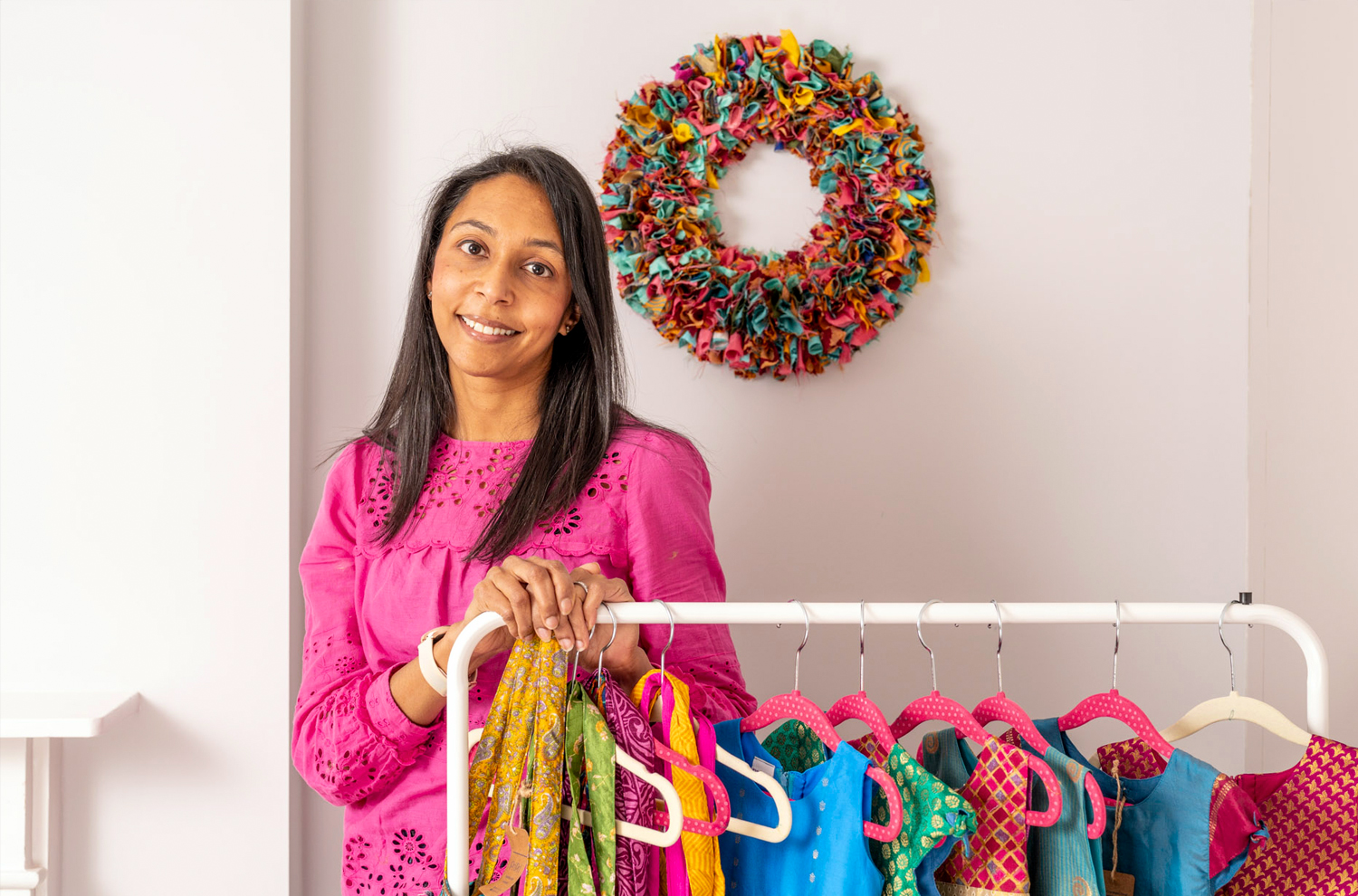
This week on Mum Means Business, I’m joined by Priya Velusami – founder of Pri Pri, an independent zero-waste brand creating colourful handmade pieces from preloved saris.
From homeware and fashion accessories to Christmas decorations, Pri Pri designs are crafted in partnership with Animedh Charitable Trust, a charity in India that helps underprivileged women gain valuable skills such as sewing.
The sari dates back to 2800BC and Priya is passionate about giving these beautiful heritage fabrics a second life while empowering women in Mumbai with meaningful training and life-changing opportunities.
Inspired by childhood memories of sewing with her sari-clad grandmother during long summers in India, Priya creates unique pieces that blend traditional Indian textiles with contemporary western design. As she beautifully says, Pri Pri is about “stitching together the two cultures that have made me.”
As a mum of two, Priya believes that success cannot be measured in profit alone. She values balance, creativity and community, and is committed to lifting other women as she climbs.
In this episode, she shares how a creative hobby grew into a purpose-driven brand, why sustainability matters and how storytelling builds deep, lasting connection with customers.
Conversation Highlights:
✨ How Pri Pri evolved from a creative hobby into a thriving product business
✨ The impact of the pandemic on entrepreneurship and the shift from casual making to serious business
✨ How Priya built ethical partnerships with artisans in India
✨ The beauty and sustainability of working with preloved saris
✨ Why meaningful storytelling is the most powerful PR tool a small business can have
✨ How creativity helps us stay grounded while navigating motherhood and growth
Listen If You’re:
✨ A mum with a creative idea you dream of turning into a business
✨ Interested in sustainable fashion, upcycling or ethical production
✨ A product-based business owner wanting to sharpen your storytelling
✨ Curious about building a business aligned with your culture and values
✨ Inspired by women who lead with heart, creativity and purpose
Favourite Quote for Mums in Business:
“Everyone has their own story to tell and that story can help to attract our right fit customers.” – Priya Velusami
About Priya Velusami:
Priya Velusami is the founder of Pri Pri, a zero-waste brand transforming preloved saris into colourful homeware, accessories and seasonal pieces. By partnering with Animedh Charitable Trust in Mumbai, Priya’s work empowers women with skills in tailoring and provides sustainable income opportunities.
Priya’s designs celebrate her Indian heritage, her love of creativity and her belief that meaningful purchases connect people to powerful stories. She is passionate about championing sustainability, slow fashion and women supporting women.
Explore Pri Pri’s collections at pripri.co.uk and you can also connect with Priya on Instagram @pripri.co.uk
About the Host:
I’m Victoria Phipps – a Mum of two, analogue family photographer, charity co-founder, marketing person and now podcaster! My career has wandered all over the place and is becoming a bit of a complex tapestry as I head into this middle phase of life, but I can honestly say I’ve loved every minute of it so far.
I was raised by a nurturing Mother and an entrepreneurial Father and have inherited traits from both, so the tension between ambition and motherhood is one I grapple with on a daily basis! I’m fascinated to hear the stories of other women on a similar path, who are striving to build thriving businesses whilst being present for their children. It’s a tough juggle, but I hope the conversations shared on this podcast help Mums in business feel less alone and inspired to keep going in pursuit of their dreams!
If You Enjoyed This Episode:
- Please subscribe, rate and review the podcast – it helps other mums find us!
- Share in your Instagram stories, tag @mummeansbusinesspodcast and let us know your biggest takeaway.
- Share this episode with a fellow Mum in business who you feel would resonate with Priya’s story.
Episode Transcript
Hello and welcome to the Mum Means Business podcast, where we shine a light on inspiring women who have one thing in common. When they’re not managing tantrums, homework, P.E. kits and play dates, they are busting their gut to create something from nothing, to turn their passion into a thriving business and build a better life for themselves and their families. We dig into what motivates devoted mothers to pursue entrepreneurship and how they integrate their work and family life.
I’m Victoria Phipps, your host, and if you’re an ambitious mum in need of some solidarity whilst navigating the messy middle of making your big dream a reality, then stick around. This is for you.
NOTE: This is the transcript from the original recording, rather than the edited episode so timings may vary.
Victoria (00:01)
My guest today is founder of PriPri, an independent zero waste brand, which creates colorful handmade pieces from pre-loved saris. From homeware and fashion accessories to Christmas decorations, each design is made in partnership with the Anima Charitable Trust, a women’s charity in India, which helps underprivileged women gain valuable skills such as sewing. The sari dates back to 2,800 BC.
And Priya Velasamy is passionate about giving these beautiful heritage fabrics a second life while also empowering underprivileged women with potentially life-changing training in tailoring. Pri Pri was inspired by Priya’s memories of sewing with her sari-clad grandmother in India during the summer holidays. Now she oversees the creation of unique pieces that are a beautiful blend of traditional Indian fabrics and Western design. As Priya puts it, stitching together the truth
the two cultures that have made me. As a mum of two, Priya believes success cannot be measured in profit alone. She values balance in work and family life and seeks to empower other women along the way, lifting as she climbs. Priya, I absolutely love what you’re doing and I can’t wait to hear you share your story on your own words. So welcome to the Mummeans Business Podcast.
Priya (01:21)
Thank you so much, Victoria. What a lovely introduction.
Victoria (01:24)
You’re very welcome.
I’m so, so pleased to have you on here because I haven’t actually had a conversation yet with a mum who has a product based business. And it is Christmas time. And I know that you do create beautiful Christmas decorations. So I have been on and had a look and I have a few things in my basket. Yeah. And I’m hoping that this inspires other people to go and have a look too, because your story is
Priya (01:46)
Amazing, that’s what I love to hear.
Victoria (01:54)
really, really gorgeous. So let’s start there. As a mum, what made you decide to start your own business?
Priya (02:04)
So my business has really evolved very slowly over time and it stems from basically what was my hobby of dressmaking. As you mentioned, I learnt to sew with my grandmother. She would come over from India during my summer holidays at school and we’d craft and make scrunchies or little dresses. And she was definitely the one who instilled the zero waste
values in me. So of that generation that you know you don’t throw away stuff you can always reuse and repurpose. And when I was kind of older in my teens I was always making clothes for myself. It was just a hobby that I got to do at the weekends. And then when my niece was born I decided to make her a dress from one of my mum’s old saris. So
My mum used to wear saris every day as well, but she had kind of collected quite a few, some of which were no longer wearable. And I said her, can I make my niece a dress? Because actually it’s kind of unique. It would be quite a nice way of a nod to her Indian heritage. And it was from that that essentially she got lots of lovely comments. And I thought, maybe I could start making them and sell them.
I was amazed when people who I’d never met actually purchased from my Etsy site. It was such a buzz. And I think that sort of saying of a happy dance when a small business owner gets an order is still very true. So that was my hobby. I had an Etsy site and then it was kind of becoming a mum, but also very much a moment.
Victoria (03:33)
Hahaha.
Priya (03:55)
during the pandemic where I stopped and I was like, actually, I’ve got this kind of side hustle business. I enjoy my part-time job, but now I don’t get the benefit of going into an office, having kind of colleagues, having a coffee from the canteen. ⁓
do I really want to be doing this with my time and rushing and leaving my children and having to sort of not be able to do all the childcare. So it evolved from that and it was essentially having young children and the working from home that made me think, right, I’m just gonna give it a go. And so I went full time with PriPri.
Victoria (04:44)
And so when was that? 2020, 2021, 2020. It’s interesting, isn’t it? I feel like COVID for people who kind of had a bit of like an entrepreneurial spark, there seems to be a bit of a trend of just having that pause in real life and everyone being in the house and a lot of people being furloughed or not being able to go into work.
Priya (04:46)
Yeah.
Victoria (05:13)
And just a moment of reflection where it seems like there was an opportunity to just take the big leap where perhaps you might not have otherwise. Do you feel like that?
Priya (05:23)
Absolutely. And I can see actually quite a lot of small businesses that I follow on social media, etc, celebrating their kind of fifth businesses at the moment, fifth birthdays, which shows you that it really was that that period of 2020 that obviously was dreadful for so many reasons, but that time to stop and think is something I’m really grateful for.
Victoria (05:35)
Yes, yes.
Priya (05:53)
So it also was a moment of flux in where I worked as well. So a lot of people were kind of leaving the business and moving on. So everything did really help cement my decision.
Victoria (06:10)
Yeah, and at that time, I suppose you were at home with your children. How old were your children then?
Priya (06:17)
So five and turning three.
Victoria (06:21)
that was that’s a hard age to be stuck
in the house with your kids. So I had one baby during that first, actually no it was even during the third lockdown and yeah that was and I had a lot of friends who had children older who they were having to home school and honestly hats off I don’t know if I have one long day in the house with my children now I’m exhausted so I don’t know how you all did it.
Priya (06:27)
Yes.
I genuinely
remember going to bed and high-fiving myself every evening. That was my proudest achievement every single day. was like, forget anything I’ve achieved in school, university, et cetera. I got through the day.
Victoria (06:52)
Good.
No, I totally understand that. And you must have very quickly run out of things to do to keep them entertained. And then the pressure of having to sort of mildly educate them during that time as the weeks went on, like honestly, yeah, I’m very impressed by all of the mums who managed to get through that time on skates. So I totally think you should deserve all those high fives. So what was that like? Because during that time, online ordering went a bit bonkers because
Priya (07:22)
Thank you.
Victoria (07:32)
everyone, you we were all in our homes. We weren’t able to go out and get that shopping dopamine hit and interact with people and do it that way. And we also, think, I mean, a lot of people had more disposable income than they normally would because they weren’t going out for that meal. They weren’t going for the pub lunch on a Sunday. They weren’t, the kids weren’t doing all the clubs. So there was a lot more online shopping. Did you see an opportunity in that? Like, were you noticing
that Etsy orders were going up during that time.
Priya (08:07)
Yeah, it was the time that I actually also decided to launch my own website. And that together with the fact that I then pivoted my product range. So I had until that point mainly been doing kids wear. So repurposing sarees into dresses in the main and…
Victoria (08:15)
Okay.
Priya (08:32)
when I had sort of time to think about designing other products from the other waste and smaller bits of offcuts, there was also this sudden demand for face masks. So that became a new product area that I started to sell and there was quite a lot of demand. I also started selling tote bags and yeah, it was…
Victoria (08:45)
Okay?
Priya (09:01)
Also the point at which I realized I couldn’t make everything myself and looked to partner with another organization that could help make up the products that I designed. So yeah, was definitely.
Victoria (09:18)
How did that look though? So presumably up until that point, everything that you sold on your Etsy shop before you launched your own e-commerce site, you were sitting down and you were making that yourself at home. Yeah, and you were marketing it, you were doing everything. And then how did you make that decision? Because what was it like trying to do that with your two children in the house all the time?
Priya (09:32)
Yeah.
Victoria (09:45)
I imagine that was a challenge. Yeah.
Priya (09:47)
not possible. And
yeah, I think even now I realise even just doing, making something as a hobby is really not possible because dressmaking requires a chunk of time really where you’ve got everything laid out. It’s a process where you can’t really pick up and leave it. it was something that I…
knew I couldn’t really do and also to grow and scale the business I knew I had to invest much more time in being the marketer and know learning social media and all these other things that had suddenly come with the idea of running a business.
Victoria (10:28)
So did you feel, I mean, we’ll come onto the outsourcing because that in itself is a really, really interesting part of your story, but did you feel, you know, having made this decision that you were gonna step aside from your part-time office job and you were gonna go all in, did that come with a kind of new sense of pressure that you needed to take this seriously in a way that perhaps before you’d been able to just kind of…
I know. mean, I say this generously because this is how I’ve often thought about my photography business in the past. I was just kind of playing and you didn’t have to kind of talk it up all the time or whatever. It was pocket money as opposed to, okay, this is an enterprise that is important. How was that shift in your mindset?
Priya (11:19)
To be honest, I don’t think I mentally made that mindset shift almost on purpose because if I did, I think I was just going to be too scared of going further with it. And someone said to me, which was really interesting and really helped me make the leap, that actually I could run this business, do it for a year and then…
Victoria (11:31)
Okay, yeah.
Priya (11:47)
still at the end of the year go into employment, but I would be someone who had 20 years experience in my retail career, plus a year of running a business. And actually, wouldn’t that person be more marketable than the same person who’s done 21 years in retail? So with that in my mind, I felt a bit more comfortable about making that leap and actually, yes, I’m going to give it a go. But I really
It’s taken me a long time to almost not have that mindset of, I’m just playing, is my little business. To really go, this is actually what I do. Even when people ask me now, have to really be strong and go, yes, I’m a business owner. I am a founder, but it’s taken quite a while.
Victoria (12:30)
Yeah, yeah.
Yeah, yeah, yeah,
it’s so interesting. You almost told yourself a brand new story helped by your friend who was giving you that advice at the time that actually this is a CV booster. ⁓
Priya (12:59)
Yeah,
but essentially that was exactly it. And she was an, she’s an HR director. So I was like, yeah, I’ll take that. Yeah.
Victoria (13:07)
Yeah, but I mean, she’s right. And
had you just done it for a year, you could have said, well, I didn’t want to rest on my laurels during COVID. I like being busy and I like challenging myself. So I went and did this for a year and it all sounds great. Like she’s absolutely right. And what a story of kind of like self-motivation during a time when you could have just sort of sank into parenting and watched a lot of telly. But actually that you weren’t ready to really think of yourself as a kind of, know, inverted commas as a CEO.
Priya (13:17)
Yeah.
Yeah. Yes.
Yeah.
Victoria (13:37)
that
it still was something that you didn’t want to put too much pressure on.
Priya (13:42)
No, I think that would have been a bit more detrimental to me in my running of the business personally. But then, yeah, I agree. I was taking it baby steps. But I totally recognize that it’s interesting because I see other founders, more so now, that just go all in. I didn’t even kind of take the leap to do
Victoria (13:48)
Yeah, yeah, too much pressure. And especially in COVID, you know, yeah, yeah.
Priya (14:12)
branding on my packaging, for example, I would buy plain tissue paper and, you know, plain stickers. it was then like, no, I’m going to invest. I’m going to invest in making this a bit more branded. And yet now I can see people who are like, they’re just all in right from the beginning. Everything is good to go. it definitely, I can see how different approaches work for different people.
Victoria (14:40)
Yeah, but that is the point. The different approaches do work for different people. There isn’t one way of doing it. And actually, think we can, I mean, I give you so much grace because you’re making all these decisions and you’re thinking about, okay, I need to now outsource. And what does that look like? Because I presume you didn’t necessarily know where to go with that. And all of this is happening whilst you’re in a pandemic. Everything is unknown. You’re all living on top of each other. You’re high-fiving yourself every night that you just survive the day.
Priya (15:08)
Yeah.
Victoria (15:09)
So I think absolutely fine, like completely understandable because to sort of put that pressure on yourself as a very, very full-time mom that you’re also going to launch this enormous business would be overwhelming in that context. Like it would be too much. So tell me how did you go about finding the right place to outsource the production of your clothing and accessories? Where did you?
Priya (15:12)
Yeah.
Yeah, absolutely.
Victoria (15:38)
Start looking.
Priya (15:41)
So I guess I had sort of been vaguely looking even before the pandemic. So I was in my head, like, if this is going to be something then how do people do it? It was more like, is this feasible?
And I explored a few options in the UK and also in India. I have a lot of family in Mumbai, in India. it was, you know, it was easy to have a few conversations. And kind of I was in Mumbai in 2016 for a little while. So just kind of exploring contacts and
I found this organization, Animate Charitable Trust, and essentially they’re in Mumbai, which is where my grandmother’s from. And their whole mission just really felt like it aligned with my values and to be able to give back to women within a city that have had very little or no education and bring them to this community where…
not only do they learn a skill and a skill that I really love, know, sewing and dressmaking, and I find a lot of satisfaction from being able to do that, but they get this wonderful community of like-minded women. They get to chat and have a bit of a social network. The organization also provides some amazing things like ⁓ scholarships potentially for…
the children of the people who work there, they offer some counseling for women who may have gone through quite a lot, financial education. So everything just felt like it was the right place to start having conversations with. And obviously we just did it gradually, you know, there were a few basic orders. There were various levels of
what they can do because some of them are still being trained. with a bit of direction and a bit of conversation, we’ve been able to make some really lovely things from my design. So I’m really pleased with how it all ended up.
Victoria (18:15)
So do you talk with them? You know, we can do that now. I mean, are you having conversations back, mean, digitally, we can do that, we have the capability. So, you know, rather than you having to go there all the time, are you having conversations with them when it comes to, you know, brainstorming and the design and what you’d like and how you’d like it done and then they’re kind of, are they able to engage with that conversation with you as an organization to kind of have a bit of creative input as well?
Priya (18:19)
Yeah.
Yeah, so it’s kind of evolved and I think we have come to now a bit of a ways of working where I have been fortunate to visit them three times now. I think initially it’s very much conversations over calls and me.
sharing what my designs are. So I will try and mock up samples and share over kind of sketches and sort of because I can. So samples, I’ll share that with them. And there’s a bit of trial and error, but we end up getting there in the end. And they also do help ⁓ me with some of the sourcing of
the saris, so we work together in terms of colours and patterns and I can see what’s available to kind of put together. yeah, there is an element of kind of opportunity for the women to be a bit creative as well, which is really nice because they have that option too.
Victoria (19:55)
Yeah, yeah. And where are you sourcing the saris from? Are they mostly sourced in Mumbai or are you sourcing some of them? How does that all work?
Priya (20:03)
So originally it was basically my mom, then friends of my mom and friends of my family. And there is ⁓ sadly just such a vast number of saris that are no longer wanted or needed. But now I predominantly work with the charity and they help. There are a lot of secondhand markets in Mumbai.
Victoria (20:10)
Yeah.
Priya (20:32)
where you can buy old saris. And it’s a particular kind of type of sari that lends itself to being repurposed and reused. it’s, yeah, trying to find those.
Victoria (20:47)
What does that mean to you in terms of the waste and the sustainability factor? know, going back to the conversations that you’d have had with your grandmother, tell me why that’s so important to you in this business.
Priya (21:04)
It’s, it’s just so funny because, you know, she would just do that, you know, naturally that was just, even, you know, whether it’s fabric or food, there was always a way you would never throw anything if there was anything, if there was any opportunity to make use of it in a different way. But she didn’t call it zero waste or sustainability. It was just how she had grown up. And now I felt like
Victoria (21:28)
Of course I know. Yeah.
Priya (21:33)
especially in the last 10 years or so it was something that, you know, was getting a bit more popular or not popular, but in the sense that people were starting to realize the impact of overproduction of so much waste and especially within the textile industry. And, you know, it definitely is something I’ve thought about through my life. My textiles project at school was about
upcycling and reusing scraps and then like in the 1990s there are figures on how much was wasted and obviously now it’s even it’s like trebled and all of that kind of I think has helped people become aware of we really need to use what already exists first and foremost before we start overproduction
Victoria (22:15)
Yeah.
Priya (22:33)
It’s such a hard thing to do because I completely understand having worked in retail for many years that you can’t always predict demand. suddenly, you buy a certain amount of stock and then you don’t know if it’s going to sell and then you might have to discount it or, no, you haven’t got what you need. But it’s just this retail model that feels like we’re just kind of predicting and therefore we have to…
to create this waste and actually maybe there’s a different way of doing things.
Victoria (23:07)
Yeah, yeah. And I think having that experience in your previous career, you you have all of that knowledge about the model that prevails for Rizal right now, and that it is guesswork. And I think there’s something kind of interesting about the fact that you decided to really make a go of this business and kind of formalize it in the way you did, even if it was only going to be for a year to boost your CV.
Priya (23:32)
Yeah.
Victoria (23:34)
during the pandemic, because actually for me, I mean, yes, I was kind of very in the thick of a maternity era, which does make a difference to the sort of level of glamour that you decide to go for each day. But, you know, we all, think, were kind of existing in our comfies and looking at all these clothes in our wardrobe that we didn’t really have cause to wear. And I think a lot of people reflected on how much
Priya (23:45)
Yeah.
Yeah.
Victoria (24:03)
they shop and how many times did they wear that new thing that they bought in 2019 and now it will likely sit there for a long time. How much wear are we actually getting out of our clothes and how much are we kind of just buying throw away fashion as well that’s everything from Primark, it’s cheap and cheerful but it’s all made of plastic and how long is it gonna be sitting on this planet?
after we wore it three times and then decided it didn’t actually look great. And I think that was a kind of period of reckoning. So there’s kind of coincidental about that being the moment that you decided to launch, well, not launch because it already existed, but to kind of put all your energy into this business.
Priya (24:52)
Yeah,
yeah, it definitely felt like there was a message that I felt I could share and there were more people willing to listen. So I needed to make the most of this opportunity and yeah, go out there and launch my business properly.
Victoria (25:15)
So tell me about the creative aspect of this for you. So you have all these gorgeous memories of learning this craft from your grandmother, which must be so precious to you. And then actually you carried that through and held onto it all the way through into your adult life and to now. So to what extent is that creativity aspect important?
to you now as a mum, as a busy mum.
Priya (25:49)
I think because I always had an opportunity to do this kind of creative thing as a hobby, I had never really missed it. I was doing it at the weekends before children. I had a ⁓ lovely period in my 20s where I would go to a pattern cutting class for four or five hours on a Saturday where you literally just…
so thrown into the zone. And obviously having children, ⁓ you no longer have that chunk of time. So I did feel that my work wasn’t necessarily giving me that at the time. And I had done creative things within my career, but
actually I felt like it was important to me. I knew that it would make me happier if I could bring some of that in to what I did as a job. So that has been fantastic. And I think, you know, everyone would say like, this is something that you need to, you need to be able to have an outlet for. It’s also been really lovely for me to see how my boys now actually
witness that and experience that and see the creativity and they are, my older one in particular is quite creative and he loves just going into my fabric pile and creating something or using it and we’ll see me maybe making designs and have some ideas and I can see that that’s important for how his brain works that he has.
⁓ way to see that creativity is really important in what you do.
Victoria (27:41)
Yeah, I imagine that’s lovely as well. And the fact that you’ve kind of got a link there between your grandmother and all of that heritage and all that family really in Mumbai. And that’s now your son is in your home and he’s kind of watching you take these, you know, beautiful fabrics and kind of bring your own imagination to them and think, well, what could we turn this into?
And it’s really nice that he’s kind of interested in that creative process and he’s seeing you make time for it. Yeah. And nice for you that he is interested because I mean, not every teenage boy I imagine would be.
Priya (28:11)
It’s so lovely. Yeah.
Yeah, no,
that’s true. yeah, I’m not sure yet as he gets older, he will, but it is lovely to see that side. And actually a bonus of this whole business that I didn’t expect, you know, he talks about the business to people, he talks about what his mum does and that’s also makes me feel really happy that he knows what I do, he understands and he can share the joy that I have from it.
Victoria (28:47)
Yeah, but not only does he know what you do, but he’s proud of you. If he’s telling everybody your story, you know, my mum does this and he’s, he’s happy to share it because he’s impressed by what you’re doing in your business. And also this is kind of, if this has been a part of their lives since they were duds. So he’s watched that evolve and you’re now stepping into that kind of, that CEO mindset, but you are investing.
Priya (28:50)
Yes, yes. Yeah. Yeah.
Yes.
Victoria (29:17)
in this business and also, you what do they think of that connection where you’re outsourcing back to the charitable trust in Mumbai?
Priya (29:25)
Yeah, I think that’s also great because they’ve come to Mumbai with me, they know the organisation, they know that part of the pre-pre, kind of one of the pre-pre values is about ethically handmade and what does that mean, you know, and
how does that contrast with other things that are made and you know actually there are things that made on machines and so they’ve got that kind of knowledge and contrast I guess so it’s great that they also understand you know there are women in particular that may not have the same opportunities and this is important to be able to give back to them.
Victoria (30:11)
Yeah, I think it’s amazing. And all of these decisions that you’re making in your business, they’re absorbing all of that all the time. When they come to make their own career choices in adulthood, they will have all of those lessons already ingrained as their foundation, which is so lovely. You’re not just kind of telling them, well, we should give back, we should do this. It’s that you’re actually
Priya (30:37)
Yeah. Yeah.
Victoria (30:41)
taking the action and doing those things. And I think it’s incredible to be able to share that with them. Tell me, what do you think ⁓ have been some of the biggest challenges in your business so far?
Priya (30:58)
So, that would be nice. Yeah. I think the growth of it has surprised me. So I, you know, made some products, designed some products. And there was a big moment for me three years ago when a couple of
Victoria (30:58)
Tell me you haven’t had any.
Priya (31:28)
were picked up for the National Trust and I managed it was it that was a real validation point and I think that was probably when I went into I’m CEO rather than I’ve just got a small business so I was approached and that was amazing and hugely validating like I say I then also ⁓
Victoria (31:32)
Amazing.
Yeah. Yeah. Yeah.
Priya (31:55)
had these incredible opportunities being approached by the likes of the V &A and John Lewis. And these were such huge brands for me. Obviously, I was totally thrilled. And I have, I guess, since got into the real world of being a founder and realizing that you don’t just get approached by big names all the time. And you do need to work hard to pitch yourself to
lots of different organisations, you have to keep changing up what you offer. You may not be stopped all the time and actually that’s going to really impact your cash flow. And like you said at the beginning, are obviously financial, profit, etc. is very important to me as a business. But now knowing that I have a team of women that are
of available to work and I want to give them as much work as possible so I’m I really want to go out there and get as many orders as I can and that’s that kind of realization has been an important kind of one for me to go you know you need to realize this is the actual real world of being a founder.
Victoria (33:23)
Yeah, and that’s a responsibility. So, you know, it’s a very different kind of business model, isn’t it? When you go into it and you have, you know, a little InvertiCommerce sideline and you open a little InvertiCommerce Etsy shop and you make some little things and you sell them on your little shop, it’s very much about you. You know, it’s about you and you’re doing as much as you can when you can and you can turn off availability if you’re, you know, you have something else on, you don’t have time, you know, you’re very much in control.
Priya (33:41)
Yeah, it’s absolutely.
Victoria (33:53)
and you can manage that and it fits in with your life, but actually the business model that you have now, do you find that actually less of your time is in the making and far more of it is in the marketing?
Priya (34:09)
and I think that is one of my bigger challenges that I want to get better at. I just find the marketing not something that comes very naturally to me. I don’t love it as much as the designing and the making. It is something that I really probably should outsource at some point, but we’ll see when that happens.
It takes up a lot of my headspace and it is clearly very essential to do because without the marketing you don’t get the orders and the orders mean that there’s obviously work for the women but also ⁓ financial rewards as well.
Victoria (34:59)
Yeah, well, you have to, it has to be a sustainable business. You you have all of these ⁓ beautiful sort of guiding ethoses. Is ethos a word that you can pluralize? I’m not sure, but you have them. ⁓ And you are working with this brilliant charity, but it is a business. So you…
you feel, I imagine that now that you have this team involved, you feel the way of that responsibility so much more than you did when it was just you. But what happened do you think to bring about that interest from such big brands in the early days? Like had you been, I know that you’ve been doing certain, like trying to get into your PR. So was it as a result of that?
PR action or do you feel like it was random? What happened there to bring those orders about?
Priya (35:57)
It was definitely a mix and like, while I say marketing feels quite unnatural, the one thing that I have had quite lot of success with is PR. So right from the very beginning, I had a small feature in a magazine which was, yeah, back in COVID. And just when I launched my website and it was for my bags and
Because I hadn’t done any other marketing, could literally see that the traffic and the orders I got were from that magazine. And since then, I’ve been fortunate to be in various publications, either for my products or for my story. I’ve had the excellent guidance of Pippa Golden, who you’ve also had a podcast with. But it’s kind of that
That is something I’ve actually quite enjoyed of doing that DIY PR and pitching to people and saying, we’ve got this beautiful product, we’ve got these amazing stories. I can help this journalist by sharing what I’m doing. And I think that together with the actual product has been what has come in my favor.
once you get one big name, think it sort of there’s a catalyst to then get ⁓ interest from other brands as well.
Victoria (37:37)
Yeah, I think Pippa describes it as the snowball effect that you’re for a long time, it might feel like you’re pushing a snowball up a hill and it’s hard work and you’re not gaining any momentum. But then at some point, you know, it just, takes a certain, maybe it’s a certain article or a certain, whatever it might be, a certain podcast interview, a certain piece in a newspaper, a certain.
Priya (37:40)
Yeah.
Victoria (38:02)
whatever it might be. And then suddenly you kind of topple over the hill and it starts to gain momentum and you feel like people are coming to you rather than you constantly pitching to everybody else. And to what extent is, I mean, you have a brilliant story and story. don’t, I don’t really like to sort of commodify stories in a marketing sense, cause I just, I am fascinated by people’s stories. I just think everybody has one, but
And yours is brilliant and it has everything. It has the environmental aspect, it has the charitable aspect, it has the community aspect, it has creativity, it has your gorgeous memories with your grandmother and all of that heritage around the meaning of the sari. And it’s a brilliant story. And to what extent do you think it’s helped you to be able to, I mean, I’m presuming,
Pippa might have helped you with this, but to kind of just appreciate the power in that story, because that is what journalists, that is what everybody’s looking for all the time is the good story. To what extent do you feel like you’ve been able to harness that in your PR?
Priya (39:19)
It’s interesting because I’m actually going to do a bit of a talk in a couple of weeks to some founders on storytelling. And like you say, everyone has their own story and it’s about how you can make that story perhaps relevant to what, well, in the PR world, what that journalist is looking for. So…
Victoria (39:30)
Okay.
Priya (39:47)
I think I was fortunate in that I just felt like I was just telling the natural evolution of my brand. But actually there were, like you said, lots of different elements that I could then pick up and use to pitch for, say, a journalist who’s looking to talk about intergenerational relationships or someone else who’s talking about eco choices at Christmas.
it’s storytelling but trying to remember what your story is and all the different elements of it and then once you’ve got that as a sort of pitch, as a patter, then you can share that with lots of people and then you are helping what that journalist needs. You’re being able to offer them something that they might not have had previously.
Victoria (40:45)
do you feel, I mean, this talk sounds really interesting. I wish I could go. ⁓ But do you, it’s hard sometimes for us to see our own story. And do you think sometimes it takes another person to come in and identify those key factors of what you’re doing? Because you kind of, you’re so close to it, you can’t see it yourself.
Priya (41:05)
I think it could be, and I think I would probably anyone who you’re close to or not close to, it could be someone random and you just tell them what you do, would probably be able to pick up pieces of what they think makes your story. But you almost, I think it’s an exercise you could do yourself, you know, perhaps with chat GPT. Like it’s something that you do.
Victoria (41:31)
Yeah, yeah, yeah.
Priya (41:36)
If you just say what you do, you need to just pick it apart a bit more. ⁓ And those, then just try and think about what might be interesting to a certain crowd or a certain audience.
Victoria (41:53)
Yeah, and I think not being afraid to sort of to tell it with the kind of understanding that it might help your business. I think there’s something sort of innate. We can sometimes feel uncomfortable like we are, I don’t know, like bigging ourselves up or, you know, just showing off or, I mean, not necessarily about.
Priya (42:15)
Yeah.
Victoria (42:19)
talking about your story, but in general, kind of just to talk about ourselves, we can sometimes feel as kind of self-indulgent and actually to concentrate on the goal, which is in your case, to make sure as many people as possible know about your product and know what it stands for, go on to buy it so that you can bring those orders in and you can support those women in Mumbai. And actually by telling your story, you give
the customer an opportunity to feel good about their purchase. I think we were talking a little bit before we recorded about how many purchases we make with no understanding whatsoever of the story behind the product that we’re buying. And actually there’s an opportunity there for human connection.
if we know more about where this has come from. mean, whenever I go onto a kind of independent website, always go to the about page, because I’m just a bit nosy. ⁓ And your about page is great.
Priya (43:20)
Yeah, well, this is it. Yeah. ⁓ thank
you. I’ll take that. Yeah, exactly. Why don’t we help people by just sharing that story more so they don’t have to go and find out and go to the about page and then it’s easier for you to do your purchasing or, you know, research because you’re like, yes, I have that connection. I know what that person does.
I buy into their kind of why and I’d like to put that out into the world and maybe that is a present or a gift that has more meaning than other products.
Victoria (44:04)
Yeah, yeah,
yeah, which can feel just quite anonymous. And then, you know, we’re in Christmas time. You know, if you are able to give a gift and tell this story, you know, if somebody buys something from your website and is able to gift it to a friend and they can say, let me tell you the story about where this comes from. And it’s so much more meaningful than being bought a kind of gift set from Boots.
Do you know what I mean?
Priya (44:34)
Yeah, yeah, there is definite thought and you as the gifter can feel great that you have helped, know, this founder, the people behind the business, the makers. Yeah, so it definitely is a feel good factor all round. ⁓
Victoria (44:56)
Yeah,
I think so. this is kind of, you know, some of the thinking behind, some of the thinking behind starting this podcast is kind of, you know, apart from digging into these stories is actually one of the things that hasn’t, I didn’t plan or expect for is that you kind of are connecting mums with other mums, you know, that there’ll be a mum in business. And I think business people, particularly solopreneurs, you know, we all understand
that it can be a lonely pursuit and that we have this kind of calling to do this thing, whatever it might be, whether it’s service-based or product-based, and we’re just trying our very, very best, and it can feel hard and challenging at times, but actually to have the opportunity to connect with other mums who are facing those same challenges and who have this purpose that they are.
working every day whilst raising their kids to kind of bring about and actually to be able to support them. You know, that somebody might listen to this and then go and buy a beautiful, my God, they’re so beautiful, Christmas wreath, which means they don’t have to go and like make one themselves or kind of like fashion something from last year’s and stick a bit of holly in it, you know. And it’s different. Exactly, yeah, well, that’s it as well. That’s also a Brucey bonus. We’ve got Christmas wreaths.
Priya (46:11)
Yeah, yes, everlasting.
Ha ha ha ha!
Victoria (46:20)
But I love
that idea of just other women supporting other women who are just trying to do the thing and whatever your thing may be. And this is where the sense of community comes into it. And I think by sharing your story, you give people the opportunity to help you. I think people are more inclined to invest in you if they understand not only your mission and what you offer, but also why, like why do you care?
what does it mean to you and how did you get to where you are now, where you’re in the position you’re trying to do this thing. And so I think it’s really valuable. And in terms of this talk that you’re doing, is kind of speaking something that you feel comfortable doing? Is it something that you would like to do more? Because I think you do have such a good story to tell and so many lessons that you’ve learned in your business that you could share with other women.
Priya (47:17)
Yeah, I really do enjoy sharing what I do. I actually, I’m stocked in the Royal Academy this year and I popped in yesterday to just share the story of the brand with the staff who work in the shop. And it…
It just felt like such a joy to be able to tell people, like, this is what we do, this is where it comes from, this is the reason why I’m doing what I do, just to be able to say, there’s a bit of meaning behind certain products. I mean, the curation of things in that story is already beautiful, but it’s something that I do, yeah, enjoy.
Victoria (47:38)
Yeah.
Priya (48:04)
doing and I’ve started doing quite a few workshops actually, especially at the moment to give if people want to be a bit more creative and make a wreath themselves, know, and they get to choose their colours, they get to have a couple of hours of just a mindful activity. again, that’s an that’s something I’ve realised, because as a celeb, as you say, you often just working by yourself. This is another thing that I hadn’t expected.
as a founder that I would do, but I really love and I love seeing how people work together. get to chat. It’s something I would love to do. I love doing anyway, you know, like being crafty and getting to see people do that. So, yeah.
Victoria (48:41)
Yeah. Yeah. Yeah.
And that I love, I love that it’s just a sort of a mild diversification, but something else, because as you say, now that you are kind of leaning more heavily into that kind of marketing role, there must be parts of you that kind of just think back to those days where you were just sat there with your sewing machine and in your own world and like really in that, I suppose it’s that flow state.
where you’re kind of creatively challenged, but you can still kind of tumble your thoughts. And there’s something really lovely about that. And I think it fills your cup. And to be able to give other women an opportunity, I’m assuming it’s women, maybe men are coming to your wreath workshops. They should. Yeah, yeah. But to give people the opportunity to just like carve out that time. And also I just think wreath making in general, it’s just a nice kind of pause at a time of year when.
Priya (49:25)
A few, a few, but not yet, it is mainly women, yeah, you’re right.
Yes. ⁓
Yeah.
Yeah.
Victoria (49:40)
everything can feel a little bit overwhelming in the run up to Christmas. Amazing. Priya, I love your story. I’ve loved talking with you. It’s been such a joy. ⁓ it’s been so lovely. I have one last question for you before I let you go. So tell me, now you’ve had an eight-year-old child, your children are older now. What would you say looking back if you could have a conversation with eight-year-old Priya?
Priya (49:48)
Thank you. So far.
Oh wow, I would say to eight year old Priya, keep that confidence going. Don’t lose it in your teens and just, you can make happen whatever you want to happen. Don’t let the outside world judge. And if they do, then they’re not worthy of your attention really.
Victoria (50:36)
Yeah, amazing. And I think actually to have embraced this love of sewing and crafting during your teenage years, I bet your parents were thrilled. You know, all the activities you could choose as a teenager at the weekend. And you you did hold onto that and look where it’s taken you. It’s fantastic. It’s brilliant. And I think your grandmother would be really proud, wouldn’t she?
Priya (50:56)
You
Yeah.
I ⁓ yeah,
yeah no, it is lovely. I think also it is really important to tell and like I feel now knowing how that childhood hobby has evolved, I really feel like I need to invest any opportunity to foster the interests of my children because you never know where they will.
Victoria (51:32)
Yeah, absolutely. And to be led by them and just be encouraging in whatever it is they decide to do. And I think a lot of that confidence, it’s easier to hold onto it if our parents are backing us and encouraging us in it, because as much as there’s inevitably a little bit of ⁓ challenge in a parent-teenager relationship, actually,
Priya (51:35)
Yeah. Yes.
Yes.
Victoria (52:01)
if you can stay close enough to your teenager and just kind of let them know that you support them. And sometimes it’s practically, isn’t it? Sometimes it’s dropping them off there and being, you know, the chauffeur and taking them to where and enabling it, whatever their chosen activity is. But yeah, you’re right. You never know where it might lead. yeah, fantastic. Thank you so much, Priya. I’ve loved this conversation. It’s really lifted my spirits.
Priya (52:12)
Yeah.
Yeah.
Victoria (52:30)
and it’s also got me excited for Christmas.
Priya (52:32)
Yes,
I am getting there as well.
Victoria (52:37)
Thank you so much for your time.
Priya (52:39)
Thank you Victoria.