
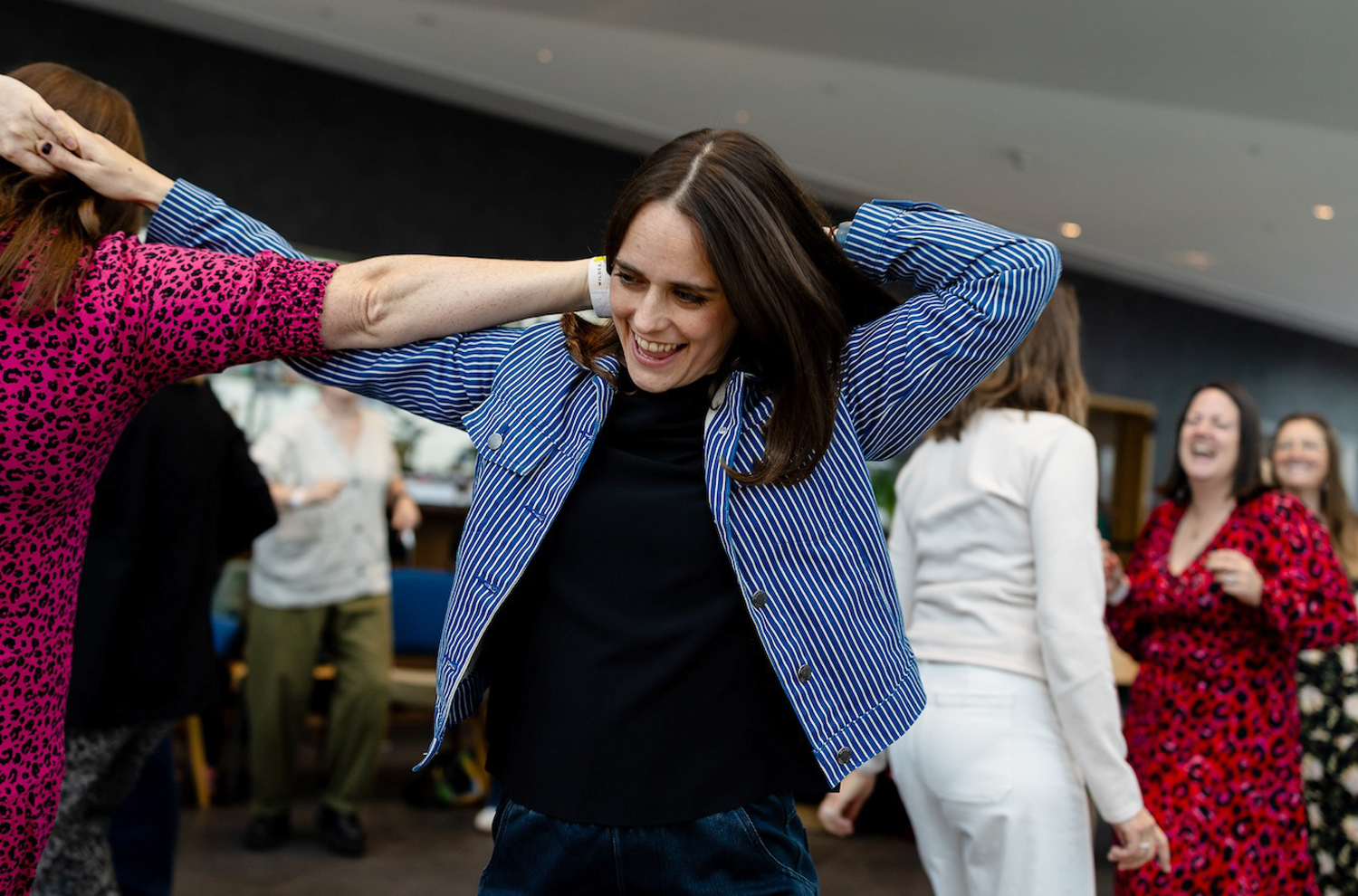
Emma Zangs is a choreographer, movement and communication coach whose work spans public speaking training, fashion show direction, dance workshops and entrepreneurship education. Born in France and trained at Trinity Laban in London, she now lives in Norwich with her husband and two young children, where she coaches entrepreneurs, lectures at Cass Business School and on UCL’s Entrepreneurship MSc and has trained founders to pitch successfully on Dragon’s Den.
In 2019, Emma delivered her TEDx talk “We Are All Dancers” as part of TEDxWomen, sharing her belief that dance has a unique power to repair and reshape our lives beyond the physical. More recently, motherhood inspired her to create ‘The Playtime Project‘, an exploration of how creativity can support parents of young children and make visible the lived realities of early parenthood.
In this episode, we explore Emma’s journey with dance and movement, the cultural perspectives that shape how we relate to our bodies and the profound connection between creative expression and mental health. It’s a conversation about resilience, playfulness, clowning, postnatal depression and the quiet but powerful act of keeping dancing.
Conversation Highlights:
- Emma’s own journey with dance and movement and how it has shaped her identity, her work and her sense of self
- How cultural attitudes towards dance and communication differ and what we lose when we disconnect from physical expression
- The role of dance and movement in building genuine connection and community beyond the studio or stage
- Navigating rejection and resilience while building a creative business and why persistence looks different in the arts
- How motherhood prompted a creative reckoning and led Emma to explore new forms of expression including clowning
- The unexpected way that clowning helped Emma move through postnatal depression and shift her relationship with societal expectations of motherhood
- Why play is not a luxury for parents but a genuine tool for wellbeing and family connection
- The story behind The Playtime Project and how it creates space for parents navigating the emotional complexity of early parenthood
- The mind body connection and why making time for movement can be a powerful trigger for mental and emotional uplift
- The advice Emma would give her younger self and what it reveals about creative courage and self-belief
Listen If You’re:
- Feeling disconnected from your body or your creativity after becoming a mother
- Curious about how movement and physical expression can support your mental health and confidence
- Building a business in the creative industries and looking for honest perspectives on resilience and rejection
- A parent searching for more playfulness and presence in your everyday life
- Navigating postnatal depression or the emotional weight of early parenthood
- Interested in the intersection of art, entrepreneurship and personal growth
- Someone who used to dance freely and wonders where that version of yourself went
Favourite Quote for Mums in Business:
“Play saved me in early motherhood. It is the most important thing in life!” – Emma Zangs
About the Guest:
Emma Zangs is a choreographer, movement and communication coach based in Norwich. She works with entrepreneurs and organisations to help people move and communicate with greater confidence, and lectures on entrepreneurship programmes at Cass Business School and UCL. Her TEDx talk We Are All Dancers has reached audiences far beyond the stage, and her community project The Playtime Project supports parents of young children through creativity and shared experience. Emma is a mother of two and a passionate advocate for the transformative power of movement in everyday life.
You can connect with Emma via her website, Instagram or Linkedin.
About The Host:
I’m Victoria Phipps – a Mum of two, analogue family photographer, charity co-founder, marketing person and now podcaster! My career has wandered all over the place and is becoming a bit of a complex tapestry as I head into this middle phase of life, but I can honestly say I’ve loved every minute of it so far.
I was raised by a nurturing Mother and an entrepreneurial Father and have inherited traits from both, so the tension between ambition and motherhood is one I grapple with on a daily basis! I’m fascinated to hear the stories of other women on a similar path, who are striving to build thriving businesses whilst being present for their children. It’s a tough juggle, but I hope the conversations shared on this podcast help Mums in business feel less alone and inspired to keep going in pursuit of their dreams!
If You Enjoyed This Episode:
Please subscribe, rate and review the podcast – it helps other mums find us!
Share in your Instagram stories, tag @mummeansbusinesspodcast and let us know your biggest takeaway.
Share this episode with a fellow Mum in business who you feel would resonate with Emma’s story.
Episode Transcript:
Hello and welcome to the Mum Means Business podcast, where we shine a light on inspiring women who have one thing in common. When they’re not managing tantrums, homework, P.E. kits and play dates, they are busting their gut to create something from nothing, to turn their passion into a thriving business and build a better life for themselves and their families. We dig into what motivates devoted mothers to pursue entrepreneurship and how they integrate their work and family life.
I’m Victoria Phipps, your host, and if you’re an ambitious mum in need of some solidarity whilst navigating the messy middle of making your big dream a reality, then stick around. This is for you.
NOTE: This is the transcript from the original recording, rather than the edited episode so timings may vary.
Victoria (00:00)
My guest today, let’s start that again because I’m croaking.
My guest today is a choreographer and movement and communication coach. From public speaking training for presentations, pitches and talks, to movement direction and choreography for fashion shows, editorial and dance workshops. She inspires people to move and communicate with confidence. Since 2018, she’s facilitated dance workshops for refugees living in the UK to help them overcome trauma, regain self-confidence and rediscover a sense of belonging and community.
In 2019, she delivered her TEDx talk, We Are All Dancers, as part of TEDx Women. Her message is that dance unites us all and has a unique power to repair and reshape our lives beyond the physical. Emma Zangs was born in France, came to study an MA in choreography at Trinity Le Ban, and liked it so much that she decided to stick around.
Now living in Norwich with her husband and two young children, she coaches entrepreneurs, teaches within businesses, lectures at Cass Business School and on UCL’s entrepreneurship MSE, and has even trained founders to successfully pitch on Dragon’s Den. Becoming a mother also prompted Emma to begin the Playtime project, exploring how creativity can support parents of young children and make visible the lived realities of early parenthood.
I’m so interested to hear more about all of this, but I’m mindful that it’s not my story to tell. So Emma, it’s about time I hand over to you. Welcome to the Mummy’s Business Podcast.
Emma Zangs (01:41)
Thank you for having me, Victoria.
Victoria (01:44)
It’s such a pleasure. There’s a lot to dig into. Writing your bio, I was just kind of beaming at all the things that you’ve been up to since you became an adult, really. So let’s start earlier on in your story. Talk to me about your journey with dance and movement in general, and what led you to take a more kind of freelance
Emma Zangs (01:56)
You
Victoria (02:13)
entrepreneurial route with that. What did that look like for you?
Emma Zangs (02:18)
Okay, so I started dancing well we all start dancing at 16 weeks in the womb of our mothers so we are all dancers that’s let’s just put it that way but I saw the Olympics in Barcelona in 1992 I believe so I was coming up to be four years old and the story is that I kept redoing all the moves on the lawn and my mum
Victoria (02:29)
Yeah.
Emma Zangs (02:45)
is a dancer and my dad as well and my mum was like okay I’m gonna put her to ballet because she didn’t really want me to do gymnastics she said it was quite a harsh world ⁓ but she put me to ballet and literally I was dancing all day I was teaching my brothers all the ballet moves and I actually remember making a promise to myself when I was ⁓
around like 14, 15 when you you start thinking about career and everyone’s saying oh I want to be a doctor I want to be this and I just remember being in my bed and be like you will never stop dancing because it’s what makes me so happy like literally there’s nothing else that makes me happier that moving and dancing especially if I do it with others and my loved ones and
I just live by that. I’m like this little girl that loved dancing. I like I’m gonna listen to that and I’m just gonna keep doing it even though it’s really difficult for ⁓ girls. I didn’t have a ballet body like in the 80s you know it was very important to have the perfect figure. My teacher luckily was not into that like she really pushed me because she saw how ambitious or like how much I loved it and passionate. The passion was so much there.
Victoria (04:02)
Hmm.
Emma Zangs (04:05)
But my journey with it is that I failed at all the competitions I did, I failed at all the conservatoires in France, you know, around 14, 15, 16, you go, or even from like eight years old, can go into dance schools, professional dance schools, and I failed at all the auditions. Like literally, I went around France, did all the auditions I could, my parents was very supportive, and I didn’t get any…
any of them. I always got to the last stage, so I wasn’t like terrible. I always got to the last, you know, 10 or 15 students and then they would take five or they would take 10 and I was always 12 or competitions, you know, they were, I was always number four, you know, I was never on the podium. So it’s kind of like the story of my life, which in hindsight really gave me, I was like, I just kept going. I was like,
Victoria (04:55)
Yeah.
Emma Zangs (05:03)
It doesn’t matter. always, I learned so much from doing all these competitions and these auditions. and then I, so I studied art history in Paris. I was determined to go to Paris because all the teachers I wanted to learn from were there. Even though I was meant to go to another city, I was like, I’m going to Paris to study. I don’t care. So I studied art history because I loved art and I it would give me the knowledge.
Victoria (05:20)
Hehehehe
Emma Zangs (05:32)
that would go with dance and it was brilliant like I absolutely loved studying in Paris and so I would go to dance classes when I could nearly every day and then go to my lectures and then do babysitting to earn money on the side and or be a waitress in a restaurant so it was like really full on life but I was I think when it’s about dance I’ve got endless energy because it’s my passion.
and even though it was really really difficult and but I never lost hope I was like there is a way even if it’s not through a professional dance company even if it’s not through a conservatoire there is a way to keep dancing and then I got into the MA choreography at Laban I was very interested in making dance films because of the art history I took I took film studies and through film studies we could make films even though it was not like a big
part of the course, so I was like, I’m gonna make dance films. And I was very interested in making dance films and choreographing for films. Not so much the stage at that time, but yeah. And then through the choreography course, I had to choreograph for the stage. I didn’t have to, but it was, you know, I like, I’m here. I may as well just like use the most of it.
And then through my studies, then separately, I met my future husband and then I stayed on. also met a business partner with whom I created a business after the MA and I stayed in London and I’m still here. I’m not in London anymore, but I do work a lot in London, like the arts. When you’re an artist, it’s hard to make a living outside of London, especially in performing arts worlds.
But yeah, that’s my journey. then the other choreographer I worked with at the time, we really helped each other. And it was a time where the budget cuts happened in the UK. So companies were closing down, companies that were really established in dance were closing down. was 2010, 11. And I was like, so you’re not going out on the street to protest? I was like, so funny.
Victoria (07:51)
Mm-hmm.
This is so
French of you, yeah.
Emma Zangs (07:59)
I was so surprised, I was like,
so we need to go out and like, like block the roads, right? And they were like, yeah, I was like, you’re not doing anything. Like what’s happening? Cause my, my three years as a, a BA in Paris, basically six months of the year, you protest and you, you, you know, you, you debate about what your rights are and what policies can change and all of that, which is so helpful as a student to go through that and to really
Victoria (08:04)
made a banner.
Yeah.
Emma Zangs (08:28)
have arguments to communicate your arguments and be like why change is needed and why this policy is actually not going to work and so it was yeah it was really formatting me and and helping me to you know stand up in front of thousands of students to say your thoughts and ⁓ and I yeah I really loved that side of of university but yeah UK was
so different and we were in Greenwich and we were quite far away from maybe the central London where maybe some protests were happening and people were like no it’s too dangerous you don’t go I’m like well yeah
Victoria (09:06)
Maybe.
It’s so interesting. Emma,
had never really considered this, but actually in your story, this is a key kind of point because you are in the UK, you have brought all your French fire with you and you’re ready to fight for what you believe in. And all of us are like, ⁓ well, I’ve got something on that day and it sounds, I mean, it might rain. ⁓
And, you know, is that really the best way to go about it? And we all just shrink away and complain and bitch in our living rooms or around the dinner table, but don’t actually take very much action. And that is very much a part of British culture, but it is about communication and actually our inability to effectively communicate our wants and needs, even even with our own government sometimes. You know, people talk about
You know, I think we are to a certain extent, and I can say it because I’m very English, you know, we are a nation of winchbacks. We complain a lot, but to each other.
Emma Zangs (10:16)
Not as much
as the French, don’t worry.
Victoria (10:19)
But we’re not, but we will do it to each other. We will all, so many conversations, oh, this country’s going to hell in a handcart, but no one does anything. You’re so right, that actually, you know.
Emma Zangs (10:30)
I know, I don’t know.
think there is in your country, and I’m not an expert, so I don’t really know, but from talking to other people, is a huge, maybe more up in the north, there is a huge history of protests and especially from more like working class backgrounds. ⁓ But yeah, it’s true that from, even from school in France, the…
the tradition of debating is encouraged. when ⁓ I remember I was maybe 13 and we had to, we were talking about Europe and who was allowed into the European Union. It was a time where they were opening up to other countries. And ⁓ I remember like we had to choose
where we stood and the question was do you feel more French or do you feel more European? And for me it’s like I don’t feel French like I feel more European, but I was like I’m not even feeling European I feel like of the world so I was very much like that side of things and other people are no I’m French and like I’m really proud of France I was like yeah, I’m proud of France as well, but also like There are some problems in our countries and like any countries and I’m a human being like anyone else on this planet
Victoria (11:41)
Yeah, yeah,
Emma Zangs (11:56)
So and I think that’s what dance also teaches us because it’s a it’s a form of communication It’s a form of expression, but it doesn’t have language So therefore you can dance with anyone literally you can rock up to any countries any clubs any weddings around the world or even funerals in some in some cases and you can dance with people and you can connect that way and that is for me I found this
absolutely amazing. I found that our bodies connecting to other people’s bodies in that way and we might disagree politically, we might not have the same language, we might have nothing in common in our lives but we have that commonality that we can move together.
Victoria (12:50)
Yeah, yeah, I love that. And I do think again, I I sound like I’m like slagging off my nation. It’s not what I mean to do at all, dancing to English people feels awkward. We don’t have a kind of national dance. And I say this because I really distinctly remember I went to Cuba in I think 2012, 2013, and I was so moved. I mean, by the experience as a whole, but particularly,
by their connection to dance and that the music comes on and everybody knows how to do it and everybody grabs a stranger or a friend or anyone and they dance together and they connect with each other. And you’re so right, it elevates them almost to a higher plane where all of the kind of, and it’s not nonsense, but all of the kind of disagreements that they may have if they were to have a discussion.
actually they dissipate and really it just becomes about just that it becomes about being human regardless of their background, their experiences, their nationality they just can get hold of each other literally and they’re on the dance floor and they’re having so much fun and I remember at the time thinking I feel like we are really missing a trick at home and we’re missing that opportunity.
to connect with each other because for me it was, you know, school discos and you’re kind of side stepping awkwardly and all the boys around the outside of the room sitting in chairs and all the girls are in the middle. And that goes on even when you’re kind of, you know, you’re in clubs, you know, the girls, when I was younger, we’re all dancing in a circle around our handbags and the boys are kind of like circulating. I’m just, it’s so awkward. It’s so awkward.
And I think a lot of us feel disconnected from dance if we haven’t had that formal training. And now we sit on our sofas and we watch Strictly every weekend and we just get such a kick out of it. And we’ve started doing this in our house and my daughter’s obsessed with the dresses and she just, she will sit there for hours and watches, she asks for it. She loves the theater, she loves all of it. The little one, not so much, but she tolerates it. Yeah, there is hope. Yeah, she’s so inspired by it.
Emma Zangs (15:10)
But there is hope, so yeah. There is hope and I think
Strictly has been doing a great job. And also when you’re watching dance, the amazing thing that happens in your body that your neural pathways are working the same way as the person you’re watching it move. So you’re not dancing per se, but you’re actually mirroring within your neural pathway what’s happening in front of your eyes. So you’re kind of dancing with them. Also I think it…
Victoria (15:35)
interesting.
Emma Zangs (15:39)
help people to go to dance classes obviously strictly is is ⁓ a quite I don’t want to say narrow but it’s a side of what dance is and it’s not all of what dance is and dance styles and and the way you can move ⁓ but there is also a resurgence of folk dances in the UK so Maurice dances and this is becoming very trendy to be a Maurice dancer which I
Victoria (15:51)
Yeah, yeah.
Emma Zangs (16:09)
I absolutely love, like I love Maurice Dancers and I always did even though I didn’t have that culture. We don’t have that in France. ⁓ And so I think there’s like loads of young people going to folk dances, which is great. And I think since the pandemic, TikTok, know, boomed of dance videos. I, maybe our generations from the…
Victoria (16:32)
Yeah. Yeah.
Emma Zangs (16:39)
late 80s, early 90s, we were very much like driven to to have a career and go for jobs and maybe be more in our brain than in our bodies but I think now there is a lot more a lot more avenues for people who have a 9 to 5 job to then also dance or exercise it doesn’t have to be dancing it’s just using your body and walks, climbing
I don’t know, it doesn’t really matter what it is, but it’s moving. It’s basically movement. Yeah. Yeah.
Victoria (17:10)
Yeah. Moving, basically, moving. Yeah. Yeah.
No, it’s really interesting. And I’m speaking to you at a point in my life where post-children, I feel quite disconnected from my body. And I think, because we met at Wild Alive and you ran a workshop where you actually managed to get 30, 40 millennial women dancing sober in the middle of the day.
and I take my hat off to you and all of us were sort of looking around in complete terror when you announced what you were going to have us do. But actually it’s just fun and we all got into it. Like it’s just fun but there is something generationally I think where we weren’t perhaps given the best start with dance and I love that you feel like that is perhaps shifting. And I love you say that we start dancing in the womb. Like I love seeing.
my children dance because it’s so innate, isn’t it? Like they just, yeah, it’s just a form of self-expression that’s absolutely essential to them. And they just do it without prompting. They do it because they know it’s fun and that’s it. And there’s something really simple and beautiful about it. And it kind of makes me sad to think back that I would have been like that. And then actually at some point I would become so self-aware that I stopped dancing. And I suppose as parents,
That’s the kind of challenge, isn’t it? Like, how do you keep your child feeling confident enough and using your body? Actually, there’s so much that’s wrapped up in confidence. People feel not confident enough to exercise or go to the gym and they do kind of have this disconnection with their body at times.
Emma Zangs (18:58)
It’s yeah.
and I always, so getting inspired through your children. Yes, totally. having disco parties in your, in your house. Great. Have a disco ball in every room. It’s like building a disco ball. You cannot not move if there’s a disco ball. ⁓ and you can get them like, it’s, it’s, it’s not that costly. We have disco bath in our, in our household. but it’s also like, I’m quite conscious of my kids.
Victoria (19:14)
Hehehehehe
Emma Zangs (19:28)
are the same age as yours I believe. So I’m a dancer so I will keep dancing and hopefully they will see that I keep moving and I perform shows and they know that’s my job. maybe their starting life is a different outlook on dance because they see me do this in the world in front of other people.
but they are boys and I’m ready for them to come back and be like, no, I don’t dance, mommy. This is awkward. how am gonna, know, what am I gonna do with this? And it’s like, yeah, it’s awkward, but you’re in the house and you know, no one is, yeah, people’s watching them dance. It can become a bit of a self-conscious awkward thing, but we’ll see. But my brothers, I’ve got three brothers and two of them are professional dancers.
And I think it’s, I don’t want to say it’s all because of me, but they saw me dance and they saw me come back home with all my dancing. They’re like, we want to do this. So I think it’s also, if you’re the person that have so much fun dancing, it’s contagious. Like literally it’s, you know, it’s the same with you. If you pick up a camera and you love taking photos, your kids will see that and they’ll be like, I want to feel that.
Victoria (20:43)
Yeah.
Emma Zangs (20:53)
It doesn’t matter the medium, it’s all about how much you’re having fun with what you’re doing and then people, your kids will be like, I want that feeling. And so hopefully we’ll see. We can do a podcast in 10 years and we can discuss that. I also wanted to mention that, ⁓ well, my train officer is gone now. There was something else I wanted to say.
Victoria (20:55)
Mm.
No, yeah, let’s check in. Let’s check in, definitely. Well, come on.
it’s all right.
Okay, well, don’t worry, we’ll come back because I do want to come back onto and talk about your playtime project because I think this kind of what we’re talking about now kind of leans into it. But just to go a little bit further back first, so we maintain some sort of chronological order for my brain to comprehend. You had an experience in dance where you had to become quite resilient.
in the face of rejection. And it’s not rejection outright. Like you say, it sounds like you just missed the mark by narrow, you know, a narrow thread every single time. And so how did, you know, you say you started a business after you finished your studies with another choreographer. How did that, what did that look like for you to reframe that path with dance that you weren’t necessarily going to be a traditional
dancer in an organisation that you were going to have to forge something for yourself that looked a bit different to that. What was that thought process like and where did it take you?
Emma Zangs (22:29)
So during the MA, because it was 12 months, I was very keen to make the most out of the resources we had during that MA. And so I don’t know really how it happened, but we had the opportunity to do a music video for a band. Because it was an MA, it was Trinity Lab and I think our MA leader got some opportunities or people asking.
would a student be interested in this project and that project? And so with another choreographer from my course, and we got along really well, ⁓ we said, yeah, let’s choreograph this. And I don’t even know if, I don’t think we were paid, but ⁓ we asked other students from the MA to do that. And we loved it so much to do choreography for music videos. We’re like, okay, after the MA, we can package things, we can.
we can go out and talk to different agencies and say that’s what we do. And on the side as well, we were making work for the stage together. And so we had some sort of like artistic duo. It was quite a funny slapstick cabaret. It was not really cabaret, but slash like contemporary dance. So was like mixing loads of things we were doing.
mock tutorials online because it was the boom of YouTube and everyone was doing tutorials about everything and we’re like we’re gonna do tutorials about dance but they’re completely fake like we’re actually not teaching you anything but they were quite taking the piss out of our industry and especially contemporary dance is so obscure, it’s so opaque like you don’t you go to see a show half the audience understand what the show is about and there’s like it’s really it’s quite it’s quite far removed from
Victoria (24:01)
Hahaha!
Yeah.
Emma Zangs (24:19)
from society sometimes, so we really made fun of that. So we had our little duo and then we performed in different festivals, different platforms. We had a show that we toured and then we had this more commercial services, choreographic services to do music videos, film, to help photographers direct better as well because we sought all the magazines, we were looking at the models or…
how people were shooting and were like, my goodness, they’re not directing the body. Like they’re just directing how it looks and like the fashion, was all very like perfectly, the makeup, the clothes were perfect, but the model had like no, we felt that it was all empty. It was just like they were just doing poses, but they didn’t even know why they were doing these poses and were like, no, we need to bring the body back into the images. So we did that. It was really difficult. ⁓
Victoria (24:53)
Mm.
Yeah.
Emma Zangs (25:17)
you know, I’m not from the UK, she’s from Argentina, so we literally, I’m gonna give you this hack, I don’t know if I would do this today, but we basically emailed the week before being like, we’re gonna come to your office next week, we’re in London, like, people thought we were not even living in London. We can come to your office next week and say hi and show you what we do, and they would not reply because they were like, who are these? Like, they were not even seeing our emails.
So on the day before we’d send another email and be like, we’re gonna come tomorrow at 10 a.m. or 11 or whatever. We were giving different times to everyone. And we had like a map of all these agencies in London and we bought loads of croissant. We would go to the agency and be like, hi, we’d like to meet so and so because we had their names. And they were like, they were like, do you have a meeting with them? And we’re like.
Victoria (26:09)
Would you like a croissant?
Emma Zangs (26:13)
Well, we got in touch and we said we’re coming, ⁓ but we had no reply from them. And they were like, let me see. So they would like call the person and they were in meetings. They were not even in the office. you know, it was just ridiculous. And we’re like, okay, could you give them that? And then we had our card and we had like, know, cross on minute. And we got our first music video gig like that. It was very Gary.
Victoria (26:27)
You
That’s awesome. That’s so good.
Emma Zangs (26:42)
It was very, very like we were like knocking outdoors. ⁓ So I don’t know, like now maybe security guards will be like and the receptionist were like, what are these two women like, what’s going on?
Victoria (26:54)
I know, but it’s
personality though, Emma. Like it’s memorable. You did give them warning. I mean, you didn’t ask to come. You said, we are going to come. And you know, that is confident. And they will receive this croissant on their desk after whatever meeting they’ve been in and be like, what the hell? And they’ll be like, I don’t remember. And then they’ll look through their emails and they will find you. And I think if I had a croissant on my desk, I love croissants. I’m just gonna put that on my desk. I’d be like, who is this gifter?
Emma Zangs (27:03)
Yes.
Yeah, I know.
Victoria (27:23)
Who is it? It’s just quirky and nobody does this stuff. Nobody does this stuff so I can see.
Emma Zangs (27:26)
Yeah, it was quite quirky. It was very quirky, but was, yeah.
And then one director, he was like, I love this attitude. Like he was like, I remember when I was young and starting music videos and like doing similar things. And it was very like pre-digital. It’s like very analog way of doing things. And people, I think people connect to that. So anyway, it was nerve wracking. We were like, literally it was not.
Victoria (27:43)
Yeah, yeah,
Emma Zangs (27:52)
Like we didn’t have a great time doing it, but we were like, let’s just do it. Let’s do it. and that was for a tool, but it was really hard. Yes, we were together. Yes. Being, being with another person really helps. Cause when you’re by yourself is, it’s like the anxiety is even higher. Yeah. And the rejection, like we got rejected. We got rejected all the time. Like, but so, so that started and that.
Victoria (27:58)
and also to do it together.
That would be painful to do by yourself. Yeah, it wouldn’t even be funny. Yeah.
Emma Zangs (28:20)
And at the time we, ⁓ so my business partner, name is Maria Amarquez, and she got onto a course at Google and it was for mothers going back to work or starting a business. It was mainly tech business. So we were, and because she was a mother, I wasn’t, could take the course. And then the leader of the program said, ⁓ do you want to come and do a talk about?
your work as choreographers. So we went and we did a talk and there was a accelerator in the room, VC firm, sorry. And they had a program to help tech startups. And they were like, we loved your talk. Could you come in and coach our entrepreneurs? They are series A entrepreneurs. We’re like, great. Don’t know what series A is. Don’t know what VC firm does, but we’ll come. We’ll come and we’ll do something. And he was.
Victoria (29:07)
But yes, we will, yes.
Emma Zangs (29:14)
Actually brilliant. we had a client, actually we had started coaching at Google campus because they could give you free space as long as you would give something back to the community. they had the fastest internet at the time. was 2012, yeah, 2012, 13. So all the tech developers were deploying their apps and their websites and tech there because it was really fast internet. And upstairs they had…
spaces to bring workshops. So we did lunchtime half an hour workshops and we brought our knowledge of movement and dance and how to be in front of an audience and how to connect with another person when you’re communicating and especially pitching. And we had people come and be like, I’ve got an interview this afternoon. So I’m coming till I get some tips. And then the person would call us back like three hours later and be like, I got offered a job on the spot. Thank you so much. You gave you boosted me. And it was like, it was immediate.
Victoria (30:11)
⁓
Emma Zangs (30:13)
responses whereas in dance when you do a show like you don’t even know what people think like it’s really hard to know if an audience like what they got and maybe yeah it stays with them but it’s harder and we love that we were very young and we were like we love that feedback and so that led us to start a business and and run that business which was really exciting I love doing things I’m a bit like you know it’s like a bit unstoppable I can’t sit for very long
But then in 2017 I had to step out because I’d forgotten dancing a little bit.
Victoria (30:51)
That’s interesting, yeah.
Emma Zangs (30:53)
you know, driving a business, it’s full on, it’s nonstop, it’s, you know, no sleeping, just trying to grind your way through. and I was losing touch with my artistic practice and that was non-negotiable. Like that little girl in her bed, being like, you’re never gonna stop moving. And I was like, okay, that’s not going to happen. I moved out of London. one thing I didn’t mention, when I got
Victoria (31:12)
Yeah.
Emma Zangs (31:20)
When I was 22, I got diagnosed with type one diabetes. And that was a big shock because I had to really look after my health and health became priority. And then suddenly, you know, making money, doing a business is not as high in the priority list. And especially when health is that important. I knew I couldn’t live in, London. It’s too far space for me. The energy is always on and I need a much more grounded.
much more slower pace and I needed to move and dance and I felt like the city was not quite giving that to me or I was not finding the space within it. And so we moved out in the countryside in Suffolk and it was quite idyllic for a year and I had a bit of a journey with dance there because I would book studios and literally do nothing. ⁓
I had some… I really had some quite difficult times I would get very dizzy I was like I’m not a choreographer anymore like I really was close to stopping it and be like you know what maybe I’m not made for this and because I was in the countryside I started dancing outside and in nature and that completely changed everything because suddenly you’re not in a white space by yourself having to…
get ideas out and having to like produce ⁓ movement, nature was giving me the moves. Because I could hear a bird and be like, okay, what does that, what that sounds does in movement? What if I follow that sound? What if I become that tree? So it was very nourishing me literally. And the link between nature and creativity is so key.
Victoria (32:52)
or perform, yeah.
Emma Zangs (33:16)
is a thing for many many art forms. Nature is a huge source of inspiration and that truly it reignited me to to dance and and it truly fed me even to this day. Like nature is so linked to my creative practice.
Victoria (33:36)
That’s really interesting because you’re so, I resonate with what you say about falling into the grind of business building. And it’s the practical impact on what your days look like because yes, you’re kind of carrying around this big ambition and this determination, but you’re probably spending a lot of time indoors. You’re spending a lot of time looking at your computer. Your posture just falls apart. ⁓
And you’re not, some days, even now some days, I feel like I spend less than an hour outside. And it’s really cumulatively depressing. And I don’t mean it as in you have a depression. I just mean that it kind of just holds you down a little bit, whereas actually just being outside in nature, looking at all the fractals.
getting the vitamin D, breathing fresh air, and detaching from that world of demand. Because actually going onto the internet, you are in demand as a business person. You have to create and you have to perform and you have to come up with something to say. And to just be and just look at the sky or the trees or the clouds and not do is a gift to give to yourself. And if you deny it to yourself for a prolonged period of time.
Emma Zangs (34:58)
Mm.
Victoria (35:05)
you you get to this, I suppose that’s the situation that you found yourself in where you’re in London and also you have this health news, which changes everything. And you have to reevaluate what you’re doing with your days. And it sounds like you really needed that.
Emma Zangs (35:21)
Absolutely and it was also we moved out and then two years later the pandemic happened and I could go to the forest every day and it was just such an amazing gift and I know how difficult the pandemic was for so many people but I live next to some woods and it was my daily hour out and it was nourishing me so much I did so much writing I did some choreographic videos I did some dance videos
Victoria (35:30)
Mm, yeah.
Emma Zangs (35:51)
And it was truly helping me to be creative and you you were talking about depression. think there is, for me, if I’m not in creation, I’m depressed. If I don’t have, and if I’m not nourished as an artist, then I go into depression. And going back, going a bit further into having children, especially tiny children, it’s very difficult to find time for yourself.
because everything is all your energy, even your body doesn’t belong to you, so everything is out of yourself. And for me, having a second child and two children very close to one another meant that I had less and less time for my creativity. Even though, yes, you probably can find creativity with motherhood and with having babies, but for me it was quite a shock. I don’t think we’re prepared as mothers to look after ourselves within that period.
And so finding that creativity through having two tiny ones was truly, I truly survived through this, especially the first two years. And I went to the woods less, but a friend of mine who’s got a practice in the woods, was like, let’s go to the woods together, let’s bring the babies. I remember.
She was so good, it was like dark winter, it was 5pm and we had like head torches and the children loved it. I mean the baby, I don’t know, he was literally two months old. But my, was like, it’s a bit dark for a two year old, for an 18 months old. But she was like, don’t worry, I’ll dance with him, you can dance and you can do your thing. And I was like, I’m so grateful for her to have done that. And we came home and we didn’t realise, but my little one had dog poo everywhere.
Victoria (37:38)
⁓ Yeah.
you
Emma Zangs (37:48)
And it was like, okay, that’s why we don’t go to the woods at night, because you actually can’t see anything. ⁓ But it was such a huge moment, because it was like, need to have these moments when you are going through, yeah, to be alone all day. And ⁓ that’s what I really want to tell people is like through movement and through…
Victoria (37:50)
Hahaha!
Emma Zangs (38:14)
dancing or you can be back into your body even though it’s really difficult when you have little ones.
Victoria (38:23)
I think what a good friend that you had to do that for you and to insist that you go to the woods in the dark because she knew that you needed it. But this is the thing, I’ve had so many conversations, even though this is a very young podcast with women who have really struggled in the way you describe with a desperate need for some sort of creative outlet during.
Emma Zangs (38:32)
Yeah.
Victoria (38:49)
that first year after having a baby or two babies, because you are overwhelmed in demand. You are on call 24 seven. And it’s so hard because really we don’t have a choice and we want to take care of our babies. Of course we do. But in doing that, we abandon ourselves and there is a cost.
to that. And actually we’re willing to do it because it just is a necessity. You have to take care of your babies and you know rationally that they’re only going to be small for such a short time. And part of you is thinking, I just need to make the most of it. I need to enjoy it. I need to soak it up. need to absorb it. But at the same time you’re like, but I’m not having a nice time because I’m exhausted and I, and I’ve lost touch with myself.
And in order to be a good mum, you have to be at peace with yourself and you have to have some energy and you can end up so easily just on autopilot, kind of grinding through the nappies and the winding and the changing and the feeding and the napping and everything day after day after day. And I found it really, really, really tough. So I completely understand. And although it’s…
Emma Zangs (40:14)
Mm-hmm.
Victoria (40:17)
As they start to get older, you can see that it was a short time. At the time, those days are really, really long, really long.
Emma Zangs (40:24)
so long and everyone does it their own way but I’m so grateful for childcare even though I couldn’t really afford it at the time I my partner and I were like my well-being is more important like if I can’t be a mother I need time for myself like I need childcare so I can have time and then I can come back as a mom and be replenished and have energy and
my parents, don’t have a, we don’t have a support system around so we can’t put them at grandparents and we didn’t have that. And I didn’t really want to put my tiny babies to nursery. So the first year I was like, okay, for a year this day was me. So around 10 months they started going to nursery. But it was very much for me to be like, okay, how can I be back into myself? How can I ⁓ do something creative? And then slowly doing it with them as well.
Um, and at the time I had, um, when I had my second one and that’s going to lead to playtime. Cause you asked me about playtime. I’m going to get into that very soon. So I had a D Y C P, which is a, a grant from the arts council called developing your own creative practice. And it’s a way to expand into skills that you don’t have as an artist. So I always wanted to, um, do miming. And at that time I was part of a leadership course and another.
Victoria (41:31)
Yeah, yeah.
Emma Zangs (41:52)
another freelance artist was on that leadership course and she was a clown doctor. I mean, she still is. And I was like, what is a clown doctor? This is the best job ever. I was like, my mind blew literally when she said that. And basically she goes to hospital as a clown, especially children’s wards. And she just brings joy to children who are at hospital going through treatment. And I was blown away.
Victoria (42:01)
I want to know.
Emma Zangs (42:22)
I was like, I want to do this. I want to know what… Yeah, absolutely incredible. So then she started doing some workshops. I went to her workshops and she said, you have to train with this and this person and this person. And through my grant, I could start training as a clown. And it was so helpful as a mother. The first rule of a clown is that you cannot say no. So whatever happened in your environment,
Victoria (42:25)
Amazing, yes!
Emma Zangs (42:51)
If something happens, if a door bangs, if there is a sound, if a child comes or an adult say something, you have to say yes to it and bring it in and use it for your clown. And I just came home and I was like, I’m not going to say no to my children anymore because they were so small. It was not saying no, like no, don’t cross the road running. Like, of course I’m going to keep them safe. But it was more around
Victoria (43:14)
Yeah.
Emma Zangs (43:19)
me saying no all the time and being negative all the time and thinking that I had to survive the day and suddenly I switched and I was like what are they gonna bring to me because I have to say yes to this like what are they gonna bring to my day if it’s dancing it’s dancing I was like you don’t want to put your clothes on well stay in your pajamas go out in your pajamas it’s like literally I dropped a lot of the perfectionist mother that I had that I had and
Victoria (43:39)
Yeah.
Emma Zangs (43:48)
Suddenly I was playing with my kids and I realized I wasn’t playing with them.
Victoria (43:54)
Yeah, that’s quite… Go on.
Emma Zangs (43:55)
and that’s true. Yeah.
Yeah. Yeah, it is. It is so… Yeah, it is such a shift in mothering and I’m not saying it needs to happen at every level, but to connect with your child in their play because they’re so good at playing. But we’re not. We have the clock, we have the mental list of all the things we need to achieve in the day and actually, who cares?
Literally, who cares if you’re late to things? Who cares if they don’t have shoes? Who cares if it’s like… I just dropped the expectation on myself. So much. And suddenly I could be with them and they were, literally, they became my artistic collaborators. I would bring them into the studio and I would be like…
Victoria (44:48)
That’s awesome.
Emma Zangs (44:53)
mommy’s tired, I would just lie down but then we would dance a lot, we would move they would have so many ideas they yeah they they are my artistic collaborators and then through that I started I wanted to make a solo about about that that about being a mother and big playtime started so playtime why is it called playtime is because
I just want to remind myself to play. It’s literally for me not to lose sight that play is the most important thing in life. And I really weigh my words. When I’ll be on my deathbed, I don’t want to think, I should have played more. I should have, you know, take life a bit more playfully, a bit more lightly. Motherhood can be so dark. It can be so terrifying. I had so many sorts of like
being scared of losing a child, my second child couldn’t breathe when they were born, I got really scared of losing them. Then I saw myself not coping, I thought the medical sector is gonna see I’m not coping, they’re gonna take my children away, like your brain goes into that completely crazy thoughts that you’re in, you really need to do an amazing job, otherwise people are watching you.
It’s like literally we need to relax about this and we need to talk about what it feels like But actually bringing play which is so hard for us as adults But because I’m a mover because I’m an artist it was actually easier I think I got it easy because I got a mind that is Already there in a creativity ⁓ But also having the help of childcare so I could have my time by myself
Victoria (46:22)
Mmm.
Emma Zangs (46:49)
I could be replenishing, going to workshops, getting fed so I can then be okay with my children. But that was the idea for playtime and then I was like, I need to bring this. I need to bring playgroups that are for parents. I need to bring things where the parents are the focus, not the children. The children’s are fine. So my solo show is called The Kids Are Fine. Because how many times you get called
Victoria (46:56)
Yeah.
Mm. Mm.
Emma Zangs (47:18)
No disrespect for grandparents and family. But as you become a parent, someone calls you and they’re like, how are the kids? Like literally you are disappearing. You’re disappearing. and, you know, I love my dad, but when my second one was quite little, I got into a show, I was performing in a show. was an R and D show. did.
Victoria (47:27)
Kids are fine. Yeah, yeah, yeah.
Emma Zangs (47:44)
We did two weeks and there were some maybe plans to then go perform in And my dad was like, who’s gonna look after the kids?
We’re still there. And I was like, well, they’ve got a father. Breaking news. Breaking news. But it’s so interesting how we disappear and especially the mother, like seen as the person staying with the kids and it’s like, ⁓ and just like getting rid of it, like just check out and. ⁓ But yeah, we, I think as a society and as.
Victoria (47:58)
Yeah, yeah.
Yeah, exactly. He helped me make them. Yeah. Yeah.
Emma Zangs (48:25)
mothers also and parents we put all the attention onto our kids and as you said I think that doesn’t make us better parents because then we forget ourselves so it’s this playtime project it’s very much about like okay how do we resource how do we support parents and mothers and could the art be the village could creativity be a puzzle in that village and so the most
Maybe one of my proudest workshop creation that I’ve done is called Moving Words and it’s for mothers with children under five or preschoolers. And they come for two hours, they can come late, they can leave early, nobody cares. And it’s a space where they can write. So I do this with a poet. She’s also an actress, so she’s got a physical practice too.
and she got some prompts about what to write. They don’t have to write about motherhood, you know. It’s not because we’re mothers that, you know, we can do everything around motherhood. And then there’s a space to move. So they can move with their writing or I give them prompts on how to move and how to be in the space, how to be within their bodies, how to be with how to be with what’s going on. And if that is rage, that is fine. You can scream here.
And we need to scream and it’s okay. And I remember the first moving words I was like there was like maybe half the group so five were writing and five were in the movement area. I was like how do we feel like doing? And we were looking at ourselves at each other and we knew we just needed to scream. We just knew it and it made us laugh and then I just put rage against the machine.
Victoria (49:56)
Yeah.
Hehehehehe
Emma Zangs (50:24)
on I was like I think I think this is a good song um and and we just did head banging and the kids like I remember this eight nine months old baby on the floor loving it like literally loving seeing this her mom just throwing herself in and doing head banging because
Victoria (50:25)
Ha ha!
Yeah.
You
Emma Zangs (50:51)
I think that the babies, feel like this emotion needs to come out. They do. And we need these spaces and we need to have supported spaces to do that. And the writing is something that they each have a little notebook and they keep it and then they can keep doing it at home. the feedback, 100 % of the feedback was since the workshop, I kept doing something creative every day, even if it’s one minute. I don’t put kids music anymore. I put my music, just this tiny switch is…
Victoria (50:55)
Yeah. Yeah.
Emma Zangs (51:20)
so crucial and so important and then you bring your kids into your life instead of the opposite and it’s just…
Victoria (51:25)
Yeah. Yeah. think it, it,
well no, it sounds phenomenal. I’ve never heard of anything quite like it. And you know, when my experience of kind of classes that you could go to with your children was very baby-centric. It’s all baby, I mean, maybe there was a baby yoga where you do a bit of movement yourself, but generally it was, you know, bend the baby this way and bend the baby that way. And really then it’s…
for the mum to find their own connection afterwards and go for a coffee or whatever they want to do. But that still is quite polite. And actually there aren’t many environments for expression of that raw emotion that might be simmering, well is simmering, absolutely is simmering under the surface. And I think it’s so interesting because it kind of echoes your own
transformation with the way that you describe your experience of early motherhood in that in the first instance, you are kind of carrying forward a form of perfectionism that and it’s about what you saw, you know, in your whole life from your parents and every parent that you’ve known about how they are raising their children and you kind of emulate that and you hold yourself to a very specific standard and it’s important that the children have their shoes on.
Children can’t go outside without their shoes on. These things are very important. And actually, the children were draining you. And it wasn’t their fault. It was kind of just the method that you had learned of how to take care of them. It was all draining you. And your energy is kind of hitting rock bottom. And it’s only through this kind of having a little bit of space to do some…
self discovery and to do the clowning which just sounds I didn’t realise there were rules about clowning. My experience of a clown is like probably some local person that just turns up in a suit but that it’s an actual profession with rules and this thing about saying yes that actually you give more agency to your children and you’re able and again it’s communication you’d probably listen to them more because I’ve certainly been in a frame of mind where the kids bring something to me they want to do.
And I feel so overwhelmed and perhaps there’s a lot of noise at the time and I’m trying to get their dinner on and I’m literally like, sod off, we’re not doing that right now. I’m trying to make you food. Like I cannot do, I am a human, I cannot do all of these things at the same time. We will do that later. No. And that word no. And for them, these gorgeous, gorgeous, adorable little people that are just looking for a moment of connection, it’s completely crushing.
because they don’t understand your overwhelm and they don’t understand the fact that you haven’t done anything for yourself for maybe two years and it’s all just getting to a point where you’re drowning. But just that mindset shift that you kind of have your eyes opened. Like you said so eloquently, you what are they gonna bring me? And can I actually notice when they do it and pay attention and allow myself to just
Pause the dinner, just turn everything off and do that thing. And I imagine you felt that that was incredibly liberating, revolutionary.
Emma Zangs (54:58)
Yeah, absolutely.
yeah, absolutely. It had such a lift in me. And I think my, my postnatal depression that I was experiencing was slowly getting better because of that. And suddenly I was waking up and thinking, well, I’m being curious about my day suddenly instead of being like, my husband’s going to work. I’m going to have to go through this by myself. ⁓
Victoria (55:26)
Yeah.
Emma Zangs (55:27)
and dreading it and instead of it I was like okay well what’s gonna happen and the truth is is that as soon as you say yes oh you don’t want to put your shoes on oh yeah let’s not put our shoes on and then literally two seconds later they have their shoes on
Victoria (55:43)
put their shoes on, yeah.
Emma Zangs (55:45)
It’s like,
what just happened? The time, the time that I saw like struggling for me to put their shoes on would have taken me longer than if I just say yes. And then it just happens anyway. And things happen, but much more organically and much more. Maybe at their pace and yet definitely there’s time where you have to like push them in the right direction and like, you know, we live in a, in a world that is regimented by time, but.
letting time just happen it really has a huge effect on on on the environment and on what happens because of it and it’s yeah it’s listening as you said it’s listening and so i’m i’m really interested in in creating these spaces for parents and you were talking about clowning i’ve i was sitting on the sofa one day and ⁓ i had some
I always have some clown noses around the house just because I do workshops and you always get one and you know, have just clown noses around. And my kids did the game where I was lying down and they were just ⁓ putting the nose on me and then taking it away and hiding it. And they found it so funny. They were finding this so funny and that gave me the idea for a show. And I started thinking about that when I…
Victoria (56:49)
You
Emma Zangs (57:13)
say they’re my collaborators, they basically give me ideas. ⁓ And I started creating The Lost Nose, which is a clown who lost her nose and she’s looking for it. And the idea is to have a show where it’s quite interactive and the families are helping that clown find that nose. So that was two years ago and then I applied for an idea award and I got it and I had to make the show.
I was like, oh, I applied thinking I’m never gonna get it. And then the producer was like, this is an amazing idea. It’s so simple. It’s gonna do really well with our families. so, so yeah, fast forward two years, I’m making this clown show, first time clowning. And I feel literally a bit out of my depth because I don’t have the training of a clown that’s, you know, it’s like years and years of experience. I’ve done workshops and I…
Victoria (57:43)
Yeah.
Emma Zangs (58:12)
keep learning how to be a clown. But I’ve got that show and I’m like, yeah. And it’s as for parents as it is for children. I did a test recently, a friend of mine was like, I’ve got my child birthday party. Do you wanna do some clowning? I was like, okay. I’m not ready, but doesn’t matter. I’ll never be ready anyway. And I went and it was great. And two weeks later… ⁓
I saw a mom that was at that birthday party and she said, thank you so much. ⁓ since then I keep the clown nose in my coat just to remind myself to be light and funny and playful. And I was like, okay, okay, it’s fine. My job’s done now, but it’s, it’s that it’s like, give yourself the permission to play. If it’s through clowning, fine. If it’s through something else, fine. But it’s like, I really believe.
Victoria (58:48)
⁓ that’s so nice.
Emma Zangs (59:05)
that we are all artists, we’re all dancers, we all have an expression, a way to express ourselves. And if we tap into this, then it has ripple effects on others. And it’s, if I give myself the permission to be a clown, you know, you will give yourself permission to do whatever you need to do and don’t really care about what people think. I actually don’t care about what people think about clowning because I know it’s so important to me and it’s so…
ingrained in who I want to be, who I am. It helps me being a parent, it helps me being a better human and it helps me not get depressed. So I’m going to keep doing it. I don’t want to cost the NHS, you know, more money.
Victoria (59:50)
No, well, that’s very selfless of you. No,
I think it’s fascinating because I mean, clowning, know so little about it. But I think if there is any kind of disparage about clowning, it’s because most of us kind of grew up again, we can go back to the 80s and 90s with like really bad clown entertainers at birthday parties. That is the sole understanding and reference point that we have. So I am
100 % certain that what you’re doing is a league above this. And it might be that there are professional clowns who have decades of experience, but I love that you are starting before you feel ready because I feel like we have to. And we can hold ourselves back in so many ways in business especially, or any sort of entrepreneurial project that we have in our mind because we feel we’re not ready.
So yes, go and be a clown. Just own it. You call yourself a clown, you’re a clown, yeah. And it’s so fun. It’s so fun.
Emma Zangs (1:00:52)
Yeah, I’ll go ahead and be in.
I’m a clown. It is really fun.
It is a profession. Like it is the more I do it. It’s really difficult to, I think clowning is the state of performance that is probably the hardest because you have a script, you have some sort of ideas of what you’re going to be doing, but you also have to be open to the present moment so much. You surround yourself, you empty yourself of yourself in a way, and you’re just in connection with the other and what…
The figure of the clown is bringing maybe the side of yourself that you don’t want people to see. The clown is failing all the time. The clown is never quite adequate. They don’t really know what to do. They’re a bit lost. know, we all, all of us feel a bit lost, feel a bit awkward, feel a bit like we don’t belong and that clown is bringing that back to you.
And that catalysis is so important. it’s like, yes, parents, have no, you you said that in your podcasts and it’s like, we have no clue what we’re doing and the clown doesn’t either. So let’s just clown around as parents.
Victoria (1:02:00)
No, in that sense, he’s… Yeah,
yes, completely. But in that sense, the clown is so relatable and the clown makes everyone else in the room feel good about themselves and feel like they’re not alone. Then if they feel lost, we all feel lost at times, sometimes more than others, but we all understand the experience of feeling like we’re failing or like we should give up on something or all of that.
It’s inherently human, it’s a shared experience, but in that, you can laugh, you know, and we can all laugh with each other. And so all of those societal expectations and those, you know, all that perfectionism and everything, it just washes away, I presume, when you’re doing these performances. I know you have the first one coming up on Sunday. I’m very excited for you. I wish that I lived in Cambridge, yeah.
Emma Zangs (1:02:51)
Yeah. Thank you. Yes, if you’re in Cambridge, if you live in Cambridge,
come to the Cambridge Junction Theatre. It’s at 2 p.m. ⁓ And I’d love to see you there. And at the end of the show is 20, 30 minute long, so not very long. ⁓ And afterwards you can make your own nose. So there will be a nuts and cracks activity. You can carry around, you can take it.
Victoria (1:03:15)
my gosh. And then you can carry it around in your coat pocket and remember not to take life
so seriously. Yeah.
Emma Zangs (1:03:22)
Yeah, yes,
yes, we don’t have to take us, especially that is something also I’m quite interested in bringing in business. So I work with teams, I work in technology, I work, you know, with business schools and it is an area where we seriousness is a thing and it has to be there, but also let’s not lose perspective about what this is about and ⁓
And I’m quite interested in bringing, maybe not clowning, but sometimes I bring some exercises of clowning to teams and I just tell them at the end that that was from clowning and you you see people’s faces, but they get it because they experienced it and they’re like, okay. And it opens a door. And also I, I see myself as bringing the art into places that might not be, ⁓ might not have that space for creativity and the arts.
And I’m a true believer, like I feel like our society is all into self-development and you know, that’s probably why we’ve got like mom perfectionism, we’re in an era where we, it’s all about wellness. It’s all about self-development. And I truly believe like going to see a show can be as good as going to see a psychotherapist or doing a yoga class, like sitting in a dark space and watching someone or watching a cast.
giving a play or doing something artistic is so nourishing and I’m quite sad to see that people go less and less to the theatre. I know it’s expensive but I feel like people are putting more and more money into themselves but forget that actually the art and theatres are incredible spaces to also be nourished and think and have that time.
have that silence or have that quietness in your mind to just let thoughts happen and let, you know, be nourished by what you see.
Victoria (1:05:30)
Yeah, and I completely agree with you. think actually if we were to sort of come up with a bit of data on this, people are investing an awful lot of money inwardly through self-development and all the kind of the routine occupations we’re supposed to incorporate into our day to make ourselves inadvertent commas well. But actually escapism can be
so needed. And if we spend all of our time kind of analysing ourselves and analysing ourselves in isolation, it can be so tormenting and to just go because art at its core is whatever it is, whether it’s dance or theatre or painting or music or whatever, a museum, yeah, it is all about expressing a shared human experience.
Emma Zangs (1:06:11)
you
The museum. ⁓
Victoria (1:06:29)
engaging with it inherently, you know, every it’s subjective, you can take what you want from it, but you will almost always find something that you can relate to that again, makes you feel like you’re part of something bigger, rather than sitting in your own home and reading about how you can make yourself better all by yourself, or listening to a podcast that tells you 10 steps to make yourself better all by yourself, actually go out into the world, or go out in nature, you know, be
in earth with other people and that probably will have a greater impact on your sense of wellness that day than listening to that podcast episode or reading that book.
Emma Zangs (1:07:12)
Absolutely. ⁓ And I’m really grateful for all the institutions that are opening up or doing matinee or allowing children to come in because when do you go to a museum like you think, my kids are going to run around. I’m actually going to check that. It feels draining. It doesn’t feel nourishing. having exactly. it’s like, so now there’s like exhibitions where, you know, children
Victoria (1:07:32)
Yeah, you don’t have time to look at anything. They’re screaming.
Emma Zangs (1:07:41)
or museums now have these buckets and you can put like toys in there and you can choose what you want and then as a child you can go through the gallery and then play ⁓ or there are some exhibitions especially you know that allowing children to be there or shows. Theatre is still, I feel like where I live is still quite difficult but I think there’s a willingness from institutions to…
have more children around and I feel like if a society is not okay with children we actually not care with ourselves like there is this we cannot leave children aside ⁓ they are part of who we are they are part of they exist in the world and they are usually behind closed doors and I I really want to break that and having workshops and and shows that are
You know, my clown show, it’s about postnatal depression underneath. You know, it’s like not finding who you are. It’s like I try different noses and I don’t know who I am. So maybe a parent will be like, ⁓ that feels a bit like me. Like, even though that’s, you know, I’m not quite obvious about the message. It’s that. And yeah, it is for their children, but literally I’m doing it for the parents. ⁓
Victoria (1:08:41)
Yeah.
Yeah, but this is it.
can have a piece of performance like that that has all these different layers, you know, and it’s done commercially, you know, Bluey. All parents love Bluey because Bluey, there’s a lot in there for mum and dad, but it’s completely over my children’s head. They’re not understanding these little digs and references and the sort of bit of resentment here and there and the need for mum to have space and all of that. They’re just seeing what’s for them.
Emma Zangs (1:09:08)
Exactly.
Mm-mm.
Victoria (1:09:30)
And it’s the
same, you can create a performance that caters to the whole of your audience and each of them will take something away and they will all come out thinking it was brilliant for different reasons. And you’re right. And also it’s just showing children that this is important, you know, to sort of bring them up, that they are invited to this, that this is something that their parents value to go to the theatre, to go and see a show, to go to a gallery.
And if these places are stuffy and parents feel they’re not welcome, then we’re denying our children that kind of natural education, just that this is valuable stuff that they might find interesting. And it’s kind of not giving them the opportunity to be curious about it themselves as they grow up.
Emma Zangs (1:10:20)
Absolutely.
Victoria (1:10:22)
I have one more question for you Emma before I let you go. I think I know the answer to this but I’m going to ask you anyway because I have OCD and I can’t not. What would you say now? You say you were 14, 15 and you made this promise to yourself that you would never stop dancing. What would you say now to your eight-year-old self?
about dancing, about movement, is there anything else that you would say to her that you feel like would be helpful to her as she moves through adolescence and adulthood?
Emma Zangs (1:10:59)
Wow, it’s quite moving that question. ⁓
think ⁓ gosh this is I think I would say to her
⁓ It’s not going to be plain sailing, there’s going to be loads of failures, loads of step backs, like life will throw things. ⁓ But whatever comes.
she’s like she’s got all the resilience and all the energy needed to
to take in and deal with it and it will be surprising and I’m sure it will keep being surprising but it’s…
Yeah, there are ways and there’s always a way.
Victoria (1:12:10)
So nice, Emma. I love that. And actually it’s advice that we can heed now. You know, we’re all facing setbacks every day. And especially as mothers and business people, you know, that we have everything we need and that we can find a different way of getting to where we want to go. And perhaps it’s just about thinking outside the box sometimes. Thank you so much.
Emma Zangs (1:12:34)
Hmm.
Hmm.
Victoria (1:12:40)
for your time, Emma. I’ve loved this conversation and I have learned a lot. I feel like it’s so interesting having these conversations with moms who are doing things all in their own way, as we all are, but it does kind of make you reflect on your own behaviors. And I certainly just in the course of this conversation have been reflecting on how often I tell my children no. And I think, you know, it’s…
Emma Zangs (1:12:41)
Thank you.
Hmm.
Victoria (1:13:08)
I don’t, and I say that not thinking that I’m a bad parent, just thinking that I’m a normal run of the mill overwhelmed mum. And some days I don’t have bandwidth for anything else, but actually that it’s kind of a sign to perhaps try and reduce the amount of days that feel like that so that I do have the space to just be more open to surprises that my kids might bring me because you just.
you are kind of limiting, you’re limiting the fun in your own family by saying no all the time. And I’m definitely gonna test out this thing about putting your shoes on. I’m literally, next time I’m like, can you put your shoes on? They say no, I’m like, okay. And I’m just gonna go and get in the car and just see what they do. And I will, I will.
Emma Zangs (1:13:50)
Tell me.
Tell me how it goes. But it might happen even
in the house. It might happen in the house. Like, okay, let’s not put our shoes on. And then I remember like lying down next to them and they were like, why is mommy doing like… You will surprise them too as well. But it’s also seeing the world with wonder. Yeah. It’s also like keeping yourself so wondering. And you you said at the beginning of this podcast, you said since you became an adult and I was like, I think I just, I’m just a grownup child.
Victoria (1:14:00)
Yeah.
Yeah.
Yeah, but I want to.
Emma Zangs (1:14:24)
And it’s, it’s fine to be like, you know, when I was younger, I couldn’t wait to be an adult and I still can’t wait to have like white hair. don’t know why I have this. I want to be wise and old and, and don’t give a damn about anything. But, ⁓ but I think there’s this like wonder that.
Victoria (1:14:24)
Yeah. Yeah.
It will come, it will come.
Emma Zangs (1:14:48)
we sometimes lose when we have to-do lists and demands as you say it so well. But it’s that, I wonder what, okay, what have you done? Like, yeah, ⁓ that’s brilliant. And you’ll see, like you just say that and it’s like, mommy, I wanna do this. Like, okay, yeah, you can do it. And you just have that voice of like, yeah, it’s brilliant. And then just slowly go back to your kitchen and sometimes they just need acknowledgement and they actually.
And sometimes you will have time to play and sometimes you won’t, it’s, it’s, ⁓ yeah. And sometimes you just don’t want to play, but it’s okay. It’s okay too. It’s okay too. So, So, so yeah, it was really, and we didn’t really talk about business, which I really enjoy because, because it’s, it’s yeah. And I think that’s what I bring to the clients and the people I work with is that it’s that
Victoria (1:15:27)
Yeah, of course, yeah. Yeah, yeah, yeah.
I know.
Emma Zangs (1:15:47)
artistic outlook and creativity outlook onto your own body, onto the way you communicate and it’s so needed.
Victoria (1:15:58)
Yeah, and you’re bringing what it is and all the best elements of what it is to be human into a world where they have historically not been valued. And had you done it earlier, had you been trying to do this in the 80s and 90s, there perhaps would not have been appetite for it. The world is changing. Still making progress there.
Emma Zangs (1:16:20)
Well, still making ⁓ women dance,
you know, I know we’re meant to, but still making women dance at that conference. I wanted to do this 10 years ago. It took me 10 years to actually do it and be like, I’m doing this. Like enough, enough is enough. But 10 years ago, maybe it was the crowd I was with, you know, you can feel the room. And I was like, this room, totally ready for this.
Victoria (1:16:38)
Yeah. Yeah.
Yeah.
Emma Zangs (1:16:49)
Like you didn’t know you were ready for it, but you were so ready for this.
Victoria (1:16:49)
Yeah.
No, I mean, it was a brilliant day and this was kind of towards the end of it. I think everybody had was kind of had their cup filled by the whole thing and were ready to kind of let loose. So, I mean, yeah, you judged it well and it was the right room. But I think it’s about delivering what people need, even if they don’t know that they need it. We need to be more connected with our physical selves. And we’ve just become so detached. And so I think the work that you’re doing is
so important. We haven’t talked about the benefits for communication and confidence and pitching and all of that stuff, but I think that’s okay because people can go and find you and they can learn more about that because that’s really important. And some of the lessons that you gave us just quickly in that workshop about how we can move and how we can
Emma Zangs (1:17:35)
Yes.
Victoria (1:17:47)
Yeah, just use our body with confidence to help us through kind of sticky moments when we’re pitching and presenting. You know, there’s so much in it and you are the person to go to and talk about it. So where can people find you?
Emma Zangs (1:17:59)
So you can find me on Emma Zangs, Z-A-N-G-S dot com. I’ve got a mailing list you can join. I’ve got a tutorial page with videos, audio, PDFs you can download and that’s all for free so you can start today. You don’t have to wait and have a session with me to start looking at what I do and the way I work. But you can also book.
calls, discovery calls, 30 minute coaching session. I love helping people on that because I think no matter how much budget they have or where they are in their journey, I always say email me, send me a video of your practice. I’ll give you some pointers. At the moment I do one-to-ones mainly and then team workshops, but I’m thinking more and more as I
come out of my motherhood cave to maybe put this into a course, especially as I’m performing more as an artist. I don’t want to lose all the knowledge and the 14 years of coaching people to go on stage or pitch in rooms or pitch for competitions and put that onto a course. So I loved your latest podcast with Natalie Webster. That was brilliant.
Victoria (1:19:18)
⁓ With Natalie.
Emma Zangs (1:19:23)
But yeah, I may have a course coming up next year, so go onto my mailing list. I send emails once a month. I always give tips and I’m always happy to hear from people and challenges they have. And I think being part of a collective like we are at the Wilder Collective really helps that. And I’ve helped many women through that collective to just give them like one advice, things to start with. It doesn’t have to be big, but as long as you…
Think of your body and use your body and think of your feet and be more embodied. That is number one. yeah, thank you, Victoria.
Victoria (1:20:02)
Amazing. And I also should just say that if people want to track you down on Instagram, they can find you under.
Emma Zangs (1:20:08)
Emma. So it’s only Emma, which is crazy and it’s so really difficult to find because it’s just Emma. I was the first Emma on Instagram. Another story, but I lived with a very geeky brother and he said, you need to sign up to this. So yeah, fast forward many years now, think it was 2006. So nearly 20 years. Yeah, 20 years I’ve been on Instagram. You can find me there.
Victoria (1:20:11)
Which is crazy.
You
You
Emma Zangs (1:20:37)
I’d love to connect with you. I love people reaching out, so please do.
Victoria (1:20:43)
Brilliant. I’m sure they will. I’ve no doubt. Honestly, this conversation has been really insightful. I’ve loved it. Thank you so, so much, Emma. I appreciate it.
Emma Zangs (1:20:53)
Thank you.