
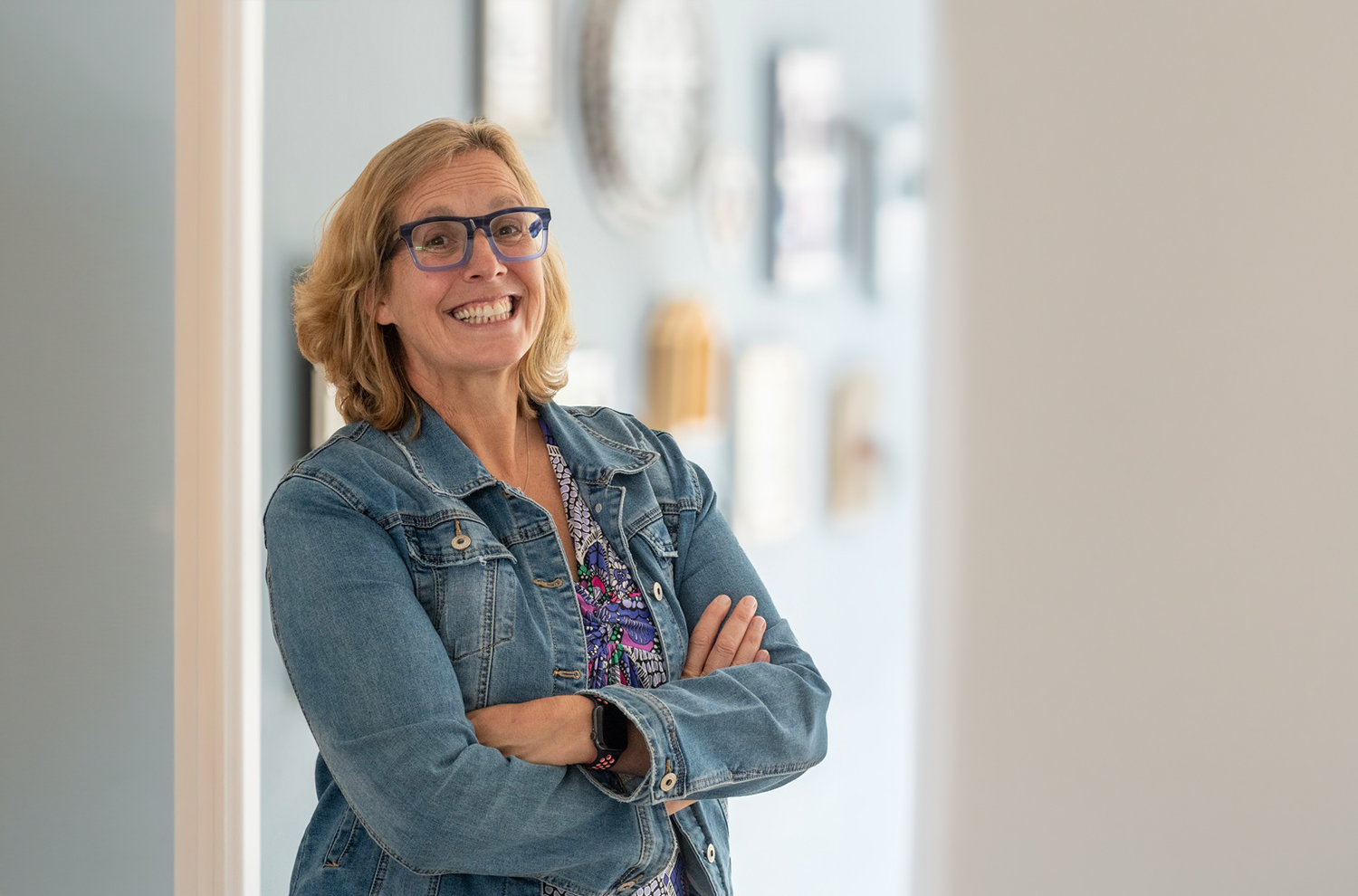
Helen Bullen is a business mentor, speaker and award-winning author who works with solo business owners who want to make a living doing what they love. In 2020 she retired from clinical practice as an osteopath, having single-handedly built Fine Fettle Multi-Healthcare, a large, multi-award-winning clinic with over 20 practitioners and a full reception and admin team. She was personally awarded Businessperson of the Year by her local Chamber of Commerce on more than one occasion and alongside her clinics built a reputation as a respected international lecturer for universities and osteopathic courses.
In June 2021, following a routine mammogram, Helen was diagnosed with stage three triple negative breast cancer. After nine months of intense chemotherapy and surgery, she was given the all clear, completing treatment and reconstruction in 2023. She kept a diary throughout, which informed two deeply personal books about her experience: Agnes, Bea, Cancer and Me and Me, Bea, Cancer Free.
Helen has also written two business books and now focuses entirely on mentoring solo business owners through her membership community, her mastermind and her business retreat programme. Known for her honest, straight-talking approach, trademarked as Kindly Blunt, she also hosts a podcast called Exactly That. She is a mum to two grown-up children and a stepdaughter and has recently become a granny for the first time.
In this episode, Helen shares the full story of building two clinics whilst raising her children through divorce, the moment she decided to close her practice just before her cancer diagnosis and how humour, resilience and a refusal to dwell for too long in the hard moments have carried her through every chapter. It is a wise, funny and genuinely moving conversation about doing business and life, entirely your own way.
Conversation Highlights:
- How Helen built her first osteopathy clinic from nothing, learned to embrace marketing despite hating it, and went on to found Fine Fettle Multi-Healthcare, a business she remains deeply proud of to this day
- The reality of building a business through divorce as a single mother with no financial support, including the honest and moving story of air beds, a bucket for a fridge and the moment her daughter’s too-small shoes became the motivation to find two or three more clients
- Why necessity became one of the most powerful drivers of her success and how she looks back on that period with pride rather than regret
- The old-school marketing that built her business before social media existed, from community involvement to genuine relationship building, and why those principles still matter today
- Why authenticity beats perfection every time and Helen’s refusal to pretend to be anything other than exactly who she is, on stage or on camera
- The decision to close her clinic just before lockdown, the negotiation that got her out of her lease with no penalty, and why the timing turned out to be extraordinarily fortunate given what came next
- The full story of her cancer diagnosis, the humour she found even in the hardest moments, and why she named her chemotherapy line Percy and her reconstructed body parts Agnes and Bea
- Her philosophy on emotional resilience, giving herself permission to have a proper meltdown before deliberately choosing to move forward, and why this is not about suppressing emotion but about not staying there too long
- How motherhood evolves through every chapter, from nappies to sports days to becoming a granny, and why ring-fencing what matters first and building your business around it is the only sustainable way to do this
- Her current mission to get on more stages as a midlife woman in business, the frustration that sparked it, and why she believes we should all lean into the things we are naturally good at rather than hiding them
Listen If You’re:
- Building a business through a difficult personal chapter, whether that is divorce, illness or simply survival mode
- A mother in business who has ever felt guilty for not being able to buy the thing your child needs in that exact moment
- Curious about how to find humour and resilience during a genuinely frightening health diagnosis
- Someone who struggles to accept compliments or take credit for your own talents and successes
- Ready to hear that there is no one size fits all approach to business, just as there is no one size fits all approach to parenting
- In a new chapter of motherhood, whether that is teenagers, empty nest or grandparenthood, and looking for permission to build a business that flexes with you
Favourite Quote for Mums in Business:
“You have to think of your business like a shop on a high street. If the blinds are down and there’s no open sign, why are you expecting somebody to buy from you? You have to put yourself out there.” – Helen Bullen
About the Guest:
Helen Bullen is a business mentor, speaker and award-winning author who helps solo business owners build sustainable, profitable businesses around the lives they actually want to live. Having built and closed two successful osteopathy clinics and navigated a stage three cancer diagnosis with characteristic humour and resilience, she now focuses entirely on mentoring through her membership community, mastermind and retreat programme. Known for her trademarked Kindly Blunt approach, she is also the author of four books and host of the podcast Exactly That. Helen is a mum of two grown-up children and a stepdaughter, and a proud new granny.
You can connect with Helen Bullen on Instagram and LinkedIn, on LinkedIn as Helen Bullen, and via helenbullen.com.
About the Host:
I’m Victoria Phipps – a Mum of two, analogue family photographer, charity co-founder, photography business educator, marketer and now podcaster! My career has wandered all over the place and is becoming a bit of a complex tapestry as I head into this middle phase of life, but I can honestly say I’ve loved every minute of it so far.
I was raised by a nurturing Mother and an entrepreneurial Father and have inherited traits from both, so the tension between ambition and motherhood is one I grapple with on a daily basis! I’m fascinated to hear the stories of other women on a similar path, who are striving to build thriving businesses whilst being present for their children. It’s a tough juggle, but I hope the conversations shared on this podcast help Mums in business feel less alone and inspired to keep going in pursuit of their dreams!
If You Enjoyed This Episode:
Please subscribe, rate and review the podcast – it helps other mums find us!
Share in your Instagram stories, tag @mummeansbusinesspodcast and let us know your biggest takeaway.
Share this episode with a fellow Mum in business who you feel would resonate with Helen’s story.
Episode Transcript:
Hello and welcome to the Mum Means Business podcast, where we shine a light on inspiring women who have one thing in common. When they’re not managing tantrums, homework, P.E. kits and play dates, they are busting their gut to build a thriving business that supports their family life. I’m your host Victoria Phipps and I’m figuring out how to play this game right alongside you. I’m a motherhood, family and personal brand photographer, I teach portrait photographers how to lead with print in the digital age, I’m marketing lead in the family business my Dad founded over 20 years ago and I’m “Mum” to two little girls.
If you’re a multi-passionate mum too, in need of some solidarity whilst navigating the messy middle of making your big dream a reality, then stick around. This is for you.
NOTE: This is the transcript from the original recording, rather than the edited episode so timings may vary.
Victoria (00:01)
My guest today is a business mentor, speaker, and award-winning author who works with solo business owners who want to make a living doing what they love. In 2020, she retired from clinical practice as an osteopath, having single-handedly built Fine Fetal Multi-Health Care, a large multi-award-winning clinic with over 20 practitioners plus a reception and admin team. She was personally awarded Business Person of the Year by her local Chamber of Commerce on more than one occasion.
Alongside her clinics, Helen Bullen had built a reputation as a respected international lecturer and subject expert for universities in the UK and osteopathic courses abroad. In June 2021, following a routine mammogram, Helen was diagnosed with stage three triple negative breast cancer. After nine months of intense chemotherapy and surgery, she was given the all clear, finally completing treatment and reconstruction in 2023.
She kept a diary throughout her treatment with the hope of raising awareness and supporting others living with cancer or caring for someone who is. Those diary entries informed two deeply personal books about her experience. Helen has also written two business books and since retiring from clinical practice now focuses entirely on mentoring solo business owners through her membership community, her mastermind and her business retreat program.
Helen is known for her honest, straight-talking approach, which she has trademarked as kindly blunt. And she hosts a podcast called Exactly That. She is a mom to two grownup children and a stepdaughter and has recently become a granny for the first time, which marks a very exciting new chapter in her motherhood journey. Helen, to give you a chance to speak in this conversation, I have left a ton of stuff out of this impressive resume.
But I’m so looking forward to digging a bit deeper into your story and learning about your hopes and dreams for your business going forward. So a very warm welcome to the Mummy’s Business Podcast.
HELEN BULLEN (02:02)
Thank you very much for having me, I’m very excited. I think it’s, I’m a little bit old so I’ve done a lot. Yeah, it is, it’s just
Victoria (02:09)
Is that what it is? Okay, that’s fine.
HELEN BULLEN (02:11)
age.
Victoria (02:12)
No, it’s all amazing, Ellen. It’s so inspiring, all the things that you’ve done. And I want to start at the very beginning of your story. So tell me what made you start your first clinic.
HELEN BULLEN (02:26)
I’m
I started my own clinic because when you graduate as an osteopath, despite all the teaching about the human body, etc. they don’t really tell you that you’ve probably got to go out and do it yourself. And back in my day, osteopaths weren’t really accepted as much in the NHS. It was purely physios. That’s changed now. So I knew my dentist and he happened to have a room. So my very first clinic was me going, my God, I’m going to move into the room next door of my dentist. I’m going to be so busy. This business is going to be brilliant.
and I sort of sat, waited and hoped for people to come in and they sort of didn’t. So I had to learn marketing pretty quick. I have to say back in those days, I didn’t like marketing and I would say that very openly, which now I look back and I tell business owners off for saying that because I’m like, well, you have to do some marketing, but back in those days. And then I got a bit more confident and I opened up a larger practice. I sold that one.
But then really my game had to up my game really because you then have to earn money for not just yourself but to keep the clinic going, to keep anybody that works for you, your staff you have. And I enjoyed the pressure but it was a pressure. So that’s really why I started out. I wanted to do it on my own and the reason I started up a multi-health care centre was because as an osteopath I was referring people to dieticians or to podiatrists and I was like wouldn’t it be great if I had everything in one place and I don’t have to be the expert of all, I can be the expert.
in what I am but then I can refer people and it did work really well and I am absolutely very proud of setting up Fine Fetal and in Fine Fetal means to be in good health so yeah it was a really good thing I really look back that’s a really nice memory for me that I did it and I learned a lot on the job you learn by your failures don’t you the things you do wrong and the money you spend when you shouldn’t so it was really good for me now in my background of helping business owners I’ve been there done that
got the t-shirt and sometimes the t-shirt was clean and white and sometimes it was very mucky and dirty and I hadn’t really got
Victoria (04:24)
Hahaha
HELEN BULLEN (04:24)
it right. So and I was I did that when my kids were little so I get the journey of being busy and trying to build your business.
Victoria (04:33)
Yeah, so that was gonna be my next question. So how did it coincide with your family life? So was it 2003 you graduated as an osteopath? And did you have children then or did they come afterwards?
HELEN BULLEN (04:42)
Yeah, I did.
Victoria (04:46)
Okay.
HELEN BULLEN (04:46)
They were very
little when I did my degree. So number one, that was mad.
Victoria (04:50)
Yeah.
HELEN BULLEN (04:50)
And it entailed me sitting outside, you know, a play group. If they hadn’t finished for another half an hour, I’d be outside studying. So yes, a little bit mad, but I did it. And I tend to jump into things like that and then think about it afterwards. And I think you manage your time. When you’ve only got a little bit of time, you have to fit it in in the time you’ve got. So when I was studying, I was always the person that put the essay in first, because if I had time when a
child was asleep or at a party, I would do that essay, whereas other people were a bit more gung-ho and they’re out partying and last minute, but I was always, I was a bit like the girly swat they used to call me. So yeah, I fitted it in around that and then the clinic came, I was actually going through a divorce at that time.
So again
Victoria (05:33)
Okay.
HELEN BULLEN (05:34)
slightly mad but I do think that sometimes a bit of adversity really motivates you to do things. It’s a really good why and I had to put a roof over their heads and food on the table and I’m one these people that split up. I never had anything from the marriage. I think I took away two or three thousand pounds on a credit card I had to pay off and I’ve never had child support so my why was very strong and from not liking marketing to having to learn to like marketing because I needed to make the money.
for the rent and the food etc and I’d always promised them that they were starting to go to little clubs and things when they’re little and I promised that I wouldn’t change anything I wouldn’t I mean I live in Surrey I wasn’t going to move out of Surrey, Surrey is expensive and I promised them I wouldn’t do any of that well that means that you have to earn some money to do it
But I do think without that maybe I wouldn’t have done what I did. I maybe wouldn’t have grown as big as I did because I just had bigger ambitions because I needed to. I I look back now and I used to have a bucket of water as the fridge because I couldn’t afford a fridge. A friend lent me a sofa and then I had one of those trundle beds that goes under a bed that one of the kids had but I had it in the lounge and I pulled it down at night and slept on it in the lounge. And when I first…
left my husband, they were on air beds for about a month. They thought it was like a camping holiday, I have to tell you, they thought it was amazing. But that’s probably
Victoria (06:50)
Yeah.
HELEN BULLEN (06:53)
my guiltiest moment being a parent, that they didn’t have beds. And then a friend of mine said, look, we’re going to get bunk beds, you pay me off, and I managed to do it. And then it was the only way was up really, and I managed to do it. And here I am today. They’ve left home. It worked out. They’re all right. They all survived.
Victoria (07:09)
I know, but there is this, yeah, I totally understand this point about necessity as a driver, because this is where like you become a lioness on behalf of your kids. And
HELEN BULLEN (07:21)
Yeah.
Victoria (07:22)
I imagine in that moment, you you’ve got so much that you’re walking around with in your head in terms of your own emotional experience through that time, because a divorce is, this is serious, adulting, this is conflict, it’s hard.
And you’re carrying that around with you, but actually you almost don’t have time to process that because you’re trying to make it feel as though as a little as changing as changing as possible for your little humans and.
HELEN BULLEN (07:53)
Yeah, definitely. really
felt that I was trying not to… like the swan and they say, you know, above water I was like this. When they went
Victoria (07:58)
Yeah. Yeah.
HELEN BULLEN (08:01)
to bed, I was sitting on the sofa and sobbing and wondering how I was going to do it. During the day, once they get up, everything was fine. Of course you’re going to have your tap shoes and whatever. Yeah. Yeah.
Victoria (08:08)
Yeah, Rosie. Yeah, yeah, but this is it
as well. And I imagine you put a lot of pressure on yourself because those tiny things were something that you could control in that moment. And, you know, looking back, your daughter may or may not remember whether she had tap shoes that week or whether they were new or whether she was squeezing to her old ones. But for you, that really mattered because you are now
the sole responsible parent and it is up to you to ensure that she doesn’t go without. And I imagine you
HELEN BULLEN (08:44)
Yeah, yeah.
Victoria (08:45)
put so much pressure on those little things like, no, I need to earn that five pounds so that he can go to this club because then life is okay. It’s literally like control.
HELEN BULLEN (08:53)
It was, it was, and
I think it was a great driver for me. I remember the day my daughter said my tattoos hurt my toes and I was thinking, no,
Victoria (09:01)
really?
HELEN BULLEN (09:02)
surely not, I’ve only bought you a pair three months ago. And I remember it like viscerally going, oh my
Victoria (09:04)
And it’s so frustrating. Yeah.
HELEN BULLEN (09:08)
God, she needs new shoes. And I think it just motivated me to go and get two or three more clients. Because at that time that was in my first clinic, not my bigger clinic, I was earning more money by then.
But it was like a visceral, I’m going to have to do this. It wasn’t like, well, I’ll find the money. of course we can have, what color would you like and what size? We’ll buy eight pairs. It was like, I have to do something. And I went without a lot, but I think as a mum, that’s quite easy to do because your priority
Victoria (09:33)
Yeah, yeah.
HELEN BULLEN (09:34)
is your kids. And I didn’t want them, although they obviously felt a divorce. I pretended that everything I was doing was meaning they weren’t feeling it at all. Everything’s normal.
Victoria (09:43)
Yeah.
HELEN BULLEN (09:43)
You still go to the same clubs, the same school. We still do the same routine. Everything’s la la la.
your tap shoes don’t fit my goodness but but yeah but it was a real driver and I now look back and think I wonder where I would be if I didn’t have that driver I think maybe I wouldn’t be where I am now
Victoria (10:02)
Yeah, yeah, totally. And I’m really sorry, I feel like I triggered some PTSD about specifically about tap shoes. didn’t mean to. Yeah, yeah, good, yeah. Yeah.
HELEN BULLEN (10:07)
No, do you know, no, not at all, not at all. Do know what? I hold it in a bit of pride. The one is the air beds. The air beds is the one that gets me, but I
still hold it in pride. And my kids actually are now grownups. And they will say, we remember when you did this. We remember when you did that.
They were very proud when I set up the clinic. They came and worked for me, for goodness sake. My kids were teenagers.
Victoria (10:30)
Yeah, it’s so good.
HELEN BULLEN (10:31)
You are now working on reception and learning how to treat people when they come in. So they had a lot from me being a business owner and they do now say it. Although my son now will go, I’ve seen you on social media. Just does that bit of that. Joe, it makes me money. It’s fine.
Victoria (10:47)
Yeah, well this is the thing and it’s about getting uncomfortable, pushing yourself out of your comfort zone. Like you have this story that you tell yourself, I hate marketing. I don’t wanna do it. What I want is to sit in my room next to my dentist and for people to just arrive and I will treat them. That would be lovely, thank you very much. And it doesn’t work like that.
HELEN BULLEN (11:04)
Absolutely.
No, and I really thought it did. I know and I call it now, I call
Victoria (11:09)
Yeah.
HELEN BULLEN (11:10)
it the sit, wait and hope method of marketing. We sit there, we wait and I might have a client at nine and then I might have had one at three. And then I sat there between half past nine and half past two going, well, somebody might come in, but they didn’t. So I had to take some action. And I think that’s important for all of us to remember. If you’re a business owner, you have to do something.
Because you can’t expect people to buy.
Victoria (11:31)
Yeah, yeah. So what did that actually look like?
Or what did you actually do? Because this is pre-Instagram. This is, yeah, this is an analogue world.
HELEN BULLEN (11:37)
I gonna say, right, let’s go back to dinosaurs,
shall we? In the day of dinosaurs, I have a kickstart dinosaur, no. In those days, marketing was a leaflet drop, which was pretty damn useless, which I still think it is now. Or it was your footfall and coming, or you might be able to put an advert in the paper, but.
An advert in the paper was literally somebody’s chipped paper the next day. So unless you hit that person on the day they needed it, it was a lot of money for very little. You could do radio, that was okay. But for me, at that time, I focused on customer care and I focused on being part of the community. So if there was an event going on, I was always there. If there was a raffle prize, I was always putting a raffle prize in. If I could do something for the local charity, the local scout group, whatever, a talk, I went and did it.
got me known and I suppose that’s really what I do now but more on social media but you know we moan about social media but I’m back in the day that I go we didn’t have that so sometimes when we moan I think we have to go my goodness we do have something that isn’t necessarily the easiest thing to do but it is free for most of us and it is a platform to get yourself out there it may not the algorithms may be all against you or you feel it is but it’s better than nothing I remember when I graduated was the day that literally around the time that text came out and I remember going
one of those brick phones and you had to test the button three times to get it to a letter. I remember thinking that was great technology. Yeah. Yeah.
Victoria (13:01)
Yeah. I remember that. my God, that was so intuitive. You just knew how many times my first phone
was like this and you just, you press A three times to get to C. my God, I’d forgotten this. Yeah, I remember
HELEN BULLEN (13:14)
You did?
Victoria (13:16)
that. Yeah, but you were just in the end, you were just so adept. That was like a whole skill in itself. Yeah.
HELEN BULLEN (13:20)
Yeah, it was. And
I thought that was the be-all and end-all of everything and then suddenly
Victoria (13:24)
Yeah, yeah, yeah.
HELEN BULLEN (13:25)
it exploded, which I’m glad it did because I’ve followed the trends. I’m always about keeping up and I’m very glad I have because I’ve got some friends that haven’t of my age and makes me laugh. They don’t understand any of it. Or me. They don’t.
Victoria (13:36)
Yeah, yeah, yeah. But I think
that that foundation in kind of a more analogue marketing approach is still relevant today and it must have stood you in really good stead because that is physically getting out of your comfort zone. That is walking into rooms where you do not know anybody and trying to make friends and hope, like you say, there’s still a bit of hope that eventually you build these relationships and that will bring you some business because you’re mentioning what you do.
and you’re talking
HELEN BULLEN (14:06)
Yeah.
Victoria (14:06)
about it. But.
HELEN BULLEN (14:07)
And I think the
key thing is not to go and sell at any of these things is to help people. It’s a great, I’m
Victoria (14:11)
Yeah, of course. Yeah, yeah.
HELEN BULLEN (14:13)
a great believer in putting yourself out there to help without any thought of what’s coming back. So when I had my clinic, it was on a high street, I would buy my coffee from the coffee shop and I would get to know them. I would do my printing from the local printer. I was part of the business group, not because I particularly wanted to stay late on a Tuesday and it was hard with the kids, et cetera, but I did it because it got me into their world. And that even years on has come back.
with people who come out of the woodwork from years ago and I help them and say, I’ve got something for you, I thought of you. And it’s lovely. And it’s a nice way to do it rather than thinking I’ve got to go to a networking meeting and I need to make sales. It’s I’m going to a networking meeting, I’m going to meet up with some nice people, tell them what I do, and then have a chat. And that has always worked for me. Absolutely. And I prefer that.
Victoria (14:56)
and hear what they do as well. Yeah, it’s a reciprocal thing. then, yeah,
definitely, because that’s a real life conversation and that’s
the point of
HELEN BULLEN (15:04)
Yeah.
Victoria (15:04)
connection. And it’s give and take all the time, but also you’re just being a human, engaging with your
HELEN BULLEN (15:10)
Yes.
Victoria (15:11)
local tribe. You all live in this vicinity. And I think there can be a tendency now when people start businesses to just live on their phones, just live on the
HELEN BULLEN (15:20)
Yeah.
Victoria (15:21)
internet. And actually it’s the same with like online dating.
I had a very sad time in my life when I had to do that quite a lot. And again, it’s like people would, you’d go to meet somebody in a bar that you’d never met before and you look around and there are lots of people, probably single, about to meet somebody and they’re looking at their phone. And I’m like, God, there are probably like 12, 15 single people in this room waiting for a date. And if they just look up, like, and look around,
HELEN BULLEN (15:49)
Yes. Yeah. Hello, I’m over here.
Victoria (15:52)
yeah, well, they might find their person.
like, you know, here. And it just used to make me laugh.
HELEN BULLEN (15:56)
Yeah, and I think
it’s a shame, isn’t it? Because we’ve got this phone and it is a great bit of technology. Don’t get me wrong, I love it.
Victoria (16:02)
It’s amazing. Yeah.
HELEN BULLEN (16:04)
we and I think maybe I did it a bit since lockdown and then I had my cancer journey after that I think I got a little bit like online online online and I’m just going back now to speaking more on stages and I love it and it doesn’t mean every business owner has to love speaking on stages but I like the in-person stuff and for me it always boosts my business far quicker
than online stuff or like this a chat a chat with somebody always boosts my big business more than me putting posts out although I get customers from that people like to actually meet you and I think as long as you are you people quite often come up to me they go you really like you are online and I’m not sure if that’s good or bad because I’m like well yeah I can’t you know
Victoria (16:45)
No, it’s really good. It’s so good.
HELEN BULLEN (16:47)
my retreats people come to my retreats they’re like you really like you are I’m like yeah what else did you think but I think that’s the thing to remember is embrace you and who you
are and that your customers will like that rather than looking at, well I call it Mary down the road, you know the person that’s always on and it looks perfect and everything and you’re worrying more about what they think than being real for your customers and real’s a funny word isn’t it? But you know what I mean, being you is much easier, it’s just much easier than pretending to be something
Victoria (17:12)
We’re just being yourself. Yeah. Yeah.
HELEN BULLEN (17:16)
or wishing you were something else, I mean I’ve done that the whole of my life you know, wish I was slimmer, taller, you know whatever I’ve wished it but I don’t so much now and again I think that’s an age thing.
Victoria (17:26)
Yeah, but I’m
looking forward to that. I think that’s great.
HELEN BULLEN (17:28)
Yeah.
Victoria (17:30)
Yeah, I think it can be hard when you, because I mean, you keep telling me how old you are. You’re not that old.
HELEN BULLEN (17:36)
Yeah, ancient.
Victoria (17:38)
I know you keep telling me, but I had an analog childhood pre-internet, teenage years. think Facebook came out when I was at uni. That was kind of the start of social media.
And I think it’s hard for a lot of people who were raised in an analogue world where like this presenting yourself thing was not for us. That was for the guy on the BBC delivering the
HELEN BULLEN (18:02)
Yeah.
Victoria (18:02)
news. And I think actually it is quite hard for people in a way that it wouldn’t be for, you know, my kids who will probably be very intuitive about it to actually be yourself in front of a camera talking to your phone or be yourself
HELEN BULLEN (18:15)
Yeah, exactly.
Victoria (18:16)
because you weren’t brought up like that. You know, this was…
you know, the BBC English and everything was clipped and proper and delivered. Yeah.
HELEN BULLEN (18:22)
And yeah, the way back, the BBC
was a certain accent as well, wasn’t it? You know, didn’t have all the regional accents, which I love now that we do, but yes, it’s very…
Victoria (18:26)
Yeah, yeah, yeah, yeah. Mm-hmm. Yeah, well, we can just be normal,
yeah. Yeah.
HELEN BULLEN (18:32)
be normal because I do get
people that I work with and they say I don’t like my voice and I’m like your voice is great unless people are jumping in hedges and going my god don’t say anything else I can’t bear it your voice is fine you know it’s like we say we say we don’t like
Victoria (18:43)
Which never happens, does it?
HELEN BULLEN (18:46)
what we look like and I used to say it’s because I work with a lot of people that are front-facing in their business a lot of therapists and I say has anybody asked you to put a paper bag on your head because they can’t bear to look at you no they haven’t but we
Victoria (18:57)
Yeah.
HELEN BULLEN (18:57)
build this thing because we see perfection a lot I think and right the BBC star
that you’re right but I think sometimes now we see on our social feeds as well that you know I had a friend funny enough this morning that said to me I’ve just looked at my daughter’s holiday on Instagram she said it looks perfect she said I know they had to come early because the little boy had earache and they had to come home early but it looks fantastic she said it wasn’t the same message I was getting so I think we unfortunately we find ourselves comparing ourselves and it’s really hard not to but I think we have to focus to not to do it
Victoria (19:31)
Yeah,
I think that’s definitely how it’s been. And I think going back to sort of the teens when I used to post in my photography business, know, it’s curated and it’s just my most beautiful photographs. And it was just that time where you could post an image and get 50 likes and be done with it. Whereas now, you know, this piece to camera thing was quite a shock for me. And it takes a lot to break away from that idea of perfectionism. And it’s not just the BBC, it’s, you know, it’s magazines, it’s everything, it’s all of our conditioning.
that tells us that we should kind of stay small. And I think what you’re doing now in your business and more recently, and we will talk about it, your sort of big challenge to get on stages is amazing because I think what is so wonderful about everything you put out is it is just you being yourself, completely natural, no airs or graces, not performing.
I think that’s the piece, isn’t it? It’s like you’re not performing, you’re just hopping on to say
HELEN BULLEN (20:35)
Mm.
Victoria (20:35)
something that’s playing on your mind. And I think it takes us quite a long time sometimes and a lot of practice and a lot of getting it wrong. And I’ve certainly posted reels that I just cannot watch back now because I’m just like, who is that person? Like trying to, and
HELEN BULLEN (20:50)
Yeah.
Victoria (20:50)
it just feels, and I think because we’re humans, know, it goes back to meeting in person. We’ve evolved, we’re so in tune with the tiny,
little signs of another person’s behaviour. We can
HELEN BULLEN (21:05)
Yeah.
Victoria (21:06)
feel if someone is uncomfortable. We can feel if somebody is feeling awkward or if they’re lying or if their body language is such a powerful thing. And of course some people are better at masking it than others. But I think if you can show up as yourself and if you can deliver the message you want to deliver.
without any of that performance, it really lands now because I think we’re tired of the polished, clipped, perfectly curated Instagram reel.
HELEN BULLEN (21:36)
Yeah, and I think with AI, I think…
I think with AI we are
also getting bombarded with the perfect. I’ve got to own up to you though. I cannot
Victoria (21:45)
Okay, go on.
HELEN BULLEN (21:46)
listen to anything back that I do because this is what I hear. That’s all I hear. So if I’m recording videos
Victoria (21:49)
Ooh.
HELEN BULLEN (21:54)
and quite often the video is either going to be for a course or something like that, I have to listen to it back. it’s like torture. So I do have this thing, but I learned straight away was don’t listen to it. I look at the start, make sure I’m not pressing the button.
at the end I put my captions on and then I go and I just let it go and that’s my way of dealing with it so if I’m honest I think I sound terrible but people don’t tell me I sound terrible so I obviously don’t but in my head I hear it as a nananana here she goes and then that’s why here so I’ve just learnt not to not to look I like done it out there
Victoria (22:31)
Yeah, so there’s a, there’s something there about like taking up space and worrying that other people are going to think that you that’s what they are going to hear that they’re going to hear. Here she goes again, she’s telling us something or she’s trying
HELEN BULLEN (22:41)
Yeah, yeah, yeah, yeah, here she goes again.
Victoria (22:44)
to teach us something, trying to get us to sign up to the thing. And this
HELEN BULLEN (22:46)
Yeah, yeah yeah yeah
Victoria (22:48)
is what we do to ourselves. Like that is torture. But I
HELEN BULLEN (22:51)
Yeah.
Victoria (22:52)
think it’s really, it’s really important to own up to that. And I definitely feel it when I put something out,
God, you I’m telling someone something again. There she goes, telling someone something or whatever. But actually, it goes back to those early days of like you sitting in your clinic and no one coming in. Like if you don’t do this stuff, you won’t have a business and you have to get uncomfortable.
HELEN BULLEN (23:14)
No, and I say that as a lot…
Yeah, I say that lot to people that you can’t expect. You have to think of your business like a shop on a high street, whether you’re online or whatever you do. If you have got a shop with the doors shut, the blinds down, you haven’t even got an open sign or a banner anywhere. Why are you expecting somebody to buy from you? You have to put it in those terms. Whereas if you had a shop and the blinds were up, so you’re showing people what you do, what you’re selling, this even works if you’ve got a service business. You just have to think of yourself as more shop like. If people can see what they’ve got, they’re more like it’s coming by.
but then you do need to have a cash register or a place they go to to buy and to come back and buy again and you need the door open and and we actually never mind somebody that if you’re going to a shop you don’t feel you have to buy when you go in a shop you go and you walk around if you want to buy something when we’re selling we’re like well somebody came in and they looked at my stuff and they didn’t buy my god it’s terrible and i’m awful but actually if we think about ourselves like a shop that we have to have ourselves seen we have to be visible
We have to have a way people can buy. We have to say what we’ve got to sell and if they don’t buy it’s just not their day for them or you’re not the right shop and they might come back another day or tell a friend and I like that way of thinking I think like that because it settles me for what I’m doing I’m like well you can’t expect sales if you’re not out there and when I’m out there I’m like well if they didn’t buy today it’s probably because it wasn’t for them today and don’t get me wrong I have the odd day I’m like come on buy but but
Victoria (24:42)
Yeah, of course, we all do. Yeah, yeah, yeah, yeah.
HELEN BULLEN (24:44)
But mostly,
Victoria (24:44)
Yeah.
HELEN BULLEN (24:45)
as long as I’ve got it set up, that there is a way. The customer journey is so important. And I speak to so many business owners that forget that bit. I want the sales, but I don’t want to do anything. And it’s like, well, it doesn’t work. So we have to do something. And if that means you don’t listen back to your videos because you’re na na na na na na, then that’s fine.
Victoria (25:04)
Yeah, whatever, whatever works for you. And I think it’s about not taking it personally. I think that’s hard.
HELEN BULLEN (25:10)
And that’s hard. It is hard.
Victoria (25:12)
Yeah, yeah, because you think, well, if you had a shop and someone walked in and walked straight out again, you’d be like, oh, well, my shop must be shit. That’s where we go. Like I have a shit shop now. Yeah, you’re not thinking,
HELEN BULLEN (25:21)
Yes, yes it is straight away. Everything’s rubbish.
Victoria (25:25)
oh, well, maybe they were looking for this and I didn’t have it, or maybe they wanted it in a different color. And you can’t ask them because they’ve gone.
HELEN BULLEN (25:30)
Yeah.
Victoria (25:31)
And so then it becomes about, where’s the gap here? Like what’s, you know, investigation or maybe it’s just volume and you need to just encourage more people, like you say, into your shop, maybe not enough people, because that’s just one person. And like you say, it just might not have been the day for them, but I think we’re so ready to get personal about it.
HELEN BULLEN (25:47)
We have to realise that…
Yeah, and think we have to realise it’s normal when you have a business not to sell to everybody. It is normal.
Victoria (25:55)
Yeah, exactly, yeah.
HELEN BULLEN (25:56)
It is normal. And once you start to take… Because I think we’re responsible for how we feel. And you’ve seen me on calls and I’m like, for God’s sake, people haven’t bought, blah, blah, blah. But mostly I can rationalise it and think…
but it’s just not for that person today. I liken it to when you used to advertise in a paper. The newspaper was fine if somebody opened it on that day and I was an osteopath if they had back pain on that day. If they didn’t, it was a useless advert. And I think we have to think about that. It might not be their day. They might not be your person. And I try and think you have to, I think there is some quotes, isn’t there? You have to get so many nos before you get the yeses. And sometimes that is a better way to think of it. There will be nos. They’re hard, don’t get me wrong.
I think we have to normalise it, that if we run a business it’s not you. Unless nobody ever buys and you’re rude to everybody and your ethics are off and you sell them rubbish products, then you need to worry. An awful person doing awful things and selling snake oil, then
Victoria (26:47)
Unless you’re an awful person, yeah, you’re fine.
HELEN BULLEN (26:52)
you need to step up. for the majority, I don’t think I’ve ever met a business owner that I haven’t thought they’ve got good stuff to sell. It’s just maybe they’re not doing it in the right way or they’ve not said it enough or people will say no.
I don’t know quite how we get over the no, but I think sometimes when you understand it’s normal and every business owner will get a no, then you don’t feel like you’re the only person in the world. Because I think that’s how we feel as business owners is, it’s only happening to me, everybody else, because we see the reels and we see the stuff on social media. my God,
Victoria (27:21)
on social media.
HELEN BULLEN (27:23)
what a great launch. And it’s not always like that.
Victoria (27:25)
I’m delighted to announce,
blah blah blah, on LinkedIn.
HELEN BULLEN (27:26)
yes, so many million. But then they
had, you know, I mean, I love the numbers, the numbers of, you know, the audience you’ve got to the percentage you get of sales is good numbers to know because it’s reality. But yeah, I think we’re hard on ourselves and as a mum we’re even harder aren’t we sometimes, I think.
Victoria (27:42)
Well, exactly,
and it applies to both. And I think that’s sort of why I started this podcast, because we can feel the same in mothering as we do in business. You know, we drop one ball and we just go out and whip ourselves and feel
HELEN BULLEN (27:54)
Yeah.
Victoria (27:54)
like a total failure is so hard on ourselves. But I think it’s conversations like this. You know, you are a successful business person. You have built two clinics. You have been given awards. You have written books.
and you are saying, not everyone that I would like to buy from me buys from me. And that is,
HELEN BULLEN (28:14)
Absolutely.
Victoria (28:14)
that’s normal. It’s so normal. And I think that just makes everybody be like, it’s all right because we think that it’s only happening to us, like you say, but it’s not. That is the reality of business building. You win some, you lose some.
HELEN BULLEN (28:28)
Yeah, and the best thing…
The best thing we can do is go and look at our own customer journey path. So if people are saying, no, just check that they can go from seeing what you’ve got to buying it easily if they can. And then you’ve got to put yourself out there a little bit, but it doesn’t have to be all singing or dancing. You know, I never show my, even they’re adult kids, I’ve never shown my kids on social media at all. I don’t need to do it. People think they see all my life on social media. They do not. I never show my friends, my parting, but there’s enough of me that I share that gets people to know who I am. And I think sometimes that is
the with mums it must be because I didn’t have my kids when there was social media per se but it must be hard to know do I put my kids on do I not do I put a smiley face over them do I not all that stuff well actually you can do it all without
Victoria (29:11)
Yeah, it’s a thing.
HELEN BULLEN (29:12)
even showing anybody if you don’t want to you build I’m a great believer in building a business that you want yes you have to tell people what you sell you have to do that but build a business that you enjoy and that you love and not because you feel the pressure from other people as to how to build it or how you have
perceived from all your lovely social media stuff that the perfect business is and the perfect mom you know I’ve worked with mums who have said well I watched this lady and she’s in her kitchen it’s always perfect and I said it’s the angle of the camera I can do that in my kitchen I can have a pile of washing up but if I angle it right my god on the floor down here there is a box it was on my desk earlier it’s down there but
Victoria (29:43)
Yeah, yeah. You just literally get all your stuff, sweep it off the screen, yeah. Yeah.
HELEN BULLEN (29:53)
Unfortunately, we’re not wired that way to think that way every time. I like to think I’m in control of how I think of things. So I’m not going to blame social media. I’m going to try and help myself to look at it a different way. And I think sometimes the nice thing to know is you can control how you think.
we sometimes we try and blame what other things are but the great thing is I can work on myself to not think that and to think that that woman has not got up and had her breakfast the kids are dressed everything’s ironed she’s got to school in a pink suit or whatever and she’s going off to work and everything is great she’s made a million pound launch I don’t think that is actually the true story I know it’s a false story yeah but if you’re on a bad day
Victoria (30:31)
not the full story yeah that might be just certain curated elements of a story with a lot of stuff left
out yeah.
HELEN BULLEN (30:38)
If you’re on
a bad day, you can go, but I haven’t even got out my pyjamas and the kids need taken to school. You know, that’s and I didn’t really have that.
Victoria (30:43)
Yeah. And that could be,
that could be the day after the million pound launch. It could be the worst day. You know, it’s, it’s
HELEN BULLEN (30:50)
Absolutely, yeah.
Victoria (30:51)
just the rich tapestry of parenthood, business, everything.
HELEN BULLEN (30:55)
Yeah.
Victoria (30:56)
And, and I think it’s about showing the whole picture, like you say, and just being relatable and honest
HELEN BULLEN (31:03)
Yeah.
Victoria (31:04)
about your experience. I want to go back talking about being relatable and honest. You exited.
your clinic. Did you sell your clinic, the fine fettle? What did you do? You closed it?
HELEN BULLEN (31:14)
No, I closed it. It was lockdown.
Victoria (31:17)
Okay.
HELEN BULLEN (31:17)
and
I offered it to the therapist and looked down, it’s a hard time to sell a in-person business. And I was
Victoria (31:22)
Yeah. Yeah.
HELEN BULLEN (31:24)
like, I’m out, I’m out, I’m out. I just didn’t want to do it. And I could afford to do that. It was fine. And I managed to talk my way out of my lease because I had three years left on it. The reason I did it was because my husband got given early retirement and I was going to retire in three years from being an osteopath, not from being a business mentor because I’ve done that for years, but being an osteopath, having the responsibility of the clinic and people in the team. I’d had enough. I’d done it.
Victoria (31:46)
It’s a lot.
HELEN BULLEN (31:47)
and
it’s hard work. So suddenly he got early retirement and I was like hang on a minute, hang on a minute, three years I’m gonna be you
Victoria (31:52)
Jealous, jealous.
HELEN BULLEN (31:54)
know it’s six days a week it was full on and I was doing my mentoring as well there was a lot going on and I just thought
I’ve always I’ve always schmoozed landlords really I’ve always I’m always a believer in keeping people in your team and in your world so if he wanted to talk to me I’d take him out for lunch and he was a great guy and I just said to him how about it do you want to make it into flats because it was a commercial building he said well actually maybe I could said well can I get out my lease I didn’t have to do any dilapidation so I talked my way out it so actually the cost of doing it didn’t cost me anything none of the other therapists were brave enough to take it on few wanted to and I was like no just go just just it’s not
worth it for the hassle. So I left, I sold my first clinic ironically and then I didn’t sell the second one. But yeah, no,
Victoria (32:37)
Okay.
HELEN BULLEN (32:38)
it was right for me and actually what worked was, you know, COVID, it was hard, I didn’t have to go through any of that. I managed to sell all the furniture,
Victoria (32:44)
Mm-hmm.
HELEN BULLEN (32:44)
I got money for that and then the next year I was diagnosed with cancer. So in my head I go that was a great move, great move, if you had
Victoria (32:53)
Hmm.
HELEN BULLEN (32:53)
to have done it, that was the time. If I was running that clinic as well, would have been a nightmare. Everything sort of came at the right, if cancer can come at the right time.
everything came at the right time because my husband retired he’s already had he’d had cancer and chemotherapy I’ve now got somebody that understands it and
Victoria (33:10)
Mm-hmm.
HELEN BULLEN (33:11)
so it sort of came at the right time so really that’s how it came about retirement I was like I’m not doing this and and I’ve always believed that you should
Victoria (33:17)
Yeah, but it sounds like… Come on.
HELEN BULLEN (33:19)
do what you want to do in business and not because you think other people think you should do it
Victoria (33:24)
Yeah, it’s about trusting your gut, like actually looking
HELEN BULLEN (33:26)
Yeah.
Victoria (33:27)
at it and projecting forward the next three years. You’re just like, no, don’t want to. And that’s, giving yourself permission. Yeah, yeah.
HELEN BULLEN (33:32)
No, was was, it was like permission.
And at right that point, my clinic was closed because of COVID. You know, you can only do online calls when you’ve got a very physical business. I was like,
Victoria (33:43)
Mm.
HELEN BULLEN (33:43)
actually, and I probably would have lost more money if I’d kept it open, to be honest, it would
Victoria (33:47)
Yeah.
HELEN BULLEN (33:48)
have been a struggle.
Victoria (33:49)
Yeah. And just very stressful. And like you say, that responsibility
HELEN BULLEN (33:51)
Yeah.
Victoria (33:52)
for all these therapists in a time where you physically can’t reach your clients, like it doesn’t work, does it? And you don’t know how long that’s going to go on for.
HELEN BULLEN (33:59)
No, I’m gonna…
And I learnt how to do redundancy packages and how to close a business down, so I learnt. I did, I learnt. Yeah.
Victoria (34:07)
Silver lining, all the silver
lining. Everything is a, every day’s a school day.
HELEN BULLEN (34:12)
Definitely.
Victoria (34:13)
So tell me about this cancer diagnosis because it sounds like you just retired-ish. You’re still perhaps doing some business mentoring, which you can do online through COVID, but you’re kind of, it’s 2021, was it? So
yeah.
HELEN BULLEN (34:32)
2021, June 2021.
I went, so this is for everybody get your tests done, I went for my second mammogram ever. And it was still, in fact, I was probably about, maybe it was May, I don’t know when it was on that year, but it still locked down. So I remember my daughter was moving house that day. You know how sometimes you have these visions? I was in a Sainsbury’s car park at one of those trailers they had. It was pouring with rain, I wasn’t allowed on the trailer because of COVID, so the people had to, I was in a right foul mood. I was in a terrible mood, like I don’t need to do
this mammograms aren’t the most comfortable but they are very reliable in saving your life so I’m going to say that.
Anyway, I had my mammogram, thought nothing of it, went and moved my house, I didn’t feel ill, didn’t feel anything, couldn’t feel any lumps, nothing. And then I got called back and I didn’t think I’d got cancer because you get called, there’s another centre near Guildford that I got called to, just want to check up, three out of a hundred women get called back, it’s normally nothing. So I’m like, Lala, didn’t take my husband with me, bye, see you later. Again, I’m sitting in the waiting room, all the chairs, you know the days when the chair next to you was taped up because you couldn’t sit next to anybody,
Victoria (35:34)
Mm-hmm.
HELEN BULLEN (35:34)
it was all like that. Walked in and I should have known when the
nurse
said how are you and I went I’m great thanks like yeah great yeah okay
Victoria (35:42)
Why am I here? Yeah.
HELEN BULLEN (35:43)
do you need a drink do you know I’m fine anyway and I walked in to see the consultant and I can read a bit of a scam with my training as an osteopath and I looked at this thing I said it doesn’t look good thinking she’d say what a load of rubbish you have read that wrong she went yeah you need to sit down I thought anyway and it sort of cascaded from there really I I’m
I don’t know, I’m in a crisis, I’m pretty matter of fact.
So I am lying there having biopsies taken whatever I’m on my own I’m apologizing because I’m shaking so my body has gone into some sort of meltdown because they’re saying to me we know you’ve got cancer but we don’t know what type we don’t know where it is so we’re taking blah blah blah talking to me and I’m just saying I’m so sorry I’m shaking it might be cold I’m very sorry I went all like maybe cold in here and then they said right well you need to have a cup of tea so British I hate tea let’s have a sugary tea you know that’s something I was like no I don’t want that have you eaten no and in the end I remember
out of there because I promised to eat a ball-borne biscuit and half a cup of coffee. They said right you need to ring your husband so I rang him I just went hi yeah I’ve got cancer I’ll be back in a bit.
Victoria (36:50)
Yeah. Yeah.
HELEN BULLEN (36:50)
poor husband, bless him. But that’s
how I dealt with it. Anyway, I laugh about it now and my book is humorous. I mean, there was one chapter that my editor said to me, Helen, we cannot blame the reader for you having cancer, because I was obviously in a black moment. But I took that
Victoria (37:03)
Hmm.
HELEN BULLEN (37:04)
out. But it is quite humorous, but it tells my story. But I tried to laugh throughout it and obviously I didn’t laugh throughout it. But I just tried to make the best of it as I could. You know, I called my peak line, which is the line you have your chemo in and out of. I called it Percy Peak because I thought it’s like Percy
pigs and then I’d say well if
Victoria (37:21)
Hmm.
HELEN BULLEN (37:21)
I’ve had a pick line I can have a bag of Percy pigs and all those
Victoria (37:24)
Mm-hmm.
HELEN BULLEN (37:25)
sort of things you know I called my boobs Agnes and B, Agnes had cancer you know that yeah so Agnes
Victoria (37:29)
I was gonna ask, because that’s the name of your book.
HELEN BULLEN (37:32)
B cancer and me is literally the story of me getting Agnes off my chest quite literally and then my second book is me B cancer free because Agnes is not there but I just found that was a way of doing it you know and going being fitted for false boobs and somebody going oh you’ve got a bit of a droop there well it’s like a shoe shop
with all the things and then they’re like
Victoria (37:51)
Lovely.
HELEN BULLEN (37:51)
stage two droop. I’m like thank you very much although I have to say now I’m fully reconstructed for anybody that has a slight little belly. I had a baby belly definitely just love your baby belly number one it is great because you’ve had kids like it’s just an honor to have it.
And number two, they made that into a boob for me. I was like, oh, she was like, yeah, you’ve got plenty. I was like, that’s rude, but anyway, I made it into a boob for me. So yeah, I got a tummy tuck a boob.
Victoria (38:13)
I’ll take it, yep. Yeah.
HELEN BULLEN (38:16)
They hitched the other one up. I am like, you know, Madonna underneath here. Actually, no, I’m not.
Victoria (38:20)
Hahahaha
HELEN BULLEN (38:22)
But I just always look, I think I do that with business as well. I like to look on the fun side. I have my most black times. I do, I do go down, but I don’t let myself stay there for long. I’m a bit of a person that says, right, if you’re going to have a meltdown, have it for about five or 10 minutes or half a day, whatever I need, meltdown, do it proper, cry or whatever. Now that’s not going to help. So what can I do to make it better? And I do that in business as well. I’ll have black moments and then I’ll think, right, that’s enough. And I’m not talking I’m depressed because I think that’s a whole different
story and people need to see their GP
Victoria (38:53)
Yeah, completely, yeah.
HELEN BULLEN (38:54)
but just down but I’ll let myself have a wallow in it sometimes I’ll even put a sad film on and think right just cry your way out of that and then I indulge
Victoria (39:01)
Yeah, just indulge it, yeah.
HELEN BULLEN (39:04)
it and then I think right enough enough now what can I do because feeling bad isn’t going to help the situation and and I at one point I thought I don’t know if I’m going to survive so why would I spend my time being miserable I have to try and be as happy as possible and I still sort of do that so yeah nothing wrong with a meltdown have
them. have full blown, my husband could tell you many stories of my meltdowns but then I’m like okay what do I need to do? Regroup, let’s go again and that’s that’s worked for me. Whether that’s just my character I don’t know but I think I must have read it in a book once. It be Hal Elrod that wrote The Miracle Morning and I think he’d had a car crash and they thought he wouldn’t walk again and he just said well I could be miserable or I could think right how am I going to manage my life. He has walked again since but he said I thought there’s no point dwelling on that. Let me dwell on how
I’m
going to make this move forward so I think I’ve taken it from that. I’m slightly nutty really.
Victoria (39:58)
It’s not nutty. think that’s, that’s
really sensible and wise. think, you know, to, to another extreme, we could ignore that instinct to sob into a pillow,
HELEN BULLEN (40:13)
Yeah.
Victoria (40:13)
you know, and just, and that’s the stoicism to the extreme, just push it down and push it down. And I think that’s unhealthy in that you, you just storing it up, you know, you’re storing that energy in your body is going to come out at some point, probably at
an inopportune moment where it’s entirely inappropriate
HELEN BULLEN (40:29)
Yep.
Victoria (40:30)
and no one can help you and no one gets it because nothing’s happened then. So it’s important to experience it and let yourself feel it, but then to give yourself that cutoff when you’re all cried out and just be like, now what can I control in this situation to make it better? And you
HELEN BULLEN (40:48)
Yeah.
Victoria (40:49)
know, that’s going to be different in every situation, but there’s always something you can control, even if it’s your own mindset.
and your own attitude towards whatever it is that life has thrown at you. And that, you know, in business, there are so many moments like that. And in motherhood, there are moments like that where, you know, things just don’t go according to plan or you drop a ball or you get rejected or there’s, you know, a drama with one of your children. You have to, that cycle is so helpful to let yourself feel it and also find a way to pick yourself up out of it.
I think it’s really great advice.
HELEN BULLEN (41:23)
Yeah, being miserable
is not a nice place to be. I don’t like it. But as I said, I do embrace it when I want to do it. I’m like, OK, do it big time. Do it big time. And then.
Victoria (41:31)
Yeah, just put R.E.M.
HELEN BULLEN (41:33)
Yeah, yeah, whatever makes you… Yes, oh my god, I have done that. But you know,
Victoria (41:33)
Everybody hurts on. Yeah.
HELEN BULLEN (41:38)
when my kids, when I was going through my divorce, I didn’t necessarily cry around them. I’m not saying I didn’t actually, because I might have done, but I used to, once they went to bed, it was like a bit of a freedom. And I’d watch something on
Victoria (41:47)
Yeah, yeah, yeah.
HELEN BULLEN (41:48)
TV and just think, just have a sad moment, and then regroup and off I go. And I have to admit, someone is, get up and think, oh my god, you look terrible. But it’s sort of got it out of my system. And I suppose we’re all different, but it’s finding what works. It might be running, it might be walking, it might be talking to a friend.
Victoria (42:02)
Yeah, just something.
HELEN BULLEN (42:03)
All of those things for me work actually, but sometimes a good old sob and a meltdown is great. I won’t have one on here, I promise. No.
Victoria (42:09)
Yeah, it’s just, okay, we don’t have time.
No, but it is just finding that thing that you know, because you have done that work yourself is going to lift your spirits. It might just be like you say, just, okay, sob, listen to REM, have your moment and then go outside and walk, know,
HELEN BULLEN (42:29)
Yeah.
Victoria (42:29)
whatever it is for you, but just having that in your back pocket to just give yourself perspective as well. You know, there is a big
HELEN BULLEN (42:35)
Yeah.
Victoria (42:36)
wide world outside.
And you can sit in your dark room watching your sad film and shut it all out, but it’s always gonna be there when you’re ready to resurface and take the next step. Yeah, yeah, yeah.
HELEN BULLEN (42:47)
Yeah, and then they say this will pass, don’t They say this will
pass. And although I don’t like telling myself that when I’m miserable, because I’m like, you can shut up because, you know, whatever. But afterwards, I think, yeah, I can look back on times when it was hard and they did pass and I can move forward. It’s not easy to do. But again, it’s about trying to train your brain to try and say, well, it will pass. But maybe I need to go and speak to a friend or, you know, I love walking with friends. Side by side
Victoria (43:11)
Yeah. Yeah.
HELEN BULLEN (43:13)
talking is really good for me because you don’t have to do that
Victoria (43:16)
Yeah.
HELEN BULLEN (43:16)
eye contact. just
walk and you talk and whatever goes on a walk stays on a walk.
Victoria (43:21)
Yeah, that’s a good rule as well. Yeah, but it’s building that resilience. And I think it comes with experience as well that you sort of see these cycles in your own life, that you know that you are resilient, that you know that the time will pass. I think when you’re younger, you know, if you’re a young mom or if you’re
HELEN BULLEN (43:37)
Yeah.
Victoria (43:38)
young and you start a business, you know, when you were in that situation and you’re…
figuring out how to make your business work and your kids are on air beds, you just think this is gonna be your life forever, you know? It just feels heavy. Yeah, exactly, yeah.
HELEN BULLEN (43:50)
And you’re normally tired as a parent as well. You’re tired.
So nothing is really, probably your nutrition is not as good as it should be. You forget yourself. You become bottom of the pile. So actually it’s really hard to do. So I would always say to people, treat yourself as number one. I know it’s really hard as a mum, but if you can be at your best, actually it is easier to be your best for your kids. But I know again, that is hard because I’ve been there. I’ve been there. But I think lack of sleep, lack of eating, lack of sometimes lack of being not a mum.
you
Victoria (44:20)
Yeah, yeah, yeah. Just time to yourself.
HELEN BULLEN (44:21)
I used to enjoy, I’ve been for
years, probably 25 years now, maybe even 26, 27, I’ve been away with girlfriends for a weekend. I was lucky enough we were all able to do it and I had parents that would babysit if I needed it. We still do it and actually they were great times to be me again because I remember thinking I’m just a mum. I remember being called at school and Joe is my youngest but my daughter was Joe Bullen’s sister and I was Joe Bullen’s mum. He was some sort of hero in middle school.
Victoria (44:49)
He was
the god of the family,
HELEN BULLEN (44:51)
became some persona we’d
still joke about it you know you’re Joe Bullens mum you know that’s who I am you know he said to his nephew he said you’re Joe Bullens nephew he well he doesn’t obviously think like that but it was like he was just I think he was just a blonde haired boy that was very sporty that everybody I know you’re Joe Bullens mum but that’s how I felt
Victoria (45:08)
Yeah.
HELEN BULLEN (45:08)
I was like well where’s me hang on hello
Victoria (45:10)
Yeah.
HELEN BULLEN (45:11)
I feel like me now though I’m very selfish you get you do get they do they leave home and then you’re like where did that go bring them back
Victoria (45:17)
Yeah, and
it’s all chapters. It’s all chapters. And, you know, I’m
HELEN BULLEN (45:20)
Here’s all chapters.
Victoria (45:22)
still kind of coming out of babyhood, toddlerhood. I’m at the beginning, really. But I can project forward and see that that time will come. And I think in those very early days, you feel like it’s going to be your life forever. And actually, you do learn quickly. It passes so fast. And I can’t believe I’ve got… Yeah, yeah. And it evolves. Yeah.
HELEN BULLEN (45:39)
And there’s a different problem on a different age group. There’s different problems. That worry for your children never stops. They say you’re as happy
as your unhappiest child. And I think that’s very true. But I’m proud, mine are. I try to think that I’m proud that they’re independent and they don’t need me. So when I was ill, it was actually very comforting to think if I die, because I had stage three, they couldn’t promise me I wasn’t going to, if I die, my kids will be all right. And I think that was very comforting. So it’s like, you if you know you’ve got a great partner, if you’ve got somebody
look it’s sometimes just having that comfort that you can think you know so when they’re grown up and they leave home and they do disappear and not need you as much actually I am trying very hard to find the pride in that that they don’t need me although I am going to do my grandson’s
Victoria (46:21)
Yeah, that’s the whole point.
HELEN BULLEN (46:24)
afternoon so you need me now
Victoria (46:26)
Exactly, yeah,
we all need granny daycare.
HELEN BULLEN (46:29)
Yeah, yeah
exactly that’s what I’m gonna I am gonna have to start doing that so Thursdays I’ll be doing granny so be interested to see how I take on board my business with a day when I’m possibly with two babies actually because my son’s baby’s due in October as well so I’m like it’s like buses we might have two of them anyway I’m sure I’ll manage
Victoria (46:47)
It’ll be great. No, it’ll be great.
It’ll be great. Well, let’s talk about this because you recovered from your cancer and then you went all in on your mentoring, your retreats, your membership. And I guess, you know, at that point, your children are gone. They’re independent. This is like a whole other chapter in your business life.
So how
HELEN BULLEN (47:11)
Yeah, very much so.
Victoria (47:13)
does that feel now to you?
HELEN BULLEN (47:15)
It feels great. No, it does feel great.
Victoria (47:16)
Yeah.
HELEN BULLEN (47:18)
I have to say I probably work Monday to Wednesdays, Thursdays and Fridays I work less and I love that. And I can now babysit my grandchildren on a Thursday if I wish to. I can go in my camper van. I’m much more free. But I work for that and I feel I’ve done my time, but I’m very structured in how I work. I’m an early morning person. It’s my choice. I can be up at five, five thirty. I started it when the kids were little actually.
because
I could get stuff done before they got up but I get my work done and then if I want to go for a walk I’ve been for a walk with a friend today I can fit things in my diary but I have to say coming off the back of cancer my business just kept going I even ran a retreat when I was having chemo it was nuts I had two booked in 2020 and obviously they got cancelled I put them to 2021 and some people left so I ended up having one and I had to put it to the October not knowing that I’ve got all these people I’ve moved
and now I’m going through chemotherapy but I did it. I went off on the Wednesday for blood tests, came back on the Friday, I’ve never worked so hard in my life but I
Victoria (48:22)
Yeah.
HELEN BULLEN (48:23)
did it. So now actually any retreat from now is really easy but I think I’ve
Victoria (48:27)
Breeze,
HELEN BULLEN (48:27)
had to rebuild my business because I kept everything going but I didn’t build it and that’s why probably it is five years now but I’ve had reconstruction, I’ve had surgery, I’m still under the care of oncologists, I see somebody every six months, I’m not out the other side but it’s really only been the last year, 18 months.
that I’ve felt okay to really go for it. And as you say, I’m doing a 100 day challenge to get seen as a speaker, which might come 365 days actually, I reckon I might just keep going. And I just thought, why not, let’s do it. I decided
Victoria (48:54)
my gosh. Wow. Okay. Yeah. Yeah.
HELEN BULLEN (48:59)
I wanted to be on stages and then thought, well, I may as well do my own stage. So I’m doing my own event. I feel a freedom of time. I still feel the stress of being a business owner. I still feel the stress of making sales and launches.
I can’t say I enjoy a launch. That period between when you open up the cart and when you close it, that bit in the middle, tumbleweed time,
Victoria (49:22)
Yeah.
HELEN BULLEN (49:23)
I just want to cut that out. I want somebody else to do that bit. Do you know, I’d love to. And then I want
Victoria (49:26)
Just open it for two days.
HELEN BULLEN (49:29)
to go, I only want to work with people that sign up straight away. Stop thinking about it. But of course, 10 minutes, yeah, you have got 10 minutes to get your name, do you know, maybe that’s a very good thought. Maybe I will, maybe I will do that.
Victoria (49:33)
Yeah, open it for 10 minutes. Yeah. It’s wild. It’s radical.
Yeah.
HELEN BULLEN (49:42)
Yeah, but maybe.
so I still do have the same frustrations. I think I have to be careful that I don’t work every hour just because I feel I should and I don’t have to. So I do book holidays and I do book traveling and I think we should all do that. Book it as the priority first and then fit the business around it. And you can get more done if you stop wasting your time. You know, I put a timer if I’m scrolling. I let myself scroll like a magazine. Like I feel it’s like reading it, but I put a 10 minute timer on my phone once
that goes off I have to stop because you lose an hour don’t you an hour and a half and
Victoria (50:16)
Yeah, yeah,
HELEN BULLEN (50:16)
you know I’ve got a lot of horse videos I used to ride horses a kid they all coming up and I’m going oh look at that one it’s no use to me I don’t know what I’m doing but I think we can get lost in time and I’m a great believer in Parkinson’s law that you fill the time you’re given and sometimes remembering that is important so if and when I had the kids if I had a 10-minute that they were doing something or a friend’s house I would sit and work I I was known for driving around the corner when they
used to sometimes go there was one friend and they both went and it was like I used to have to have return have the other two kids as well but I would sometimes drive around the corner not take the time to drive home and I’d work in my car because I got so much more done so I think it’s about making the time but also making sure you book the sports day off and all those things as your priority not as a I can’t make it and if you do it first then you’re more likely to get it done and treat it like an appointment I think sometimes we go no I can’t do that because that would be terrible and if you finished it’s
3 o’clock, finish at 3 o’clock, 2 o’clock, whenever. Run your business the way you want to run it. So I don’t know if I actually answered your question, then I went off on a whole nother tangent. Nothing new there.
Victoria (51:21)
I love a tangent. No, I love a tangent. And how
do you feel about this stage thing? So obviously it’s important to you because I think to go and say, I’m gonna post a reel every day for a hundred days, maybe 360 days, just to try and get the word out there that I want to speak. One, a lot of people are frightened of public speaking because it’s a lot, but you’ve decided that this is something that matters to you.
for your visibility, for your authority, and actually well deserved, you have a whole wealth of experience, you are a wise businesswoman. What bothers you about
HELEN BULLEN (52:01)
Thanks.
Victoria (52:03)
it? What is it, do you feel that there aren’t enough women in midlife on the stage?
HELEN BULLEN (52:11)
Absolutely, I do. I know you know that about me. I do. think maybe, do I think that’s actually true? Or is it what I perceived? It could be what I’ve perceived because I was going to events and thinking, everybody’s so young and what have I got to value? And then I sort of forgot that actually my value is I’ve run a business for many years. You know, as I said, I’ve made the mistakes, I’ve done the good things, the bad things. And I was listening to speakers and thinking, that is not really helpful for a small business owner. And I was getting frustrated about it.
also I really feel for the audience. So when people were telling people, it’s not all of the speakers, absolutely, but sometimes you think you’ve learnt this, it’s not the real life of business owning and I’m worried about the audience feeling bad. I don’t like it when I see a speaker saying that we should all be in control and making six figures or it’s easy to do or we should be posting all day and everybody in the audience is going, my God, I wish I was like that. Everybody else must be, but I’m not. So part of it was the age.
getting on the stage, part of it was me thinking I could do that and I could do a better job and I don’t often, it’s not boasting is it, but you know what I mean, in my head I can hear that as I’m you to say that, but I am actually, it is one of my talents, I am good at speaking because I’m good at thinking on my feet so when I do my retreat I do prep at a planet but I’m really good if there’s a side angle I need to go on I can teach it, I can do it. I’ve never been frightened of talking as long as it’s a subject I
understand and I used to say that when I took taught as well you know I don’t mind doing it but if you want me to do neurology today I’m gonna have to do a bit more work but anatomy physiology osteopathic practice I can do so I am lucky that I’m confident on a stage I know I’m not worried this is where it all goes belly up I am not worried about me speaking on a stage on a stage or even on a stage I’m not worried about it all because somehow
whether it’s I should have been on the stage I’m not sure. I enjoy making things simple. I enjoy an audience. I enjoy the interaction which sometimes you don’t get. used to love live so we did lives in the days that lives were
Victoria (54:18)
Yeah.
HELEN BULLEN (54:19)
good because I like an interaction with the audience and I only the other day I ran a panel and I was supposed to be a speaker and suddenly I was running the panel and I’d got all these questions literally at midnight which were terrible. No they terrible. They weren’t linked to the all the speakers and I’d
Victoria (54:35)
Mm.
HELEN BULLEN (54:36)
got somebody that was
in finance, somebody that was in a GP, somebody that was a nutritionist and I was really good I thought. In fact I was, somebody said I was phenomenal so I’m gonna just gonna go for it because I’m good at pulling it together I can think. In
Victoria (54:46)
Yeah, go with good, go with phenomenal. Yeah.
HELEN BULLEN (54:50)
my head there is a whole different story going on like my god put it together, smile, blah blah blah, make sure you include them, there’s all that going on but I can do it. Now this would be the time the next time I stand on stage I’ll be like I don’t know what to say but I’m lucky that I do and I understand that some people don’t like speaking on stages but
I do so part of me has done it as well because it is one of my natural things that I’m good at and I think you sometimes should go with the things that you’re good at you are and I’m
Victoria (55:16)
Definitely, yeah.
HELEN BULLEN (55:17)
not just blowing smoke you are really good at a podcast really good because you naturally ask really good questions and you’re calm about it and you’re thoughtful about it I’m too like little to have guests I have to do on my own because I’d be rubbish
Victoria (55:29)
You
HELEN BULLEN (55:30)
I’d be rubbish but I think it’s sometimes understanding what you’re good at and so yes I want to speak on a stage I also
wanted to be and you mentioned it that I’m known as kindly blunt I am straight talking I wanted the truth to be on the stage of it can
Victoria (55:43)
Yeah.
HELEN BULLEN (55:44)
be difficult it can be hard when you’ve got kids it doesn’t always work it isn’t always shiny but it can be brilliant and it can be great fun and it is great to own your own business and here’s how to do it and that’s really what I’m passionate and I think that’s what it is I’ve come across as being passionate because I am when I talk about speaking and I loved the event last week I was like my god I’ve got such
a buzz this is what I need to do. I’m embarrassed
Victoria (56:07)
Yeah. Yeah.
HELEN BULLEN (56:09)
when people tell me I’ve done well it’s really weird I don’t want to take that and when they go off would you agree yeah maybe yeah
Victoria (56:14)
But that’s just the conditioning. I know you’re like, oh, I wasn’t. It’s the same thing
that when people say, oh, I really like your top and you’re like, oh, I’ve had it for 28 years and it’s all threadbare and I only got it for
HELEN BULLEN (56:20)
It’s just…yeah.
Victoria (56:22)
a fiver in the sale at the time and you know, whatever, we just, cannot accept compliments. We’re not taught how to do that. Yeah, but, but
HELEN BULLEN (56:27)
No, as women we are really bad. Females are really bad at it.
Victoria (56:32)
I totally believe you and I can see that that is a strength of yours. And I think it’s amazing to just own it and
And my dad said something to me the other day, which I think is really applicable. And he was, we very rarely get time to talk these days, but we happen to be in a car together. And he was like, we are all given gifts. Everyone has a gift or something. And really it’s our responsibility to use it for the good of everybody else that we happen to be on the planet with at the same time. And if
HELEN BULLEN (57:03)
Yeah, absolutely.
Victoria (57:04)
we ignore it, then what are we here for? Really? And this…
HELEN BULLEN (57:07)
Yeah and it’s not boastful
is it to pick up on a talent I
Victoria (57:10)
No, not at all.
HELEN BULLEN (57:11)
think sometimes we hold ourselves back because I couldn’t possibly say that but if it feels good
Victoria (57:14)
We do, yeah.
HELEN BULLEN (57:16)
do it yeah absolutely yeah yeah
Victoria (57:17)
Yeah, exactly. No, exactly. And if you enjoy it, do it. And I
think there is so much conditioning that we have to overcome as women about playing small and staying in our box and, and is it boastful? Are you too much? Are you showing off? Blah, blah, blah, blah, blah. There’s so much of it. And, you know, you being sort of 10, 15 years ahead of me, there’s even more of it. I think it’s less and less with every sort of half generation, but to actually just reject it, even when you feel it.
Even when you’re there and in your head you’re running a panel and thinking, God, smile, do this, do that, why did you say it like that? But you keep going and you put all those feelings to one side and you just do it anyway. And then people come and tell you you were phenomenon, phenomenal. I think that’s amazing. Yeah, it’s amazing.
HELEN BULLEN (58:00)
love that word yeah and it and
sometimes I think we have to listen for those things and not be
Victoria (58:06)
Yeah.
HELEN BULLEN (58:06)
too proud to push it away you know it’s like somebody that sometimes you see people and you know they just put together outfits brilliantly well great do it do it for other people not my bag I can sing I can sing I sing in a band I used to hold off from that that maybe gives me some of my confidence now because I wanted to sing
Victoria (58:22)
Mm.
HELEN BULLEN (58:23)
for years and somebody heard me singing on a drunk evening and went
singing the band and was like and I did it the first time it was difficult now everybody’s like no I’ve heard you sing why are you not singing all the time and so somehow I think sometimes you have to do it a few times and then do it and I say I could fall flat on my face but I know I think sometimes if you know you’re good at something you don’t think about the the negatives you just go and do it whereas
If I don’t know, you asked me to be a photographer for a wedding, I would be, my goodness, Victoria, no. But that’s your skill. That’s your skill.
Victoria (58:55)
Of course you would, yeah. I’m not the right person right now. Yeah, exactly, but
also I was a beginner at that, you know, and it’s practice and,
HELEN BULLEN (59:04)
Yeah. Yes.
Victoria (59:06)
you know, choosing where you want to put your energy and where you want to practice and where you want to hone that skill. And the more you go on stage, you are getting better every time you are honing that talent that you might have a natural gift for, but we still can learn and get better. And
HELEN BULLEN (59:20)
Absolutely.
Victoria (59:21)
I think it’s…
It’s amazing to say, just acknowledge the tension between, you know, feeling confident and also feeling anxiety. Like, you know you can do it, but doesn’t mean you don’t feel a bit, you know, anxious about it. Yeah.
HELEN BULLEN (59:33)
I’m terrible. I’m terrible
at an event like that beforehand. I have one friend that really knows me well.
and I can’t speak before I go on stage I’m not speaking in full sentences I am twittering between
Victoria (59:43)
You
HELEN BULLEN (59:44)
one thing and another and it’s got to be done and she’s great she goes yep I’ve got it I’ve got it I’ve got it so you need a wingman sometimes but I
Victoria (59:50)
Yeah, yeah, yeah.
HELEN BULLEN (59:51)
think it’s just understanding how you do things and I just want to urge everybody to do something that they feel is for them and sometimes if it’s not if you’re not feeling for you so if you don’t want to dance on reels I don’t don’t do it you know if it’s not for you don’t do it but find something else that is if you need to be
scene and and I I the one another one the reasons is because you have to have a showreel and I was like I really got showreels I’ve done talking I’ve done they I’ve never so I was like well I’m gonna build my own stage and I’ll get a real I’ll show you I do a lot of that I’ll show you I can I will and you can flippin well watch me that is how my mind works I’m like yeah you want a showreel oh I’m gonna give you the whole event
I won’t tell you which platform I want to speak on but I’m like, you want to show real? Are you going to get more than that? You’re going to get the whole flipping event that I have organised and stood on the stage. Anyway, you’ll see. I don’t know whether that’s good
Victoria (1:00:42)
Yeah. Yeah.
HELEN BULLEN (1:00:43)
or bad but it inspires me to do it and I find it funny in myself that I’m like, you’ve gone then, show them.
Victoria (1:00:50)
Yeah, exactly. But there is, I mean, that’s the competitive edge and that’s the stubbornness. It’s like you’re told you shouldn’t or can’t or won’t do something. So it just makes you all the more determined to do it and do it with a bang. Do
it with bells on. Yeah, yeah, yeah.
HELEN BULLEN (1:01:03)
Yeah, and that’s just my personal motivation. Other people are different ways.
But for me, it’s like, you just tell me I can’t do it. OK, keep telling me I can’t do it.
Victoria (1:01:10)
Yeah, here we go.
HELEN BULLEN (1:01:12)
Yeah, here we go.
Victoria (1:01:14)
Yeah, I love it though, I love it. And I think what is really inspiring about the way that you see all of this stuff is that it’s so nuanced and it really is just about the experience, like normalizing the highs and the lows and helping people to navigate both of that and accept that as just an inevitable part of the process. It’s an inevitable part of the human experience. When we get to the end of our lives, we’re not gonna look back and say, well, that was lovely.
All of it, it’s just perfect. there was no…
HELEN BULLEN (1:01:43)
Yeah, yeah, smooth running all the way through.
Victoria (1:01:48)
And this is the thing about business. And this is why I love it. Like the kind of entrepreneurship, that life, it’s a choice. But the fact that it is so bumpy, that road, it’s so aligned with life. And it allows you to be human. If you can embrace it and you can see the patterns and the cycles.
and you can find a way to respond to those like you have that you get a blow or a knock and you feel like shit and
HELEN BULLEN (1:02:21)
Yeah. Yeah.
Victoria (1:02:22)
you’re so desperate at times. And it could be as serious and grave as a cancer diagnosis or it could be that you pitched for something you really wanted and you didn’t get it, but that there’s a cycle and that you find your own way to navigate through it that suits you and that enables you to
to just embrace the dip because the dips will come. And then to find a way to pull yourself
HELEN BULLEN (1:02:45)
And it is about working about what…
Victoria (1:02:47)
out of it.
HELEN BULLEN (1:02:48)
Yeah, what works for you, you know, not following what somebody else has told you. It’s working out what’s your way of doing it. And I think,
Victoria (1:02:50)
Yeah, yeah, yeah, yeah.
HELEN BULLEN (1:02:55)
as I said, I think understanding that you are in control how you think. You might not think you are, but unlike having to rely on somebody else, you can actually go, right, I can change. How am I going to change how I’m seeing Mary turn up on social media and I think she’s perfect? I’m either going to start on following her or I’m not going to know it’s not. And I have to keep reminding myself. And I think
As soon as I, and that’s what I do a lot, is I think I’m in control of this. If I’m feeling bad or something, and not everything, we’re absolutely in control, but how we take it in we are. You know, I’ve had people pass away far too early and it’s awful and don’t get me wrong, months of grieving, but then I think, well, I’m going to live my best in their honour. I have to do something because they didn’t
Victoria (1:03:37)
Yeah, exactly, yeah.
HELEN BULLEN (1:03:39)
get the chance. it’s trying to, it’s not like being sickly positive, it’s just trying to turn it a bit and thinking, I can change this a bit.
of
something, what have I got? And some people do have just awful things thrown at them in their life and I’m very aware of that and normally they’re the strongest and the bravest people. You look at them and you go, why am I moaning? Why am I moaning? They have, you know, they’ve coped
Victoria (1:04:00)
Yeah. Yeah.
HELEN BULLEN (1:04:02)
with all of that. So yeah, it’s interesting. Yeah, absolutely.
Victoria (1:04:04)
Yeah, and to be inspired, be inspired by them and also to support
them. Like it’s all about connection, isn’t it? It’s all about helping each other through it all and celebrating the wins as well because so often,
HELEN BULLEN (1:04:16)
Yeah.
Victoria (1:04:17)
you know, we find a way to navigate those dips and then something brilliant happens and we just have a cup of tea and smile at ourselves and get on with the day. It’s just like embrace. Yeah, yeah, yeah, yeah.
HELEN BULLEN (1:04:24)
Well, we’re still looking for the next thing. You sometimes we get a win
and we forget that that was a win and be in that moment now and we’re still looking for the next thing and I think,
Victoria (1:04:31)
Yeah, yeah. Yeah.
HELEN BULLEN (1:04:34)
yeah, we have to slow it down a little bit.
Victoria (1:04:36)
Yeah, just be present and enjoy every high and allow yourself to feel every low. I think that’s
HELEN BULLEN (1:04:43)
Yeah.
Victoria (1:04:43)
really, really important. Tell me, I’m gonna ask you one last question. And don’t tell me how old you are and that it’s a really long time ago and you can’t remember. What would you say if you could have a conversation with eight-year-old Helen?
HELEN BULLEN (1:04:58)
yes, do know, that’s a great, I love that question because at school I always thought I was thick, horrible word, but I did because I think I’m a little bit dyslexic. So school for me was a lot of people writing on boards and dictating out of a book that I cut. My brain won’t do both. can’t, I need to learn. And so eight year old me will say, probably pick a different learning style. I think I would have been okay in education now because I need to understand something. I’m not very good at learning rote.
I need to understand it and to learn that that is my magic and my power that I do make things simple so I can understand them. But that really works well when you’re explaining it to somebody. And I don’t think I had that power. I was very sporty, very sporty at eight. Eight onto sort of, I used to play National League volleyball. was very, very sporty. I went down that route, but my brain, I had told myself that I wasn’t clever because I couldn’t spell and you had to spell in every lesson in my day. And I just thought I wasn’t academic, but I
was I just wasn’t being taught the right way. that was a very long answer. Just to say that there are different ways of learning and you’re not being approached the right way didactic teaching was not for me. needed to and once I got to osteopathy funny enough that is very hands on especially when I got to clinic it’s very hands on and learning the mechanics and understanding it. I was really good at it and suddenly I was like I’m not I’m not dim I’m not thick I’m not it was just that it was just the wrong learning style. So yeah the eight year old me would go back to
school I often think I’d love to go back to school I’d love to learn things in a different way because my general knowledge is terrible my kids are really good I sit on a you know there’s quiz teams I am the one with the glass of wine because I’m like I don’t know unless it’s anatomy don’t ask me
Victoria (1:06:44)
Yeah, but it is such a shame that you felt that way. And it plays back to these stories. The stories that we tell ourselves, age eight, are quite sticky. We can carry them right the way through to adulthood. And actually, it’s not you. It’s the system that you’re working within that doesn’t fit. It’s really important to kind of think. And we can take that through to every stage in our life when we’re critical of ourselves. Like, is this me or is this?
the thing I’m navigating, the thing I’m working within that doesn’t work.
HELEN BULLEN (1:07:16)
Absolutely, yeah, absolutely. And we’re all wired differently,
I think we have to understand that, we are all wired very differently, and you have to accept that whichever you’re wiring, when there’s a magic moment to whichever way it’s wired, you just have to figure out which way it is.
Victoria (1:07:31)
Yeah, and that’s the nuance that you need to bring to all the stages. That it’s not a one size fits all, do X, Y, Z, and you’ll be a millionaire by Friday. It’s not how it works. Yeah.
HELEN BULLEN (1:07:40)
Absolutely.
Victoria (1:07:44)
I know, sorry, disappointing.
HELEN BULLEN (1:07:46)
down.
Victoria (1:07:47)
Where can everybody find you, Helen? Where should they go and look you up and connect with you online?
HELEN BULLEN (1:07:52)
The easiest ones are Instagram and Facebook, Helen Bullen UK. There’s one L in Helen and there’s two in Bullen. So Helen Bullen UK and on LinkedIn I’m Helen Bullen. So yeah, find me on any of those. My website is Helen Bullen. My email is Helen Bullen. Google me Helen Bullen, you will find me.
Victoria (1:08:08)
And if anyone has a stage, you want to be on it, is the message we’re closing with.
HELEN BULLEN (1:08:13)
Absolutely and seriously
though I don’t mind it’s big, small, whatever. I mean honestly it’s not too far to travel but I will travel. If you’ve got a group you want me to speak to I’m really happy. The more people, small business owners I can help, the happier I will be and that’s part of it. I love doing it so it doesn’t matter podcast, speaking, whatever.
Victoria (1:08:32)
bit. Thank you so much for your time Helen this has been so much fun and buzzing.
HELEN BULLEN (1:08:38)
Thank
you for having me, I’ve loved it.