
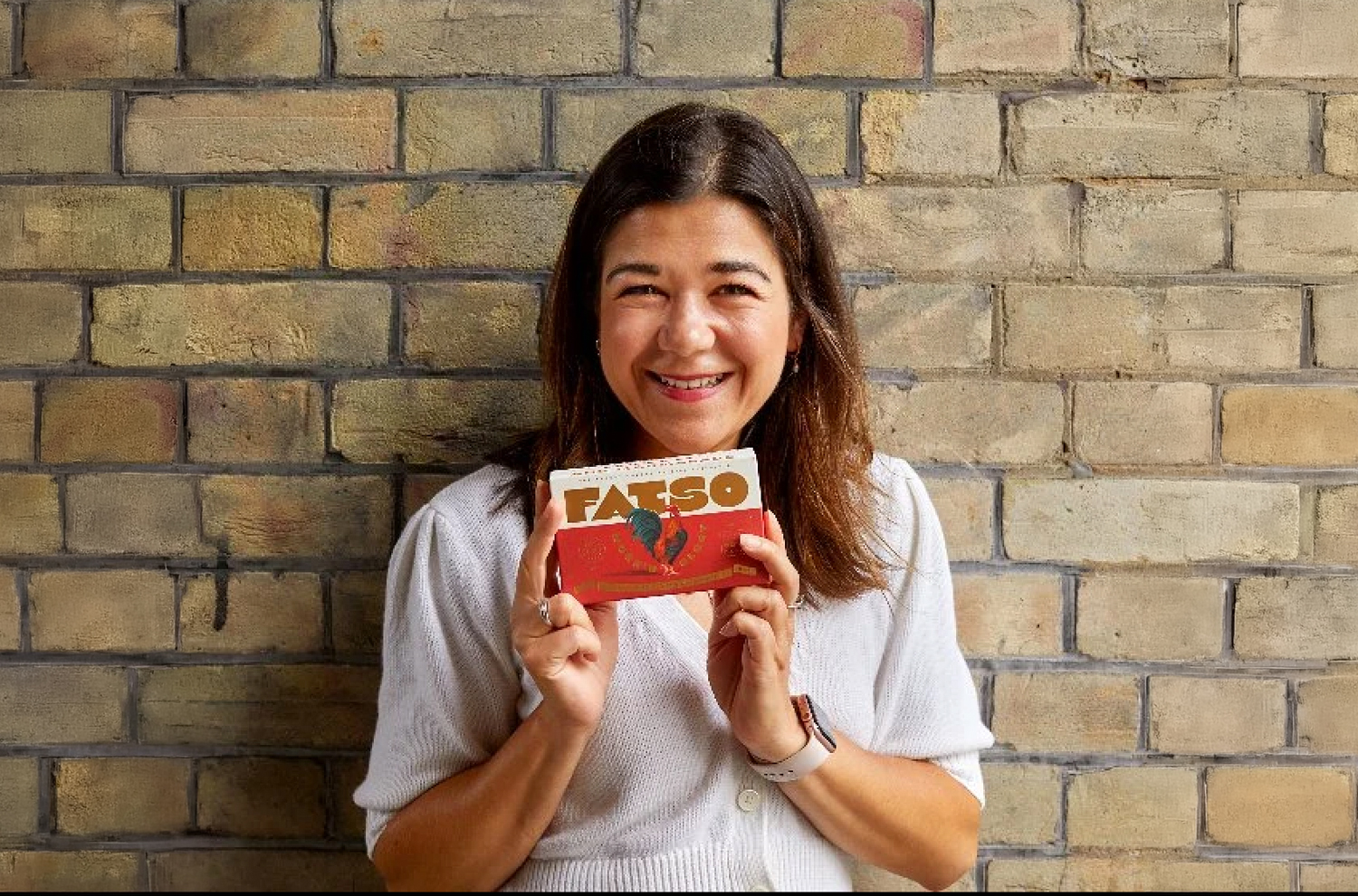
Ella McKay is a self-proclaimed food obsessive, a marketing professional turned entrepreneur and the co-founder of FATSO, a premium dark chocolate brand on a mission to prove that dark chocolate can be every bit as fun, flavourful and full of personality as its milkier counterpart.
The idea was born in lockdown from a conversation about how boring and overly serious dark chocolate had become. What started as a side hustle to shake up the category quickly revealed Ella’s entrepreneurial instincts and she soon left the world of big corporate brands behind to drive momentum behind FATSO full time. Aware of the environmental and ethical challenges facing the chocolate industry, she partnered with Luker Chocolate, a family-run, purpose-led grower and maker in Colombia whose values aligned with her own.
Just three years in, FATSO’s chunky bars of premium dark chocolate are stocked by retailers around the world. In this episode, Ella shares the story of how it all came together, what the leap from corporate to founder actually felt like and how positive psychology, maternal instinct and a willingness to trust herself have shaped both her business and her approach to motherhood.
Conversation Highlights:
- How a lockdown conversation about the sorry state of dark chocolate became the seed of a global brand and what those early side hustle days looked like before Ella took the leap full time
- The decision to leave a successful corporate marketing career behind to back herself and FATSO and what gave her the confidence to make that call
- Why partnering with Luker Chocolate in Colombia was about more than supply chain, it was about finding a partner whose values and purpose aligned with the kind of business Ella wanted to build
- The reality of navigating early motherhood and entrepreneurship simultaneously and how she found her footing across both
- How Ella approaches the balancing act of work and family life and why rigid rules have never been her style
- The role of instinct in both parenting and business and why millennial mothers in particular need to reconnect with their intuition after a lifetime of being told what they should do
- How positive psychology shapes the way Ella leads her business and her family and why that philosophy feels like a natural fit for both
- Why embracing individuality in motherhood matters and what she would say to any mum who feels like she is doing it wrong
- The advice she would give her younger self and what it reveals about confidence, identity and trusting the path that lights you up
Listen If You’re:
- A mum in business who has been second-guessing her instincts and needs permission to trust them
- Someone with a side hustle that is quietly revealing your entrepreneurial spirit and wondering whether to take it further
- Curious about what it takes to build a product-based business from a lockdown idea to global stockists in three years
- A dark chocolate lover who is about to discover your new favourite brand
- Interested in how positive psychology can shape the way you lead both at work and at home
- Ready to let go of the shoulds and start following what actually lights you up
Favourite Quote for Mums in Business:
“Instinct is your most powerful tool when becoming a mother. Don’t be afraid of marching to the beat of your own drum. Don’t be afraid of being different.” – Ella McKay
About the Guest:
Ella McKay is the co-founder of FATSO, a premium dark chocolate brand built on the belief that dark chocolate should be as fun, flavourful and full of personality as any other kind. With a background in marketing for some of the world’s biggest brands, she brought both commercial expertise and genuine passion to building FATSO from a lockdown side hustle into a globally stocked product. Ella is a mum who leads with positive psychology, trusts her instincts and believes that doing so is one of the most powerful things you can model to your children.
You can find FATSO chocolate at sofatso.com and connect with Ella on Linkedin.
About the Host:
I’m Victoria Phipps – a Mum of two, analogue family photographer, charity co-founder, photography business educator, marketer and now podcaster! My career has wandered all over the place and is becoming a bit of a complex tapestry as I head into this middle phase of life, but I can honestly say I’ve loved every minute of it so far.
I was raised by a nurturing Mother and an entrepreneurial Father and have inherited traits from both, so the tension between ambition and motherhood is one I grapple with on a daily basis! I’m fascinated to hear the stories of other women on a similar path, who are striving to build thriving businesses whilst being present for their children. It’s a tough juggle, but I hope the conversations shared on this podcast help Mums in business feel less alone and inspired to keep going in pursuit of their dreams!
If You Enjoyed This Episode:
Please subscribe, rate and review the podcast – it helps other mums find us!
Share in your Instagram stories, tag @mummeansbusinesspodcast and let us know your biggest takeaway.
Share this episode with a fellow Mum in business who you feel would resonate with Ella’s story.
Episode Transcript:
Hello and welcome to the Mum Means Business podcast, where we shine a light on inspiring women who have one thing in common. When they’re not managing tantrums, homework, P.E. kits and play dates, they are busting their gut to build a thriving business that supports their family life. I’m your host Victoria Phipps and I’m figuring out how to play this game right alongside you. I’m a motherhood, family and personal brand photographer, I teach portrait photographers how to lead with print in the digital age, I’m marketing lead in the family business my Dad founded over 20 years ago and I’m “Mum” to two little girls.
If you’re a multi-passionate mum too, in need of some solidarity whilst navigating the messy middle of making your big dream a reality, then stick around. This is for you.
NOTE: This is the transcript from the original recording, rather than the edited episode so timings may vary.
Victoria (00:01)
My guest today is a self-proclaimed food obsessive. With a background in marketing, she had worked for some of the world’s biggest brands when she and her co-founders made the decision to start a business. It was a conversation in lockdown about how boring, serious, and overly permissible dark chocolate had become that originally sparked the idea for a side hustle. To prove that dark chocolate could retain its quality and permissibility and also be injected with a hearty dose of
personality and flavor. This side hustle exposed Ella McKay’s entrepreneurial spirits as she soon scrapped the big corp life to drive momentum behind the premium dark chocolate brand Fatso. After all, why should milk chocolate have all the fun? Aware of the environmental and ethical challenges the chocolate industry faces, Ella partnered with Looka Chocolate, a family run purpose led chocolate grower.
and maker in Columbia that aligned with her values. Just three years in, Fatso’s chunky bars of delicious dark chocolate are now available in stockists all over the world and I can see why. kindly sent me a beautifully packaged selection box ahead of this recording and I can tell you that it didn’t last very long at all. We all indulge in a daily dose of dark chocolate in this house, so I’m very happy to spend an hour talking about it and hearing your story in your own words. So Ella.
Welcome to the Mummeets Business Podcast.
Ella (01:27)
Thanks for having me and thanks for the introduction.
Victoria (01:31)
Such a pleasure. And I’m honestly so excited to talk about chocolate for an hour. I love it. Exactly. So tell me
Ella (01:35)
Yeah, I mean, what a horrible thing. What a horrible hour we have ahead.
Victoria (01:42)
a bit more about the origins of this. I’ve kind of alluded to it in the intro, but in your own words, what made you start Fatso?
Ella (01:51)
The moment of madness, of course, is all good entrepreneurial ideas.
Victoria (01:56)
You
Ella (01:57)
It was one of those really boiling hot days in lockdown, and I, at the time, was working, sort of consulting for a small soap business. So I was sort of helping them scale and to scale up, basically. And it was a really hot lockdown time. We were talking about…
soap and the kind of structure of the business and basically how are going to pivot this business. But we were all really craving ice cream and obviously it wasn’t quite as simple in lockdown to go and get your like you know fix from the ice cream van or whatever or just nip to the shops if you remember. Sometimes I forget actually with Covid how many kind of strange
Victoria (02:41)
Yeah.
Ella (02:41)
things we had to kind of factor in, like you couldn’t just pop to the supermarket, you’d have to go and then queue around the corner because they were only allowing certain number of people. So anyway, it wasn’t quite as readily
Victoria (02:50)
crazy isn’t it?
Ella (02:51)
available exactly. So we’re this conversation about ice cream, which led to us talking about, how do you have your ice cream? Because it’s no good just having a scoop of vanilla in a bowl. That’s not enough. Like, what do you add? I add nuts and all. actually put granola on mine and I always shave some good healthy amount of dark chocolate on there because it just makes it all much better. So it basically long
story short led to this conversation about dark chocolate and how it is so delicious and such an elevator of food and flavor but actually if you were to just sit and eat a bar of dark chocolate it’s really quite boring and it’s there’s not very much on the market that has emphasis on flavor and and kind of innovation and the story and the narrative behind dark chocolate had almost become
like it’s the thing that you should have if you’re going to have chocolate, you know, it should be dark because it’s much better for you. And I’m like, whoa, whoa, dark chocolate, that’s not like it’s chocolate. Why are we trying to make chocolate serious?
Victoria (03:54)
Mm.
Ella (03:54)
So it was a conversation about ice cream that was, you know, that kind of led to this thing around, God, dark chocolate is so boring. And actually you have to do stuff to it to make it interesting, which then led to this idea of, well,
maybe we should think about how we can add more flavor and stuff to dark chocolate. anyway, so it was that sort of nugget of insight and maybe it was because we had the sort of luxury of a bit more time and space and life felt a bit less frenetic, but it basically led to me going away and creating a market research project for myself as to, is that kind of perspective true? You know, is that?
Is there really nothing out there? there no real dark chocolate brands out there doing bold flavour attitude, something a bit different? Or is milk chocolate truly having all the fun, which was my kind of hypothesis.
Victoria (04:48)
Yeah.
Ella (04:52)
And also kind of what does it take to create a chocolate bar? I knew nothing about the market. All I knew was it’s delicious to eat and I like chocolate.
So starting at a very, a real base level. And then I basically started to learn about the history of it, the origins of cacao and farming. And obviously I knew that there was a kind of slavery, a kind of a history of child slave labor, particularly in cacao supply chains and farms. But I didn’t know farming, but I didn’t know a lot about it. And then I watched this documentary called Rotten.
I don’t know if you ever came across that, but Netflix,
Victoria (05:36)
I haven’t seen it.
Ella (05:38)
it’s really good. Netflix basically did it. It’s almost like a panorama expose on different food groups and chocolate cacao is one of the episodes. And my goodness, it just completely changed everything for me. I was like, my God, you know, this is, this is, this is a really modern day issue. This goes, this isn’t something that’s been improving over time. And you know, there have been…
big brands have come to the market and created movements that we all believed in, like Fair Trade, even organics and likes of green and blacks and things. We did all think that more had changed and the world had moved on and that actually there was more sustainability and ethics in cacao growing and production, but the truth is that there isn’t and actually it’s probably…
in some respects in modern times worse than ever. So that was kind of forming in my mind and then we were… And then obviously I’d had this kind of insight nugget of an idea of what if we created a chocolate brand that had all of the quality credentials and the wonderfulness of dark chocolate but injected all the fun, bold personality. And that then layered into what we would have to make sure that…
if we ever did anything, it would be kind of done with absolute care and that we wouldn’t be a market entrant coming to add to the problem in the industry. So then that’s when I came across Luca, who were this amazing family run cooperative of farmers in Colombia, which is where cacao was originally found back in the sort of Aztec eras.
And they kind of loved the idea and gave me the confidence to kind of go forward and develop a prototype of this slightly mad chocolate bar that we wanted to do and put dark chocolate at the heart of it. And so that was the start of FATSO.
Victoria (07:45)
I love it. And I love that you started from the simple position of, really like dark chocolate. Like that, that can be enough. You’ve got a passion for it, you enjoy it, and you can see that there’s something missing perhaps in the market. So talk to me about the side hustle element of it. Did you start it whilst maintaining your job? And at what point did you decide to make the leap and focus all your attention?
on
Fatso and also tell me where the name Fatso came from. Cause it’s an interesting one. Two questions.
Ella (08:19)
yeah. It’s so funny, isn’t it? It’s so kind
of part of me now. don’t even, it’s like, yeah, I run a chocolate, you know, I started and run a chocolate business called Fatso and then it doesn’t really compute in my mind anymore that that would be also, I should probably say, and it’s called Fatso because Fatso came
Victoria (08:35)
You
Ella (08:36)
from, Fatso, so we developed this product, right? That was chunky, abundant. It was about big, bold flavor and creating a bar of chocolate.
that was rooted in dark chocolate but genuinely satisfied. So the category was all these thin chocolate bars. Sorry, I got distracted then because someone looked like they were about to walk into the room. What was I saying? I’ll start again, assuming you do lots of editing.
Victoria (09:05)
It’s all right. Yeah,
no, it’s fine. I’ve got an audio editor. So I will just do a big clap and he’ll know to come here. You were talking, so I’ll bring you back and then I’ll clap and
Ella (09:17)
Okay.
Victoria (09:17)
then you go. So you were talking about why it’s called Fatso. So we’ll wait for those people to move along. And if you just
Ella (09:27)
They’ve gone.
Victoria (09:27)
start with like why it’s called Fatso, okay.
Ella (09:33)
So it’s called Fatso because we wanted the product, we wanted the bar to be super chunky, abundant, packed full of flavor, basically everything that you couldn’t find on the market. We were sort of bucking the trend essentially as to this sort of thin, apologetic, just have a little bit, it’s dark and bitter, you don’t need a lot, like kind of almost fine dining, fine wine.
position of chocolate and I’m like, no, no, no, Chocolate is there to be satisfying and delicious every day of the week. you know, that’s just like, that’s how I believe chocolate should be. So when we started the brand and whenever we were briefing, whether that was briefing the design or whether it was briefing the chocolate.
makers that we were working with to develop this product. It was all about extra with everything like go more, go bigger, go bolder, know, be weirder, be all of these things and be chunkier, you know. And so when we then had this, so we have this concept. So when it came to naming it, we had this really long list. I mean, it must have been, it must have had like a hundred different words on a page that could emulate this idea of extra and more.
And Fatso was in there, just somewhere in the middle of the list, just looking a little bit quiet over here. And honestly, there was a few of us in a room and we all zoomed in. was almost like, even though it was the same font size and it was just in a long list, it kind of jumped out in such a way that hit you in the heart and went, and you know, was like, ooh, but can we?
But we should, because the whole idea was that we’re here to disrupt and to challenge convention and reframe a category and maybe by association, reframe a word that is, you know.
kind of has some negative connotations, but actually I do think the world is kind of moving on and that we don’t need to, you know, it’s kind of, it’s quite a cute, it’s kind of a, it’s just a lovely word. I think it’s a lovely word in a, and then it was so interesting because when we then told Luca the chocolate supplier in Columbia, what we were going to call it, they were like.
Well, that, well, yeah, of course, that’s a great name for a brand. We were like, why have you responded to that so brilliantly, given, know, they’re Spanish and culturally, fatso isn’t a word that would necessarily, they would have known in translated terms. And then of course, yeah, yeah, because in Colombia, call, call our, matriarch of the families call their kind of beloved.
extended families in the villages like my fatso’s, like all my fatso’s and it’s a real term of endearment.
Victoria (12:19)
wow.
Ella (12:20)
So was complete serendipity that this was also really meaningful to the people that
Victoria (12:26)
Yeah.
Ella (12:27)
we were kind of, that start, who make making a chocolate bar possible, the start of it. So that was why fatso.
Victoria (12:36)
I love that and it speaks to kind of the layers of meaning in words. And yes, on the one hand, you’re disrupting in that, because, you of course, like you can go back to our childhood, there might’ve been a kid in school who was called Fatso and it’s not very polite and it’s not kind, but you’re so right about this dark chocolate, you know, the thin bar that it speaks about restraint. You know, you have one, and everyone talks about, I do have one piece of dark chocolate after a meal.
And it’s so restrained and it’s, you’re right, it’s
Ella (13:08)
Mm. Mm.
Victoria (13:10)
really small. It’s
Ella (13:13)
Hmm.
Victoria (13:13)
not bold, there’s no joy in it. And actually
Ella (13:17)
Yeah.
Victoria (13:17)
what you’re talking about in terms of abundance and actually the fun and going back to the kind of layering of flavors that chocolate actually can amplify the taste of complimentary flavors. So
Ella (13:30)
Mm-hmm.
Victoria (13:31)
all of your bars have all of these like fun different ingredients in them.
And it is joyful and it is happy. And then to hear that actually there’s this Spanish reference as well, that it’s kind of something, there’s a term of endearment and it’s affectionate. And actually
Ella (13:46)
Mm. Yeah.
Victoria (13:49)
that that is part of the origin story and you’re kind of blending cultures with this name. You’re disrupting on one hand with a kind of traditional Western word, which has not always been, you know, in our reference, from our reference.
from our point of view, it’s not always been a word that we think of as like particularly kind, but actually, like you say, we are moving forward, don’t speak to each other like that, hopefully anymore. And
Ella (14:15)
you
Victoria (14:16)
it’s also about acceptance of chocolate is not something you should eat in a restrained way if you don’t want to, there are days when we need lots of it and that’s okay.
You you probably don’t want to eat like five fat soaps. They are amazing in their chunkiness, like five fat soap bars
Ella (14:30)
Yeah.
Victoria (14:31)
a day. You probably feel a bit ill, but that’s the same with everything. So why strip the joy out of it and why not offer something that is in its nature fun. And it has a warmth about it as well with that second layer of meaning. It’s really nice. It is serendipitous, like you say. So,
Ella (14:46)
Yeah. Yeah, thank you. Yeah.
Victoria (14:50)
so go back to the kind of timeline of it.
Ella (14:54)
Hmm. yes, why the side hustle?
Victoria (14:55)
You’ve named it, it exists, it exists
as a concept, but at what point did you feel confident enough in it that you would kind of go all in?
Ella (15:05)
So as I say, I working for this small soap business and they had kind of got to a point where there was kind of great momentum and there was a crossroads. And the truth is, solitussles are great, but unless you really are some kind of superhuman that doesn’t sleep.
a side hustle can’t stay a side hustle for long if you really have ambition for it. And I think when we launched it and we saw the pick up both from a kind of PR industry perspective through to consumer press, but then also that we had like.
all these sort of independent stockists that were like, yeah, this is great and I really like it. You know, and we were kind of getting momentum at quite a nice pace and we were getting some momentum, I think, quite quickly and I was just like, we can’t just let this kind of fly under the radar as this tiny little thing that we do on the side. I think this has got something. You know, this could be a brand that we see in a supermarket one day or, you know,
So this could be a brand that actually challenges the likes of Tony’s Chocolonely maybe one day. And this isn’t necessarily an always kitchen table artisanal.
cottage industry business, this has legs to properly shake things up at a category level. you know, as I say, as you said in my introduction, I did come from a big corporate marketing background. I worked for big global powerhouse brands. So it was never really in my nature to think of things as, you know,
cottage culture businesses.
Victoria (16:55)
Yeah, little businesses.
Ella (16:56)
There was always going to be an ambition and drive to be bigger because I had worked on bigger brands.
I think so we the the idea came as I said locked down it was you know proper 2020 then we launched so then we took a good 18 months developing prototyping launched officially September 2022. Is that right? Yeah. And I think it was in the March that that was when
it was probably before the March, probably the beginning of the year, so beginning of 2023, we decided no no no this is this is where we’re gonna go, this is we’re gonna we’re gonna go all in so then spent a couple of months obviously setting up for that and gearing up to that and making sure that we’d kind of tied up any loose ends and things and then um and then yeah I just I I went all in and um we’re still here in year four so
Victoria (17:58)
Yeah, how did that feel? you in any, did you have any trepidation about it or were you just like, you had enough momentum that you were just so excited when you went all in?
Ella (18:12)
Yeah, don’t think I’ve ever felt trepidatious about these things. To be really honest, and that’s a really lovely, and I appreciate that, that’s a real
Victoria (18:21)
Yeah.
Ella (18:21)
privilege, but I do think that there’s something about the people, and I’m sure lots of your listeners as well, we kind of have something within us that it’s almost like…
unnerving not to scratch those entrepreneurial itches and that risk taking element, know, the safety almost doesn’t feel that safe for people like us, I think, because it just feels too, it doesn’t feel satisfying to reference my chocolate chunk, you know, I think,
Victoria (18:52)
I know what I was going to say.
Ella (18:54)
you know, I’m all about the satisfaction and I, and, and, know, I worked for, as I say, I for these big companies and I never, I was always a bit of an
an annoyance I think to my poor colleagues because I wasn’t very good at towing party lines, wasn’t very good at following process, I wasn’t very good at being staying within the status quo, as always even my very first job at GlaxoSmithKline, know, industry job, I went into work on one toothpaste brand and by the end of it I seemed to be working across all the oral care brands in some strange capacity with about, you know…
four dotted line reports that I was reporting into. So I had one-to-ones coming out of my ears because I was kind of doing a little bit for everybody and that sort of, you know, and I worked for an agency for a while and my job titles were never that clear because I was always thinking, I think I should also do some of this. And I don’t really know why we do it that way. So maybe we should create a role over here that can kind of address it. So, you know, I just, was easier for me to just
peeing out on my own somewhere doing something else.
Victoria (20:02)
Well, it sounds
like even in your corporate career, you’re kind of following your interest and following the fun, maybe. Like actually,
Ella (20:09)
Yeah?
Victoria (20:09)
this is something that is interesting. I’d like to get amongst that. And so you go a bit this way and you get, and everyone else is trying to kind of keep you contained, but you kind of perhaps can’t be contained. And I really relate to this idea of like the safety aspect. Actually, it feels constraint, like constricting.
to not go after this stuff. Once you’ve got the idea in your head, of course you like test it and this is what you did. You know, you had 18 months of kind of just mulling it over and presumably, you know, it’s a product business. Did you have any experience about, with product businesses? I know you’d worked for the soap company, but in terms of supply lines and manufacturing for chocolate, that was all new to you.
Ella (20:48)
Yeah, mean, I’d said that the soap, working with the soap company gave me a really good grounding in terms of supply chain and kind of various aspects of that, but certainly never obviously in chocolate and food, obviously it’s very different.
The cosmetics industry is its own beast and there’s lots of regulation around cosmetics, but obviously in food there’s loads of other things you need to think about, even your storage, like is it food safe or how you’re packaging things and the inks that you’re using. There’s lots of little nuances that you have to learn. What is wonderful though is that it’s not…
Because we sort do everything in the UK, so we source our chocolate from Columbia and then everything happens here and I work with just two, I have a wonderful packaging supplier and have the factory I work with.
It’s quite a small world really and everyone’s so supportive. I hate the word supplier because it just feels really transactional and distant. I have really good relations with my partners because I wouldn’t be here without them. So it’s been a massive learning curve but there’s always someone that will be able to…
help you or give you the answer. And that’s part of the joy of it, you know, learning. I’ve always said, you know, the moment you stop learning, it’s probably time to move on. And maybe
Victoria (22:19)
Yeah.
Ella (22:19)
part of that, you know, that was the kind of phase I was with the working with the soap company and previous jobs, you know.
Victoria (22:26)
Yeah, yeah, it’s about
staying kind of almost staying out of your comfort zone a little bit so that you can keep growing and keep stretching yourself. I love that.
Ella (22:36)
Yeah, exactly.
Victoria (22:37)
So when you started that, so you were not a mother,
you were footloose and fancy free.
Ella (22:41)
No, speaking of, yeah, speaking
of making things harder for yourself.
Victoria (22:49)
So, I mean, were children in your future or was that just something you literally were not thinking about?
Ella (22:56)
No, I’ve always thought about children and I love children. I’ve got this sort of, there was something maternal in me, I think, from a very young age. I was a stereotypical girl, like obsessed with dollies and babies.
playing mum was always, all of that stuff as a kid and that never left me really and I think it’s spammed my relationships and it was always a kind of… So Andy, my partner and I had been, we met in Vancouver. We lived in Vancouver for three years.
we came back here together and yeah, set up sort of built our home foundations, I guess, back here in London in 2017, I think we moved back and just we always knew we wanted children there was
So one of those things, there was never gonna be a good time. think also we do live in a world now with parenthood where actually conceiving fertility, seems to be a very noisy present topic, whether that be because of social media, so we’re just more aware of it, or if there’s an increase in the fact that people find it more challenging to conceive. I don’t know, it just seemed to be around me a lot through close personal friends all the way through to just kind of media or absorb.
So there was a part of me that was a bit concerned that if you leave this too long and then you discover that it’s not something that’s going to happen. So there was that niggle, but I also knew it’s not the best time because she just launched a business.
And then obviously typically we had no issue and it all happened quite quickly. So maybe a bit of an overshare, we’re all, yeah. And so yeah, it was November, 2023. So I was still in our, we were still in our first year, first full year of
Victoria (25:07)
You
Ella (25:08)
trading. So, and I remember feeling really…
I mean, obviously I was really pleased and I was excited. I was also absolutely sick as a dog. my goodness. And I was not one of those people that just had a bad first 12 weeks. I had a bad nine months of sickness. I did not have an easy pregnancy. And I just remember saying, like, you know, saying to my business partners, I just felt so bad in so many ways. I felt so torn.
between the fact that I was going to become a mother and I wanted to be the best mother I possibly could be and I wanted to look after myself and I wanted to do all these things and then also I wanted to, I didn’t want anything to slow Fatso down and I still had this huge ambition for it and that was kind of also my baby, you know, my business baby. So it was a real
Victoria (25:59)
Yeah. Yeah.
Ella (26:00)
moment of, it was quite complicated emotionally to kind of, to work through that.
But, you know, there’s never a good time and I wouldn’t change it. And I think in some respects becoming a mother makes you a better leader and brings perspective and attitude and creativity and all sorts of other weird and wonderful things that I channel into the business. And I share with my team and, you know, it’s a totally different thing. But yeah, it’s also amazing.
Victoria (26:38)
Well, we talk about mom guilt, don’t we? Like you feel guilty going to work and leaving your child. But I really appreciate you sharing that the reverse can be true. That you can feel guilty, especially because you were just at such an early stage in your business and you’d had all this time building up to it. And you’re finally at a point where you’ve launched it, but it still needs so much TLC to keep that momentum going. And then you have this big life shift.
to navigate and that’s like entirely new territory for you as much as you have wanted it. And it’s going to require head space and it’s physical labor,
Ella (27:18)
Yeah, yeah, yeah.
Victoria (27:19)
know, looking after a baby, the physical time that that is gonna take, take you
Ella (27:22)
my god. Yeah.
Victoria (27:24)
away from your business. And so it is important, I think, to acknowledge that we can feel guilt in the reverse and that that is okay. Like all of these feelings are completely valid.
Ella (27:34)
Yeah.
Victoria (27:36)
It’s natural
Ella (27:37)
Yeah.
Victoria (27:38)
when you’ve poured so much heart and soul into this business baby. And especially if you’re part of a team, it’s not just you where you feel like, okay, well, now that I found out I’m going to have this baby, I can kind of slow that down a little bit. Actually, don’t even, you don’t want to because you can feel it pulling
Ella (27:54)
No.
Victoria (27:55)
like it wants to fly, it wants to go. And you’re just anxious, I suppose, about what this is going to mean for that momentum and worried about it. So what did it mean?
Ella (28:03)
Yeah. Yeah.
Victoria (28:07)
How
did it change things?
Ella (28:08)
Well, I think, you know, to your point, I think I just had, was much more, it’s an interesting one.
I think I worried and still do worry more about…
how I am as a leader, as someone that’s driving the business forward about the success of the business. I worry more about the business and my role within it and how I’m showing up for it than I do about being a mother and a good mother. I actually feel quite confident and comfortable in my instincts. And maybe, again, maybe, I don’t know if it’s me or if it’s kind of society’s construct of, well, yeah, because I’m kind of built.
almost to be a mother. So that’s like, it’s so deep within me. I’m not necessarily, you’re learning how to be a business leader. You don’t necessarily need to learn how to be, I mean, you are like, you’re always learning how to be a mother, but it’s not, it’s, it’s not kind of a, it’s not a concept. It’s just there and in you. So I think
Victoria (29:19)
Yeah, it’s instinctive.
Ella (29:20)
it’s, yeah. So, what, what it, what it meant really was that,
I didn’t slow down in those, well, it’s not really nine months, it? Because I was probably about seven weeks when I found out. whatever the period of time when I was pregnant. So I didn’t slow down in that seven months, except from to vomit every half an hour. But you know, I felt so, I didn’t feel good because I felt sick, but I felt,
I carried, like I kept walking, I’m very lucky, I walk to work, our office is in Richmond and I live in Richmond, so, but it’s a good sort of half and outside walk to work every single day and home. was, you know, present for my team and then obviously you’d kind of figure out all your appointments and that sort of stuff. And then…
I did all my hypnobirthing to try and make sure that I was going to have the best labour that I possibly could. And so I kind of, I found this sort of real balance actually during the pregnancy. I definitely didn’t do enough. The risk I took was I’m not going to try and find ways to replace me so I can…
take a year out or six months out or whatever. I was very much of the opinion that as long as I’ve got a team around me that can man mark and keep the, do the day-to-day stuff, I will still be in the business because having a baby isn’t going to stop me coming to work. Which was this sort of place of beautiful naivety and the very best intent. I actually think
what happened was I went into labor early. So I woke up at 7 a.m. on the morning of the 1st of July and I had…
very light contractions and I was like, oh, I think I might be going into labour. Called the midwife and they were like, oh yes, obviously sounds early days. They were basically like, until you can’t talk to us, don’t bother coming in. So I just, I went into the office and I was like, well, I’ve not really done a handover yet. So I’m going to, so I walked to the office and it was a really hot day and
completely freaked the team out. were there with a mop because they thought it was going to be like the movies where my waters are break and something, but it didn’t happen like that. I think I stayed till about 3 p.m. and then Andy came to put me up and I had him on the second the next evening. So a nice 40 hours later.
Victoria (32:01)
Hmm.
Ella (32:03)
But I…
I just, remember those sort of middle of the night feeds and all that. was there while I was working. I was just still doing bits of work here and there. I sort of, sometimes I, I hesitate sharing that, that, you know, even in that first couple of weeks, I was working, doing bits of work, forecast planning, all of that stuff. And then certainly by week two or three, I was bringing my son into the office and feeding, nappy changing, having
meetings and I hesitate sharing it because I would never want someone to think that I did that because I felt I had to or I did that because I didn’t have a choice or that I’m coming across like I believe that as someone, as a woman who’s in business or a woman that wants a career they need to somehow give up that early precious one-on-one time with their child.
I absolutely, it was a very, very personal choice for me and it was what was right for me. I also found those early days and the kind of physicality of it and the intensity of feeds it, breastfeeding and the kind of monotony actually of particularly those first few months of being a mother, which was so different to what my life had been like.
Victoria (33:30)
Mm-hmm.
Ella (33:31)
If I wasn’t doing the work, I think I would have gone.
crazy and I actually believe that that that bring it keeping the work going and doing doing what I could has made me a much better calmer patient mother most of the time we’re potty training at the moment so calm patient mother is not not the
Victoria (33:49)
Hahaha!
Ella (33:51)
self I am bringing to the table at the moment but you know I yeah that that like for me and I think what we have to be really careful about as mothers
is letting what other people think and how other mothers did it creep in too much about your every… I think, as I said, back to the very top, so I’m really waffling it now, but going back to like motherhood is… can be such a kind of instinctive thing. Instinct is your most powerful tool when becoming a mother, and that will look different for everybody. And I think following your instincts and doing what feels…
What makes you survive is the most important thing. What makes you your best possible self? What do you need to do to resource yourself to be the best mother, the best business leader, the best wife, whatever it is?
Victoria (34:45)
Yeah,
yeah, it’s really complicated. And I completely relate to your story. So I took a year out with both of my daughters, but I worked throughout as and when, and particularly, think I’d learned, you your first is quite a shock, but I’d learned by the time I had my second daughter, I knew what was coming. I knew about the monotony of those first few months in particular, you know, before they’ve even smiled
Ella (35:11)
Yeah.
Victoria (35:12)
and the reward.
is limited, you know, you’re putting in
Ella (35:14)
Mm.
Victoria (35:15)
all of this physical graph to keep them going, to get to that point where they just smile at you. And it can be really hard, particularly, you know, it’s part of your identity, you’ve gone from, you know, founder, you’ve got this such an exciting project that you’re working on, and you’re building something, and it’s exciting, and you can feel momentum. And it feels really, I imagine, energizing. And then actually, there is a big sort of cliff drop.
when you have a child in terms of your hormones, like physically, you’re
Ella (35:46)
Mmm.
Victoria (35:46)
kind of falling off a cliff. Emotionally, those first couple of weeks are seismic in terms of their shift. You your brain is literally rewiring you in order to give you the tools you need to be a mum. But it takes some serious thought and time.
And like you say, trust in that instinct in order to make that identity shift for you as painless as possible, because
Ella (36:12)
Mm.
Victoria (36:13)
your life is gonna look different now, but you have to figure out which bits of the old you, know, the independent woman can come with you in that. And
Ella (36:22)
Mm.
Victoria (36:23)
I found, you know, keeping my mind stimulated and keeping going on like ongoing projects that I’d had from before and doing a bit of work and
The engagement with adults as well
Ella (36:36)
Yeah.
Victoria (36:37)
in that time, so crucial to my mental health. And I often think because of the messages we get from like social media and society about, you know, that sinking into those early stages of motherhood and just sort of like sitting on the sofa, perhaps with a nice shaft of light coming across you as you breastfeed your baby and it’s calm and serene. I
Ella (36:53)
Gorgeous, lovely.
Victoria (36:56)
always was like, God, I wasn’t really like that for me. And that’s because I made the choice to do it a bit differently.
because I wanted to. And that’s
the message.
Ella (37:06)
Yeah.
Victoria (37:06)
Do what you want. Like think about what do I need right now in terms of your head as well as physically, like physically you might need a nap. So go and have a nap if you can. Get someone
Ella (37:16)
Mmm. Mmm.
Victoria (37:17)
to help you have that nap, but also mentally what you need. And if it is work, then work. If it is sinking
Ella (37:22)
Yeah. Yeah.
Victoria (37:23)
in and watching this morning, sink in and watch this morning. Like do what you want. And I think if I’m understanding rightly, that’s the message that you’re kind of, yeah.
Ella (37:30)
100 % the message
and I think don’t be afraid to exactly listen to what it is that you want or what you think that you might need as opposed to what you should. So if you’re sat on the sofa with that serene light and you know and you feel great
Victoria (37:46)
Hehehe.
Ella (37:46)
and that gives you a sense of calm, brilliant. If you’re sat, which is what I would have, I had you when you try those moments because you think that that’s what you should just be doing,
Victoria (37:55)
Mm-hmm.
Ella (37:57)
I was like, like
I felt so uncomfortable and so…
intruded upon. it was suddenly like my, it’s the expectation that my whole identity is now wrapped up in this beautiful baby. But I don’t feel, and you know, everyone says to you, you know, that it’s the fourth trimester. they believe they’re still inside you. They, babies haven’t figured out yet that they’re, they’re separate and they’re independent to their mothers, which is why they need you. And Harper was the absolute koala baby of the century and that we didn’t sleep for eight weeks in a bed because he wouldn’t physically
go down, you know, he slept on us and I wouldn’t
Victoria (38:39)
Mm.
Ella (38:40)
change a thing of that because it was the most wonderful thing. Andy and I slept in shifts for eight weeks, hilarious, but
Victoria (38:45)
Yeah. Yeah, yeah.
Ella (38:47)
if I didn’t have those little extra bits of work or what, you know, the things that I was doing for me, I think…
he would have picked up on that anxiety, he would have picked up on the fact that I wasn’t really comfortable and at one and relaxed and all that and that then impacts them and how they show up and all of their responses and behaviours. So I think it is a bit of a two-way process, know, ultimately you need to be at your kind of… you have to look after number one to be able to look after…
Number two, baby.
Victoria (39:22)
Yeah.
Ella (39:24)
And I don’t think we, and I don’t necessarily think the healthcare system is set up to be supportive of that either. know, oh, you must just sleep when you can. What if I actually don’t want to sleep? I just want to do a bit of work so I feel a bit like me. You know?
Victoria (39:38)
Yeah, yeah,
completely. Yeah, yeah. And it’s about energy. You know, I would, I’ve got
Ella (39:42)
Mmm.
Victoria (39:43)
memories. I would often like breastfeed my kids on their like nursing big like raised up nursing pillow at my laptop and at my desk. And actually my babies were with me 24 seven. They, know, as far as like feeling like they were a part of me still in that fourth trimester, they were like.
I
would, as they got older, I’d put them down on the play mat. They’d have some tummy time and I’d do some work or whatever it might be. And there’s all the napping and everything. But I was with them all the time, but
Ella (40:12)
Yeah.
Victoria (40:13)
I wasn’t like looking at them all the time.
Ella (40:15)
Looking at them? No.
Victoria (40:18)
And I actually think that’s quite a lot of pressure to be like looked at so
Ella (40:21)
Yeah.
Victoria (40:21)
much. And I know they’re babies, that’s probably all they want. But like, I wouldn’t have brought my best self.
if I made that baby, and I don’t think in the longterm it would have been best for them, if I made my daughter the center of my world, you know, of course they are in the first instance and you fit everything else around it, but they are naturally gonna become more more independent. And I wanna show my girls now they’re five and three, I’ve got my own stuff as well. Like they are anything,
Ella (40:49)
Yeah, mommy goes to work.
Victoria (40:51)
exactly. Yeah, and mommy’s excited about it and mommy likes it and mommy enjoys it. And
Ella (40:53)
Yeah. Yeah.
Victoria (40:55)
mommy’s doing things like creating things from nothing.
And that they can do that too. You know, the message has to be there from the off. And it’s not, of course, if the chips are down, you pick your child over anything. You know, if your child’s in trouble, they’re number one, but
Ella (41:08)
Yeah, we’ll see. Yeah.
Victoria (41:12)
they’re not in grave trouble every day. So we have to find that balance and whatever feels good to us, I think you have to really like think carefully about having that conversation. Like, what, what do I need?
for my own mental health.
Ella (41:26)
Yeah.
Victoria (41:26)
And then you can bring the best version to your family and also to your business. And the baby
Ella (41:31)
Yeah.
Victoria (41:32)
becomes part of your business because you’re taking your baby into the office, they’re part of the furniture and people look forward to seeing them.
Ella (41:36)
Yeah, yeah,
yeah, our first mini fatso. I mean, yeah. I think the other kind of thing on that is that…
from a young age, you know, when I was going into the office and things, I mean, my mum, my mum’s been an amazing, well, I’ve got lots of, we’ve got the most amazing support network, but particularly in those early days, mum was around quite a bit and, you know, she’d come with me to the office to just sort of sit and be with him and like,
Victoria (42:06)
Yeah.
Ella (42:07)
you know, let me kind of get on with it. and
So from a really young age, he was passed around like a little football and was looked after by lots of different people. I think maybe after five days or something, Andy and I went and had a drink at the pub on our own and left him with my mum. And we left him quite early. I mean, it was probably for an hour, but we kind of consciously made the decision that…
We wanted him to be, you know, so many people in our support system wanted to love and be part of this little boy’s life. And we let them. And
Victoria (42:51)
Yeah.
Ella (42:52)
it’s been extraordinary because he’s so happy with anyone, you know, I I’m sure it be like Little Red Riding Hood where he just, you know, talks to
Victoria (43:02)
Hahaha
Ella (43:02)
strangers, which, you know, but he is so, he’s so sociable and very aty.
And so I’ve been we’ve been really lucky where we’ve never had a big kind of separation anxiety thing when he’s been to nursery or we had a Nanny as well for a little while went after he was about six months. So, you know But it’s also made me feel So at ease leaving him Because
I know, he knows I’m his mummy and I know that I’m his mummy and that he will always be, you know, number one. But I also know, I also make him feel safe going to other people because he feels that, you know, there’s this kind of weird two-way street understanding that we have that, yes, I’m mummy, but lots of other people love you and they’re going to look after you you’re going to have great fun with them. And actually they’ll probably be less annoying because they won’t be insisting
Victoria (43:57)
You
Ella (43:58)
that you potty train at 20 months. So, you know, yeah.
Victoria (44:03)
Absolutely, I feel completely the same and it’s confidence building in them as well. also just, you know, it’s a scary world out there showing them that there are so many people in their life, like you say, who just love them and who dote on them and who want to get to know them. And it gives them at a really early age, a good sense of like, there are different types of people and you know, figuring everybody out and it’s all part of like human behavior. And I think it’s really important. So tell me, go on.
Ella (44:29)
And I think it’s
a lovely point about him knowing, apparently quite recently, because he’s getting a few words and things at nursery, he’ll say, where’s mummy, where’s daddy? And then someone will say, oh, they’re at work. And he’s like, oh, yeah, mummy work, daddy work. And he’s really understanding that
Victoria (44:47)
Mm.
Ella (44:47)
that’s what we do. We go to work. And he’s never upset about the fact that if I’m like, I’m going to work now, darling. And he’s like, OK, mummy work. Yeah, so that’s good. Yeah.
Victoria (44:56)
Yeah, yeah, no, my kids are the same, but also seeing
you, seeing you go to work and you’re looking forward to it, are you happy about it? Because, yeah.
Ella (45:01)
Yeah, exactly. It’s not just, mommy’s got to go to work now and I wish I could stay with
you, which I actually think can sometimes be quite, you have to be careful about that language because if you’re like, I’m showing you my child that I don’t want, that I don’t really want to do that, then that’s going to kind of exacerbate their not wanting to do something that is without you. Whereas if it’s like, I’m going to go and have fun over here and you’re going to go and have fun over there, that’s just a generally positive forward way of looking at it.
Victoria (45:27)
Yeah. Yeah. And also teaching
them, you know, your son’s 20 months old, so it’s early days, but teaching them that work can be fun. You know,
Ella (45:35)
Yeah.
Victoria (45:36)
and it’s all part of, you know, your story really is about following the fun. It is about stretching yourself. It is about abundance. It is about making the most fun, enormous, indulgent, abundant chocolate bar. You know,
Ella (45:51)
Yeah.
Victoria (45:52)
it’s all about like, you know, this positivity that you
are
bringing to your business and you’re showing that to him. So talk to me, I know that you’ve done a bit of work around like positive psychology. So talk to me about
Ella (46:06)
Yes.
Victoria (46:07)
the impact of that on your mindset as a leader and as a mum.
Ella (46:13)
So.
I’ve on and off, but not certainly not since having Harper, but I had on and off done the odd bit of had a little bit of leadership coaching type stuff. And I always enjoyed it. But actually on reflection, I always felt that actually what I was getting out of it was like a nice conversation, but it sort of felt like business led counselling more than anything. And I wasn’t finding it particularly productive other than being an outlet and a platform for me to talk about things that were maybe on my mind, which I think
plays a role is great and it was probably great and right for the time. we are, Fancy is kind of going into its next big phase of growth. We are about to, well, as of today, although I’m sure when this goes out, it will have happened, but we are launching into Waitrose on Monday. So it’s our first
Victoria (47:03)
Congratulations.
Ella (47:05)
multinational listing and it’s really going to change that it’s kind of, it’s changing a lot for us just from a scale, but also just
the kind of, it’s making us sort of think really carefully about, you know, who we do business with and the partners that we want to work with and, know, Waitrose just feels like such a wonderful fit for us because of their kind of quality and their kind of ethical driven value proposition that we very much share. And it’s that kind of proof point for us as a brand that…
we have that we do have permission to play in these bigger spaces, but still kind of maintain the integrity of what we’re about and what we do. And it’s exciting because we are a category disruptor and we’ve now got a big, retailer who wants to go, yeah, yeah, you’re a category disruptor and let’s go and disrupt our shelves. So it’s super cool. I’m super excited and it’s been sort of a 10 month process. So anyway, the big.
Victoria (48:00)
It’s very exciting.
Ella (48:01)
Yeah, so at the beginning of the year I knew that was happening and then I also got a place after a lengthy intense application process onto the Goldman Sachs 10,000 small business program, just in case I didn’t have enough going on, which is like
Victoria (48:15)
Yeah.
Ella (48:19)
best described as a sort of four month mini MBA and you come out of it with a
business growth plan for the next three years, but it really interrogates your thinking. kind of spans everything from defining, really solidifying your purpose, vision and values all the way through to your kind of growth strategy, your goals, your financial modeling in lots of detail. And so it’s a really amazing program, but it’s an intense period of time. So I kind of knew that I was going to go into this slightly frenetic period and I…
probably needed something that could just help me resource because, you know, being a leader, a founder, co-founder, whatever, is quite a lonely thing. You know, you don’t have a boss that you can go and ask. You are ultimately accountable. You make sure payroll happens every month, you know, you make sure that the rent’s paid, whatever it might be. Like, the bug really does stop with you.
I started to explore coaching and I came across this lady who completely by coincidence turns out lives literally around the corner from me, but it was by coincidence,
Victoria (49:26)
Ideal.
Ella (49:29)
called Noni White. She’s got quite a lot of clients, she works a lot with female founders and the clients kind of within challenger FMCG space, so she kind of understands that and she basically has this…
method which is all around positive psychology so thinking about are you are you protecting your
the foundations and your kind of wellness day to day to resource you to make you kind of show up as the best possible self. And that is all through the lens of thinking in a positive forward way. Now that could sound quite fluffy, but the point of the kind of research and the academic thought behind it is that if we are positive, we are inherently more creative, we have better cognitive space function.
to look at things in a bigger picture way and make good positive decisions. And when we think negatively, which is our kind of our natural instinct as humans, which kind of then inherently brings in emotions of things like fear and anxiety, we are reducing our cognitive function and our ability to think creatively. So as a leader and as someone that’s trying to push things forward or set direction or
lead in ambition or whatever, make big decisions. If you are doing that from a place of inherent negativity and fear and anxiety, you’re not best placed to do those things well. And you kind of then just kind of perpetuate a kind of cyclical place of that. And then you don’t make as much progress. So there’s a real kind of, there’s a lot of research and…
psychological, academic stuff that talks about how positivity is such a brilliant tool for success and productivity and unlocking full potential. So as a small anecdotal example, other than me talking you through the last however many weeks I’ve been
Victoria (51:43)
You
Ella (51:44)
working with her.
But I now have this thing called, I have a five minute daily journal that Noni gave to me when we first started working together. And every morning I wake up and I write the three things I’m grateful for, three things that would make today great, and a daily affirmation. And these can be really like simple things. So, you know, something I’m grateful for is.
the nice linen on my bed or my comfortable mattress or the cup of tea, like the fact that Andy brings me a cup of tea in the morning, whatever. The three things you want that would make today great could be drinking more water, could be listening to the birds. They don’t have to be big things. Your affirmation is obviously that could be led by the day, it could be a bigger thing, could be, you know, I lead a…
extremely profitable whatever business or you know and then at the end of the day before you go to bed you write the best the three best things that happened to you today and one thing that you learned so
Victoria (52:51)
Okay.
Ella (52:52)
it takes it’s like five it’s like three minutes in the morning two minutes in evening and it’s just such a nice I I found it I wasn’t cynical but I wasn’t particularly I didn’t think this was going to really change it has honestly been such a change for me
because all those little things that can irritate you sort of stop taking up as much space in your mind because you’re trying, you’re basically practicing gratefulness.
Victoria (53:21)
Yeah, and at the beginning, it’s like the open and close of your day every day. And I think as a mom, know, so many of these things, you know, there’s so many sort of self-care routines that we’re supposed to all be going through where we sort of wake up before our kids are like five and go and do some exercise and then meditate for a bit
Ella (53:39)
Mm.
Victoria (53:39)
and manifest and whatever. And as a mom, these things can feel exactly like completely unattainable and just wild and actually quite offensive.
because so often we are woken up with like a foot in the face or we’re woken up with like, want, I’m hungry, whatever. No, exactly. Yeah, I wanna maximize my sleep. want
Ella (53:55)
Yeah. Or I don’t want to get up at five because I’m tired and I actually just want to sleep till they wake up. Like, yeah, 100%. Mmm.
Victoria (54:05)
to literally, I don’t mind being woken up with a foot in the face if it means that I get woken up at seven instead of getting up at five and like doing some exercise. So completely, but actually this is something, know, and journaling again, it can feel…
I’ve dabbled in it, but I’ve never really got into a rhythm because it can feel like, and again, it’s sort of societal pressure. You feel like you’ve got to write War and Peace. You know, really have to get into it and like access your deepest feelings. But this is something like so quick and easy that you could access that. And you can be kind of rough and ready about it and just, okay, just look around the room. Yeah, yeah, I’m really…
Ella (54:38)
Yeah, it can be literally anything. Yeah, Andy didn’t snore. I’m grateful because Andy didn’t snore.
It can be the most kind of rudimentary and often it is because you have just woken up. So you’re not
Victoria (54:49)
Yeah.
Ella (54:49)
thinking in your deepest self and you’re about to go to bed and you’re like, kind of just want to read my book now. I want to turn the light out. But that’s almost the power of it because it’s not about.
Pressurizing yourself to be grateful about these big wonder, you know being grateful for the fact that I’ve got a roof over my head and there’s lots of people in the world that might not it’s not about guilt guilt ripping your way into You know being great
Victoria (55:12)
Yeah, gratitude, yeah.
Ella (55:14)
into gratitude. It’s just about acknowledging that there are lovely things in your life and that’s just and that and it’s all about then kind of being able to kind of think from that and it’s so interesting because since I’ve been doing it
you notice people that don’t do stuff like that. You notice, you know, even in my team, I notice these little nuggets of things that they might say that come from a place of negativity, as I say, total human nature. But actually then as a leader practicing something like this, you can really help them reframe and bring them out of that space and then help them progress into, no, they’re not that that’s maybe you’ve read that email like that, but actually.
if you think about it from their perspective, it might just be this is this and why don’t you try this is that. And then suddenly it’s like this kind of positive action driven approach to next steps. it’s.
Victoria (56:07)
Yeah. And you become a
reassuring leader because I think if you’re a leader that leads in leans into never negativity, if you’re a leader that leans into negativity, that energy does rub off on everybody else beneath you. You know, these things kind of filter down. And if some news comes in that isn’t what perhaps the company had hoped for and the leader is catastrophizing and spiraling.
Ella (56:32)
Mm-hmm.
Victoria (56:32)
then
everyone’s catastrophizing and spiraling. Whereas if the leader is robust and the leader is like, oh, that’s such a shame that that didn’t work out that way. I know that we all had our hopes pinned on that, but it is what it is. We can come back to it at a later stage. Let’s not scrub it off completely. Let’s move on and concentrate our effort over here and just maneuver people to a more positive space. Then everyone feels like reassured. And I think you’re so right that we do have like a natural disposition in that we kind of
do lean into the negative, but if there are
Ella (57:04)
Mm-hmm.
Victoria (57:04)
people that are in that headspace,
Ella (57:06)
Yeah.
Victoria (57:07)
reassurance like that can bring them out of the fear. know, people are looking to their superiors to sort of sense, get a sense of how serious is this blow
Ella (57:17)
Yeah.
Victoria (57:18)
to the business. And if the leader is giving off the impression that this is enormous, this is a big deal, this is damaging, then it’s not helpful. And everyone…
Ella (57:27)
No, no.
Victoria (57:29)
picks up on this stuff because we’re humans and this is how we relate to each other. And I feel like it’s one of those things that you can’t quantify, but to qualify it about the ripple effects are enormous. And obviously you’re
Ella (57:42)
Yeah.
Victoria (57:42)
seeing great success and you’re in Waitrose, so it’s working out.
Ella (57:45)
Yeah, apparently. mean,
yeah, and I think that’s, you know, but it’s, think as leaders, we know sometimes that you’ve got to put on a bit of a front, you know, or at least, you know, I think objectively leaders believe that they have to show up in a particular way.
And every person will have their own kind of interpretation of what that showing up looks like, whether it be the sort of leader that kind of really cracks a whip or very kind of gets in the weeds with things or kind of really is always sunny and sunshine raises top
Victoria (58:19)
You
Ella (58:19)
line. But I think some of that is it’s almost like, as I said, it’s an objective point of view of how you believe you should be. But are you how much are you doing to actually practice that kind of version of yourself? And I think doing things like
journal, you know, these kind of little quick journal things or even, so one of the things that we’ve done is like a real kind of solidification of my values and my strengths and then I’ve got them on a post-it note on my screen and it’s like every kind of conversation I’m having or when I’m making a decision or I’m trying to frame something, I kind of try and put it through the lens of my strengths and my values because then it feels authentically right for me but…
you’re kind of living, you’re living it within, so you’re probably showing up much more authentically and also you kind of then believe it, you’re not kind of just being like, I think I should be like this and it’s actually a really lonely place and I don’t really think all of those things but I just think I need to be really positive so that the team don’t feel bad. It’s like
Victoria (59:20)
Mm.
Ella (59:21)
yeah but that’s not probably helpful either actually exactly
Victoria (59:23)
Mm.
Ella (59:24)
in your example.
let’s have a conversation and be open about it. How’s everyone feeling? But because
Victoria (59:31)
Yeah.
Ella (59:31)
you’re in a more positive frame of mind, you can kind of move on from it rather than being stuck in it on your own.
Victoria (59:37)
Yeah,
it’s living in it and dwelling in it for too long. It’s like, yeah, just as you said, like address it, validate everyone’s natural reaction because business is highs and lows. Like you’re gonna have days
Ella (59:49)
Mmm.
Victoria (59:50)
when you’re launching into atros and you’re gonna have other days where something happens that’s on the negative
Ella (59:54)
Yeah.
Victoria (59:55)
side of the spectrum. And we have to be able to like ride those waves. And it sounds like this positive psychology is really helping you, which is great.
Ella (1:00:02)
It
is, yeah, yeah. It’s a little tit bit, but it’s definitely helped me.
Victoria (1:00:07)
Yeah, I love it. Let me ask you one more question before I let you go. And it’s a question I ask
Ella (1:00:11)
Sure.
Victoria (1:00:13)
to everybody. So if you could go back and have a conversation with eight year old Ella, what would you
Ella (1:00:21)
Mm-hmm.
Victoria (1:00:21)
say to her?
Ella (1:00:33)
I would say to her,
just.
Don’t be afraid of marching to the beat of your own drum. Don’t be afraid of being different. And whilst when you’re eight, all you want to do is fit in or be cool like the other kids or…
have the same thing, stuff, set up, family life, whatever it might be, as everybody else. Actually, the differences and the nuances and the characteristics and the complexities and all the kind of wonderful bonkers weirdness of your life from a slightly dysfunctional family set up through to launching a chocolate brand called Fatso.
It’s what ultimately will make you different and succeed and kind of have a life of love and satisfaction.
Victoria (1:01:41)
That was great. Yeah, that great.
Ella (1:01:41)
That sound alright? I
was really thinking about my eight year old self. was like, God, that was a…
Victoria (1:01:48)
I know, but it gets you right, because you just feel like, you know, lot of people have said they just first and foremost want to go and give that little girl a cuddle because eight years old, you know, it’s, it’s a time where you’re like tweet, you’re starting to tween on you between like, you know, the innocence of childhood to like the extreme self, the insecurity of adolescence. And I think actually that message that what perhaps you feel.
is different about you, that’s because somebody’s told you, whether that’s because you’ve been teased or you’ve overheard conversations and you feel like, perhaps that doesn’t fit or that’s not appreciated. Actually, those things are what is gonna separate you and they might become your greatest strengths. And I think
Ella (1:02:35)
Yeah.
Victoria (1:02:36)
that’s really beautiful advice, whether an eight-year-old would take that as different. But I think that’s…
Ella (1:02:42)
Yeah, that’s it now thinking I don’t know if she’s
going to listen. But, you know, I actually really hope that this next generation and as we as mothers and we think about the conversations that we want to have with our kids and how we want them to feel. And of course, we’re going to fuck them up in our own special ways. But as all parents do, but I kind of I really hope that the world has moved on from.
I hope that a younger age children can celebrate being different because I think as adults ultimately we get there or you know by and large I think we all feel as we get older or become mothers or have careers we accept and enjoy our difference because otherwise it would be boring. I hope that we can…
as a collective group of parents bringing up the next generation really encouraged the celebration of difference because for me that was what was quite obvious growing up was that it was just so not acceptable to be different. know, whether it be in how you look or what you’re good at or, you know, the family set up you have, like it was all…
Yeah, that’s kind of what it was all about. How do you all be the same? God, life so isn’t like that. And why we really need so… So that’s my hope.
Victoria (1:04:08)
No, I share that hope and I feel like, you know, growing up there was almost a right and a wrong way to be in general. And I really, I take that quite seriously as a parent and it sounds like you do too, that that’s just not the case.
Ella (1:04:22)
Yeah. Yeah.
Victoria (1:04:24)
The grey, I mean, most of us are living in the grey. You know, it’s not black and white out there and actually taking your advice that if your child comes to you and says, such and such said they didn’t like this or…
you know, I did this and the teacher said that and that we can just sort of rebut that and just
Ella (1:04:42)
Hmm.
Victoria (1:04:43)
say, actually, sweetheart, that
Ella (1:04:46)
Hmm.
Victoria (1:04:46)
is one of the coolest things about you and you just keep going, you crack on. And I think that confidence from your parents at least, you know, that’s all we can do really. But, you know, you pay attention to these conversations as a kid and they validate, you know,
Ella (1:04:59)
Yeah.
Victoria (1:05:01)
like you were saying before, you you validate the feeling and then…
You question it and you re-maneuver and reposition and move on positively. And it’s the same, so much overlap between motherhood and business and leadership, which is probably why I started this podcast. So tell
Ella (1:05:17)
Totally. Yeah, well done you. Yeah, yeah.
Victoria (1:05:22)
me Ella, where can everybody go and find you? Obviously as of Monday, this is, so we’re Easter, so this is perfect timing for you as a chocolate brand to be going into the
Ella (1:05:29)
Yes.
Victoria (1:05:30)
world’s greatest supermarket.
Ella (1:05:34)
Well, no, but
in true fanciform, we’re just turning up a bit late because we’re going in on Easter Monday when the chocolate moment’s over. But that just feels very us, so that was quite right. That felt good. Yeah, so we’re
Victoria (1:05:45)
Yeah.
Ella (1:05:47)
nationwide in all big kind of waitress stores, but we’re also in some other wonderful, I think we’re…
think our count is something like 600 independent stockists as well. we have a stockist
Victoria (1:06:01)
fantastic.
Ella (1:06:02)
map on our website. So if you click where to buy on our website, pop in your postcode and you can find your nearest store or you can buy direct online as well. yeah, whatever’s best for you.
Victoria (1:06:17)
And on social media, where should they go to follow you and follow your story or Fatso’s journey?
Ella (1:06:23)
Instagram, so.fatso. And then LinkedIn, I’m Ella McKay and fatso chocolate. Yeah.
Victoria (1:06:32)
Perfect. Thank you so much, Ella. I’ve loved this conversation. It’s been so lovely talking to you. Take care.
Ella (1:06:34)
Thank you. Me too. Thanks so
much. Take care.